

I. Business plan for setting up an agency
- Business plan introduction
- Various stages in setting up a new agency
A. BUSINESS PLAN INTRODUCTION
If an individual or start-up want to build his/her own advertising agency, need a small financial support, powerful business idea, a bit of push and passion. Starting own advertising agency can be a very rewarding and profitable start-up choice. Managing, operating, and controlling our own advertising agency required lots of effort and dedication to set the ground. However, at the same time, to form an advertising agency also required huge research and preparation to avoid future consequences or uncertainties.
Today’s world markets are highly competitive and saturated; here businesses need effective and creative advertising campaigns to help attract customers. In this highly competitive market, advertising agencies are specializing in creating and planning all types of these plans. Let’s start an advertising agency by following steps.
1. Plan your agency business
A clear plan is essential for success, or you need to define definite goals as an entrepreneur. First, you need to consider whether the founder is looking for a full-time foundation or just a spare time from home. If you are looking for or want to be the next big agency in the near future, then you need to set the office in a prime location where businesses function easily.
The business plan and goals will determine how you run your business or agencies, what type of specialized staff you want, who your target market is, and how much budget it requires to start the advertising agency. For example, what type of agency are you looking for, like a full-time agency, specialized agency, creative agency, etc.? There are certain stages required to set up a new agency, which are given below.
2. Process Design and Documentation
This involves getting people on board to document best practices. It includes identifying the key people involved in an agency process. To have the best industry practices, you should check with other similar agencies.
Process design aims to establish what the process produces and inputs and parameters that target success. It indicates how the agency gets the work done and the support to come from people and the technology. So facilitation is important to bring people who matter together. It essentially shows that it won’t be one person’s viewpoint but the whole team’s.
B. VARIOUS STAGES IN SETTING UP A NEW AGENCY
3. Creating and holding necessary funds
There’s no magical number that put to all businesses. The cost to form an agency is varying from agency to agency, so business may need more or less finance depending on the circumstances.
The start-up costs of starting an agency are minimal. Ideally, agencies should have an office for meeting clients, a production house for working, the latest computers for daily work, and expenses included for other works. Few start-ups are well equipped with all necessary funds and backing, in this situation they are more capable to face any situation.
However, if start-ups that are operating with a tight budget can rent an office as per the requirement, outsourcing some business works with the help of other agencies, hiring employees on low wages, or sometimes appointing interns for a limited term and preferring public places to meet with clients.
4. Identify the target audience
Before you start pitching yourself to potential clients, sit down and think about who your ideal client for businesses. In the case of the advertising agencies ideal client most often are corporates for their upcoming and existing product, non-profit organizations for effective social content creation.
Advertising is a dynamic industry, so agencies need to keep all information on the newest trends in the market, buying patterns of consumers, competitors’ strategies and promotional methods, etc. All this information helps advertisers to create a unique plan to make their client successful in the current trend.
The advertising agency played an important role for an industry as a retainer. A retainer means an arrangement where a client pays an agency a consistent amount regularly on the basis of weekly or monthly periods, or it depends on the number of hours each period to work on the client’s promotional activities and regular campaigns.
5. Creating an industry-based knowledge
Industry-based knowledge is a major key factor between the company and advertising agency. Getting ahead of the competition is crucial to advertising agencies here to deliver the best service providers that can get you to where you want to go. The ad agency helps to connect businesses with experienced professionals and introduce them to proven software solutions. The agency performs an extensive analysis and review based on custom-tailored evaluation methodologies uniquely devised for each service or software type.
Advertising agencies understand the key performance indicators of the company. Here we can say that the agency knows the current trends of the market and understands the needs of consumers, which helps to achieve the industry’s goals and objectives through specialized advertisements.
6. Build effective interaction/communication with industries, media and consumers
The quality and commitment of the people working with business will determine the quality of advice, level of service and expertise provided by advertising agency. The roles of communication procedures in advertising agencies are creative processes with industry, media channels, and consumers. At the interaction level, agencies have a passion and commitment for building strong, healthy, vibrant brands, specifically in existing brands. Most prominently, my agency is to create and support an existing brand with effective communication with all working elements.
7. Transparency and dependability with clients
“Transparency” must be one of the most-used words in the advertising industry. There is a tremendous benefit to building trust in a brand, but it takes time and specific strategies. Be accessible to customers and allow them to interact with you. Advertising is an industry that spends over a billion dollars yearly, so make sure the money counts. So here the agency should be honest and transparent about all costs and estimations.
8. Media networking
Media buying is taking a commercial, or newspaper ad, or other sales message and getting it viewed by the future audience. Media buyers negotiate and purchase audience-targeted time and advertising space to convey a marketing message.
A media buy is the purchase of advertising from a media company such as a television station, newspaper, magazine, blog, or website. It also entails the negotiation for price and placement of ads, as well as research into the best new venues for ad placement.
There are three integral aspects of the media buying process:
a. Networking
Media buyers must be able to grow and cultivate relationships with important channel owners. Airtime is not unlimited and in order to get the optimal spaces, it is important to know the right people.
b. Investigation
Find the latest, greatest, and most appropriate locations for distribution. Keeping up on the media trends is an important task when it comes to media buying. The development of the communications business must be understood; purchasers must be on top of new platforms and their target markets and be able to translate that into beneficial client recommendations.
c. Negotiation
Media buyers should not only be able to negotiate fair prices for the media slots. But also find deals or extras to profit clients.
9. Agency compensation
An advertising agency is an autonomous business organization focused on advertising work that commences the work of planning, making, and performing advertising promotion for its clients. In current time agency payments are based on their inputs; if they succeed or fail in performance in the end, it may affect their profit. For many marketers, reducing agency fees is a main target when it comes to meeting budget-saving goals. In this dynamic situation agencies need to open a new compensation method which supports their goals with those of their clients. Earlier, media agencies paid a fixed commission on the media they purchased on behalf of their clients.
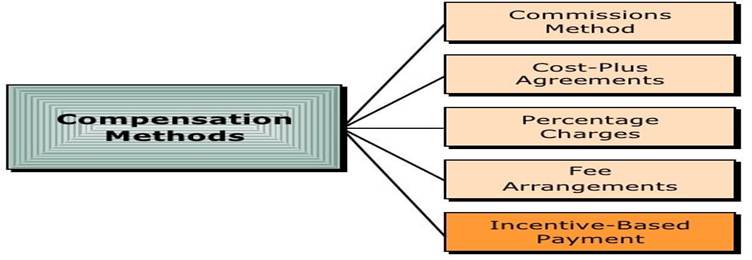
Advertising agency compensation may change strongly in current time as advertisers put stress on agencies to lower commissions and link compensation to performance following advertising campaigns. The reasons are very clear given the need to attain balance in market fallouts and stabilize or cultivate working media levels while reaching the preferred savings target. Advertising agencies don’t sell products; they sell ideas, with the knowledge and planning to achieve them. There are various ways the advertising agencies get compensated for their work and services. Agencies may be compensated in a variety of ways include:
a. Commission method
In the earlier years, as the advertising business advanced, newspaper owners paid a commission of 15% to advertising agents who credited advertisement space in their newspapers and publications. Most of the companies still paying commission use some form of paced procedure or descending scale, and the amount of media commission reserved by the agency or rebated to the client is by negotiation.
b. Cost-Plus Agreement
According to George E. Belch in his book Advertising and Promotion, “Under a cost-plus system, the client agrees to pay the agency a fee based on the costs of its work plus some agreed-on profit margin (often a percentage of total costs). This system needs the agency to keep complete accounts of costs incurred in working on a client’s account.
c. Incentive-based payments
According to George E. Belch, Incentive-Based Compensation, many clients these days are demanding more accountability from their agencies and tying agency compensation to performance through some type of incentive-based system. While there are many variations, the basic idea is that the agency’s ultimate compensation level will depend on how well it meets predetermined performance goals. These goals often include objective measures such as sales or market share as well as more subjective measures such as evaluations of the quality of the agency’s creative work. Companies using incentive-based systems determine agency compensation through media commissions, fees, bonuses, or some combination of these methods.
d. Fees arrangements
Fee Arrangement Under the fee structure, the client and the ad agency negotiate a flat sum to be paid to the agency for all work done. The agency estimates the cost (including out-of-pocket expenses) of servicing the client, who either accepts or negotiates for a lesser amount. Negotiations continue until an agreement is reached. There are two basic types of fee arrangement systems.
e. Percentage charges
An agency works on a profit margin of 01 percent to 10 percent, or it may depend on negotiation and how the agency is run and structured. So that means if an agency has 1,00,00,000 Rs. (1 Crore Rs.) in an account, the agency will end up with anywhere between 1,00,000 Rs. (1 Lakh) to 10,00,000 Rs. (10 Lakhs). in its pocket as profit.
The rest of the money will be spent on buying commercial advertising space (print media, broadcast, internet, etc.) and paying the agency for marketing advice (expert, professional, skilled, etc.) and creative and production costs (talent, knowledge, capability, etc.).
It may sound like the agency will be making money on that, too, but that money paid to the agency from the client will be used to pay staff and operating expenses. The profit is what is left over when all the money has been spent to pay salaries and other expenses.
10. Share information
In most cases, the client has taken on an agency to fill a gap in their business and wants to see value for money. The agency’s most important job is to be the experts’ advice to clients. The best advice helps to achieve their consequences and remain an active performer in the market.
The agency then has an obligation to ask all the queries they need to in order to confirm they have took the brief properly. Consuming an open and informative conversation at the commencement of a project means that the client can go away safe in the information that the agency knows what they’re doing.
11. Work in collaboration
Keep in mind that both parties are invested in what they do and that keeping a strong relationship will require continuous work on both ends. Agencies aren’t possessions; they’re strategic partners. Clients and agencies are experts in their respective fields, and they should treat each other as equals. Trust, honesty, and commitment are vital elements for the achievement of any campaign and relationship. In a collaborative environment of a relationship, each party must have confidence in the other’s capability.
12. Set realistic expectations
One of the best ways to build a strong relationship with a client is to gain a reputation as an agency that not only delivers results but is also willing to go above and beyond. Setting realistic expectations gives you the chance to impress the client and position yourself as a partner. This is especially important when working on behalf of a client.
Both parties need to take part in this process to make sure that each knows what’s expected of the other. Agencies may have exclusive methods, but a good degree of transparency is essential. These services create trust and set realistic expectations.
13. Attempt for nonstop progress
When an agency functions with these principles, performing measured efforts to their clients and determined to not only accomplish but maintain confidence with clients, the phase can be set for achievement with great appraisals, referrals and customer remembering.
About the Author