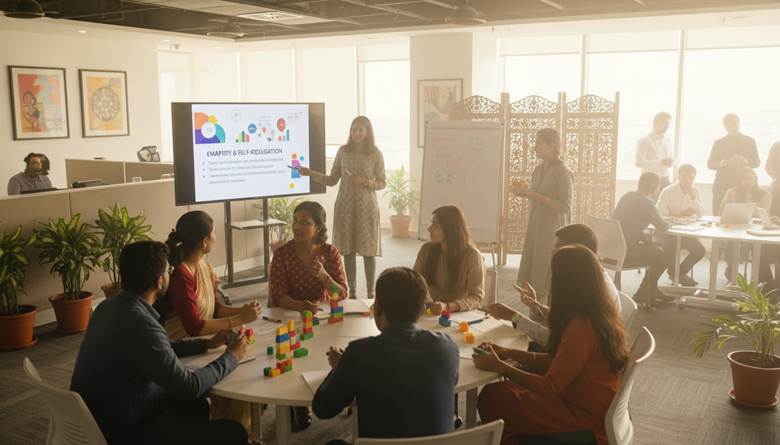
Education

I. SELF-MANAGEMENT AND EMOTIONAL REGULATION

1. Introduction

Self-management and emotional regulation are fundamental life skills that play a crucial role in personal growth, social harmony, and professional success. In the context of India—a land with deep philosophical traditions and diverse societal challenges—these concepts acquire unique significance. This note explores the meaning, methods, and importance of self-management and emotional regulation, with detailed Indian examples and case studies, linking ancient wisdom to modern realities.

2. Understanding Self-Management

Definition

Self-management refers to the ability to regulate and control one’s own emotions, thoughts, and actions in different situations. It encompasses self-awareness, self-regulation, motivation, goal-setting, and adaptability, forming the core of emotional intelligence (EI).

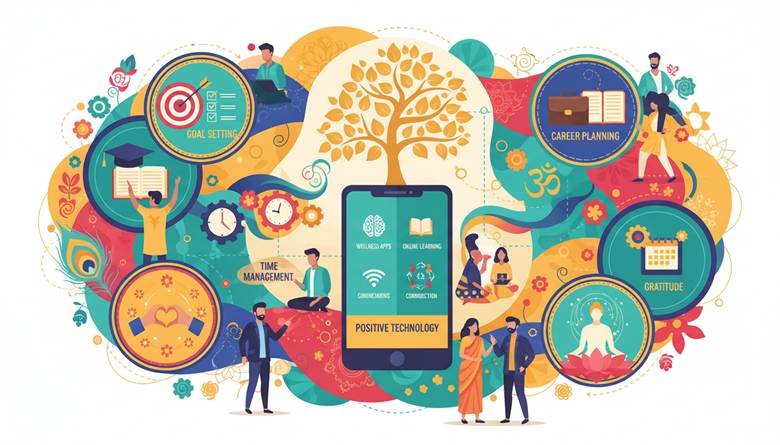
Core Components of Self-Management

  • Self-Awareness: Recognizing one’s emotions, strengths, and weaknesses.
  • Self-Regulation: Managing disruptive emotions and impulses.
  • Self-Motivation: Directing energy towards personal and collective goals.
  • Goal Setting: Identifying and planning actionable steps for achievement.
  • Time Management: Efficiently allocating time among priorities.
  • Adaptability: Flexibility in the face of challenges or change.

Importance

  • Fosters discipline and resilience.
  • Enhances productivity and well-being.
  • Builds leadership and decision-making skills.
  • Reduces stress and promotes mental health.

3. Emotional Regulation: Concepts and Techniques

Definition

Emotional regulation is the ability to monitor, evaluate, and modulate emotional reactions to achieve goals, complete tasks, or control behavior. It is a subset of self-management and is critical for maintaining healthy relationships, coping with adversity, and making rational decisions.

Common Strategies

  • Mindfulness: Being present and aware of thoughts and feelings.
  • Cognitive Reappraisal: Changing interpretations to alter emotional responses.
  • Problem-Solving: Addressing emotional triggers at their root.
  • Relaxation Techniques: Yoga, deep breathing, progressive muscle relaxation.
  • Seeking Social Support: Sharing experiences with friends, family, or counselors.
  • Expressive Writing: Journaling to process and understand emotions.

4. Indian Philosophical Traditions and Self-Management

India’s rich spiritual and philosophical heritage offers profound insights into self-management and emotional regulation.

A. Bhagavad Gita

  • Core Teachings: The Gita emphasizes equanimity (‘samatvam’), detachment (‘vairagya’), and self-control (‘atma-vinigrahah’).
  • Example: Arjuna’s dilemma on the battlefield is a classic case study in emotional turmoil. Krishna’s counsel guides him toward self-management through duty (‘dharma’), meditation, and selfless action (‘nishkama karma’).

B. Yoga and Meditation

  • Yoga Sutras of Patanjali: Outline methods for controlling the mind, emotions, and senses through practices like asanas (postures), pranayama (breath control), and dhyana (meditation).
  • Vipassana Meditation: This ancient Indian technique teaches observation and equanimity towards bodily sensations and emotions, fostering emotional regulation.

C. Gandhian Philosophy

  • Self-Discipline (Swaraj): Gandhi advocated for mastery over the self as a prerequisite for societal transformation. He practiced fasting, prayer, and introspection to regulate his emotions and maintain clarity.
  • Truth and Non-Violence: These principles demanded strict self-regulation and emotional control, especially during the freedom struggle.

5. Contemporary Indian Practices for Self-Management

A. Yoga and Wellness Programs

  • Widespread Adoption: Schools, colleges, and workplaces in India now integrate yoga, meditation, and mindfulness sessions to help students and employees manage stress and emotions.
  • Government Initiatives: Programs like the International Day of Yoga and the Fit India Movement promote holistic well-being.

B. Emotional Intelligence Training

  • Corporate Sector: Companies like Infosys and Tata Consultancy Services (TCS) offer training in emotional intelligence, time management, and resilience.
  • Education Sector: Institutes such as IITs and IIMs include counseling services, peer support groups, and workshops on emotional regulation.

6. Indian Case Studies and Examples

A. Mahatma Gandhi: The Epitome of Self-Management

  • Context: Gandhi faced hostility, imprisonment, and personal loss but maintained emotional equilibrium.
  • Techniques: Regular prayer, reflective journaling, fasting, and silence (‘maun vrat’) as tools for self-regulation.
  • Impact: Translated personal mastery into mass movements based on non-violence and truth.

B. Civil Services: Stress and Emotional Regulation

  • Example: Armstrong Pame, IAS officer in Manipur, used community mobilization and meditation to overcome bureaucratic challenges and personal stress while building a 100 km road without government funds.
  • Learning: Emotional regulation enabled him to inspire trust, resolve conflicts, and achieve goals.

C. Academic Stress Among Youth

  • Scenario: The pressure of competitive exams (IIT-JEE, NEET) leads to anxiety, depression, and sometimes tragic outcomes.
  • Intervention: IITs have introduced yoga, mindfulness workshops, and peer counseling. Positive outcomes include reduced stress, better focus, and improved academic performance.

D. Indian Corporate Sector

  • Example: Infosys conducts regular wellness programs, including yoga, meditation, and emotional intelligence workshops.
  • Result: Employees report lower burnout, higher satisfaction, and better teamwork.

E. The Art of Living Foundation

  • Workshops: Offers the ‘Happiness Program’ and ‘Youth Empowerment Seminar’ focusing on breathwork, meditation, and life skills.
  • Reach: Millions, especially youth, have benefitted from improved emotional awareness and self-regulation.

7. Challenges Unique to the Indian Context

  • Stigma Around Mental Health: Talking about emotions or seeking help is often taboo.
  • Academic and Professional Pressure: High parental and societal expectations can cause chronic stress.
  • Rapid Urbanization: Migration, lifestyle changes, and isolation impact self-management capacities.

8. Overcoming Challenges: Indian Solutions

  • Value-Based Education: CBSE and other boards have begun integrating value education and life skills into curricula.
  • Community Support: Traditional joint families, spiritual groups, and NGOs provide informal support systems.
  • Government Initiatives: Programs like ‘Ayushman Bharat’ focus on holistic health, including mental well-being.

9. Techniques and Tools for Self-Management and Emotional Regulation

A. Mindfulness and Meditation

  • Vipassana: Teaches non-reactivity and awareness of sensations.
  • Transcendental Meditation: Popularized by Maharishi Mahesh Yogi, widely practiced for stress management.

B. Yoga and Pranayama

  • Asanas: Physical postures that improve body-mind coordination.
  • Pranayama: Breath control techniques like Anulom-Vilom and Bhramari for calming the mind.

C. Journaling and Reflective Practice

  • Daily Diaries: Encourage self-reflection and tracking emotional responses.

D. Social and Community Support

  • Peer Groups: Sharing experiences with friends or mentors.
  • Family Systems: Leveraging traditional Indian family structures for emotional support.

E. Professional Counseling

  • School and College Counselors: Growing presence in urban India.
  • NGO Initiatives: Organizations like Snehi and The Live Love Laugh Foundation work to destigmatize mental health.

10. Indian Case Studies in Detail

1. The Amul Cooperative: Emotional Regulation and Self-Management in Rural India

  • Background: The Amul dairy cooperative movement transformed the lives of rural women in Gujarat.
  • Challenges: Initial resistance, financial hardship, and gender bias.
  • Self-Management Strategies: Collective decision-making, conflict resolution, and resilience built through self-help groups.
  • Outcome: Empowerment, improved mental health, and economic independence.

2. IIT Madras Mindfulness Program

  • Context: High academic stress, suicide risk.
  • Intervention: Mandatory mindfulness and yoga sessions, peer listening circles.
  • Result: Significant drop in stress-related incidents, enhanced emotional well-being, and campus cohesion.

3. NIMHANS, Bengaluru: Integrative Therapy

  • Program: Combines yoga, ayurveda, and modern psychotherapy for treating stress and emotional disorders.
  • Approach: Holistic, patient-centered, drawing from Indian traditions and scientific research.

11. Comparison: Traditional vs. Modern Approaches in India

AspectTraditional Indian MethodsModern Approaches
Emotional ExpressionStorytelling, rituals, musicCounseling, group therapy
Self-ManagementYoga, meditation, fastingApps, time management tools
Community SupportJoint family, panchayatsHelplines, online forums
EducationGurukul system, moral storiesValue education, soft skills

12. Recommendations for Students and Young Professionals

  • Practice Mindfulness: Begin with 5-10 minutes of meditation daily.
  • Set Realistic Goals: Avoid overburdening yourself; break tasks into manageable steps.
  • Seek Support: Don’t hesitate to talk to friends, family, or counselors.
  • Adopt Indian Practices: Incorporate yoga, breathing exercises, or traditional music for emotional balance.
  • Use Technology Wisely: Apps for journaling, reminders, and guided meditation can help manage time and stress.

13. Conclusion

Self-management and emotional regulation are not just personal skills but also social assets. Indian traditions provide age-old wisdom and practical tools, while modern science offers structured approaches to mastering these capabilities. By learning from Indian thinkers, case studies, and contemporary programs, individuals can cultivate resilience, empathy, and ethical living—qualities essential for thriving in today’s complex world.

______________________________________________________________________________

II. EMOTIONAL INTELLIGENCE (GOLEMAN FRAMEWORK)

1. Introduction

Emotional Intelligence (EI) refers to the ability to recognize, understand, manage, and utilize emotions effectively in ourselves and others. Daniel Goleman, a renowned psychologist, popularized the concept and developed a five-component framework that has become foundational in both personal development and organizational leadership.

2. Goleman’s Five Components of Emotional Intelligence

  1. Self-Awareness
    • Definition: Recognizing and understanding one’s own emotions, strengths, weaknesses, and drives.
    • Indian Example: Mahatma Gandhi was highly self-aware, openly reflecting on his limitations and emotional struggles in his autobiography, “My Experiments with Truth.” This self-awareness helped him evolve as a leader.
  2. Self-Regulation
    • Definition: Controlling or redirecting disruptive emotions and adapting to changing circumstances.
    • Case Study: Ratan Tata, the former chairman of Tata Group, demonstrated self-regulation during crises (e.g., the 26/11 Mumbai attacks). He managed his emotions and led the organization and its employees through empathetic and calm decision-making.
  3. Motivation
    • Definition: Being driven to achieve for the sake of achievement; passion for work beyond monetary gain.
    • Indian Example: Dr. APJ Abdul Kalam, known as the “Missile Man of India,” was intrinsically motivated, often working late into the night for the development of India’s space and missile programs, inspiring countless youth.
  4. Empathy
    • Definition: Understanding and considering other people’s feelings when making decisions.
    • Case Study: Mother Teresa epitomized empathy, dedicating her life to caring for the marginalized in Kolkata. Her deep understanding of others’ emotions allowed her to connect and serve effectively.
  5. Social Skills
    • Definition: Managing relationships to move people in desired directions, building networks, and fostering rapport.
    • Indian Example: Sundar Pichai (CEO of Google, originally from India) is recognized for his collaborative leadership style, strong communication, and ability to bring diverse teams together, a testament to excellent social skills.

3. Application of Goleman’s EI Framework in India

Educational Sector

  • Many Indian schools, such as The Doon School and Delhi Public School, have started including EI training and activities (like value education, peer-group interactions, and mindfulness sessions) to help students develop self-awareness and empathy.

Corporate Sector

  • Organizations like Infosys and Wipro offer workshops on EI, focusing on empathy, self-management, and social skills to improve teamwork and leadership.
  • These initiatives have resulted in improved employee satisfaction, reduced attrition, and better workplace harmony.

Government and Civil Services

  • Indian Administrative Service (IAS) officers are increasingly trained in EI, especially for conflict resolution and public engagement. For example, Armstrong Pame, an IAS officer in Manipur, used empathy and social skills to mobilize communities for developmental work.

4. Challenges and Way Forward in the Indian Context

  • Barriers: Social stigma around expressing emotions, a focus on academic over emotional development, and hierarchical workplace cultures can hinder EI growth.
  • Solutions: Incorporating EI into educational curricula, promoting open communication in families and organizations, and learning from Indian leaders who exemplified EI.

5. Conclusion

The Goleman Framework of Emotional Intelligence is highly relevant in India’s diverse and dynamic context. By learning from Indian leaders and case studies, individuals and organizations can cultivate EI, leading to better leadership, harmonious relationships, and greater success in all spheres of life.

III. MENTAL HEALTH AWARENESS AND COPING STRATEGIES

1. Introduction

Mental health awareness is the understanding and acknowledgment of mental health issues, their impact, and the importance of timely intervention. In India, due to stigma and lack of information, mental health often remains neglected, making awareness crucial for well-being.

2. The State of Mental Health in India

  • According to the National Mental Health Survey (2015-16), nearly 14% of India’s population suffers from some form of mental disorder.
  • Barriers include social stigma, misinformation, and limited access to professional care, especially in rural areas.

3. Awareness Initiatives and Progress

  • Government Programs: The National Mental Health Programme (NMHP) and initiatives like Ayushman Bharat focus on integrating mental health care into primary health services.
  • NGO Efforts: Organizations such as The Live Love Laugh Foundation (founded by Deepika Padukone) and Snehi work to destigmatize mental illness through campaigns, helplines, and workshops.
  • Media Campaigns: Celebrities like Deepika Padukone and Virat Kohli have openly discussed their struggles with depression and anxiety, encouraging public dialogue.

4. Coping Strategies: Indian Context

A. Traditional Approaches

  • Yoga and Meditation: Widely practiced for mental peace. For instance, Art of Living and Isha Foundation offer programs combining yoga, breathing exercises, and mindfulness.
  • Spiritual Practices: Prayer, chanting, and community rituals can provide emotional support and a sense of belonging.

B. Modern Psychological Tools

  • Counseling and Therapy: Growing acceptance of psychologists and psychiatrists, especially in urban India. College campuses and workplaces are introducing counseling services.
  • Peer Support Groups: Initiatives like YourDOST provide online and offline platforms for sharing and support.
  • Helplines: Organizations like Snehi and Vandrevala Foundation run 24×7 helplines for crisis intervention.

5. Case Studies

  • Case Study 1: Deepika Padukone
    • The actress publicly shared her battle with depression, founded The Live Love Laugh Foundation, and advocated for seeking help without shame. Her openness increased awareness and encouraged many to seek support.
  • Case Study 2: IIT Madras
    • After a series of student suicides, the institute introduced mandatory wellness workshops, peer counseling, and yoga sessions. This led to improved student well-being and a more supportive campus environment.
  • Case Study 3: Rural Outreach
    • NIMHANS, Bengaluru, runs outreach programs in Karnataka villages, training community health workers to identify mental health issues and provide basic counseling, bridging rural-urban gaps.

6. Conclusion

Mental health awareness and coping strategies are gaining ground in India, blending traditional wisdom with modern approaches. Continued dialogue, education, and accessible support systems can help overcome stigma and ensure a healthier, more resilient society.


IV. RESILIENCE AND GROWTH MINDSET

Understanding Resilience

Resilience is the psychological strength to cope with stress, adversity, and uncertainty. It enables individuals to overcome setbacks, adapt to change, and emerge stronger. In the Indian context, resilience has historical, cultural, and individual dimensions, shaped by societal challenges, economic hardship, and diverse cultural values.

Growth Mindset: Concepts and Relevance

A growth mindset, a term popularized by psychologist Carol Dweck, is the belief that abilities and intelligence can be developed through dedication, effort, and learning. This mindset contrasts with a fixed mindset, where individuals see talents as static and unchangeable. In India, adopting a growth mindset is critical given the competitive academic environment, rapid socio-economic changes, and the need for continuous personal and professional development.

Key Elements of Resilience and Growth Mindset

  • Optimism: Maintaining hope during tough times.
  • Adaptability: Adjusting to new environments, methods, or circumstances.
  • Learning from Failure: Viewing mistakes as opportunities for growth.
  • Perseverance: Persisting in the face of challenges.
  • Self-Efficacy: Believing in one’s ability to influence outcomes.

Indian Examples and Case Studies

1. Dr. APJ Abdul Kalam: From Modest Beginnings to Presidency

Dr. APJ Abdul Kalam’s journey from a humble background in Rameswaram to becoming the “Missile Man of India” and the President is a testament to resilience and growth mindset. Despite economic hardships and initial failures (like the failure of the SLV-3 satellite launch), he persevered, learned from setbacks, and inspired millions to pursue scientific and national goals. His autobiography, “Wings of Fire,” documents his philosophy: “We should not give up and we should not allow the problem to defeat us.”

2. The Lijjat Papad Story

In 1959, seven women in Mumbai started making papads (thin, crispy snacks) with a loan of just ₹80. Facing gender bias, lack of resources, and market challenges, they persevered, adapted business models, and learned from failures. Today, Shri Mahila Griha Udyog Lijjat Papad is a women’s cooperative with more than 45,000 members, exemplifying collective resilience and a growth mindset.

3. Indian Start-Ups

Entrepreneurs like Kiran Mazumdar-Shaw (Biocon) and the Flipkart founders (Sachin and Binny Bansal) faced repeated rejections, regulatory hurdles, funding crises, and stiff competition. Their willingness to iterate, pivot, and learn from failures led to global success and showcased India’s start-up spirit.

4. COVID-19 and Student Adaptation

The pandemic forced millions of Indian students to switch to online learning, often with inadequate resources. Initiatives like DigiSakshar in Haryana and community-led digital literacy programs enabled students and teachers to persist and adapt, demonstrating the resilience of India’s youth and educators.

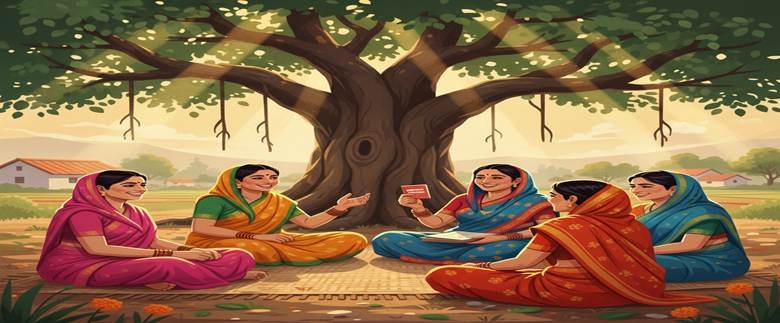
5. Self-Help Groups (SHGs) and Rural Women

In states like Andhra Pradesh and Tamil Nadu, SHGs empowered women to overcome social and economic barriers. By pooling savings, accessing microloans, and supporting each other, they built businesses, improved their families’ welfare, and became agents of social change.

Analysis: What Drives Resilience in India?

  • Family and Community Support: Strong bonds often provide a safety net.
  • Cultural Narratives: Stories from epics like the Ramayana and Mahabharata emphasize perseverance.
  • Religious and Philosophical Beliefs: Teachings from the Bhagavad Gita, Buddhism, and Jainism encourage acceptance, self-discipline, and inner strength.
  • Education and Skill-Building: Access to education and skill development programs fosters growth and adaptability.

V. COMMUNICATION & INTERPERSONAL SKILLS

Defining Communication and Interpersonal Skills

Communication skills involve the ability to convey information clearly, listen actively, and adapt messages for diverse audiences. Interpersonal skills encompass relationship-building, empathy, teamwork, conflict resolution, and cultural sensitivity.

These skills are vital in India due to its linguistic diversity, multicultural society, and rapid globalization.

Components of Effective Communication

  • Verbal Communication: Language, tone, clarity, and persuasion.
  • Non-Verbal Communication: Body language, facial expressions, gestures.
  • Listening Skills: Active, empathetic listening; understanding implicit messages.
  • Feedback: Giving and receiving constructive criticism.
  • Cross-Cultural Competence: Navigating differences in language, customs, and etiquette.

Indian Examples and Case Studies

1. Mahatma Gandhi: Communication as a Leadership Tool

Gandhi’s mastery in communication played a pivotal role in India’s freedom struggle. He conveyed complex ideas—non-violence, truth, and self-reliance—in simple, relatable terms. His speeches, letters, and public dialogues united diverse communities. His empathetic listening during meetings with peasants (Champaran Satyagraha) and political adversaries facilitated conflict resolution.

2. Sundar Pichai: Cross-Cultural Communication

Hailing from Chennai, Sundar Pichai rose to become the CEO of Google and Alphabet. His ability to communicate complex ideas simply, listen to diverse perspectives, and build rapport with global teams is widely praised. He often credits his Indian upbringing for teaching him humility and adaptability.

3. Anna Hazare’s Anti-Corruption Movement

In 2011, Anna Hazare’s clear, persuasive communication ignited a nationwide movement against corruption. Through public rallies, media appearances, and effective use of social media, he mobilized millions, transcending age, class, and geography. His interpersonal skills enabled him to build coalitions among activists, politicians, and citizens.

4. Infosys & TCS: Soft Skills Training

Indian IT giants like Infosys and TCS invest heavily in training employees in communication and interpersonal skills. Cross-functional teams, international client interactions, and leadership roles require fluency in English, cultural sensitivity, and strong collaboration skills. Soft skills modules cover everything from email etiquette to negotiation and conflict management.

5. Healthcare Communication: Narayana Health

Founded by Dr. Devi Shetty, Narayana Health emphasizes doctor-patient communication as a core value. Doctors are trained to explain diagnoses and treatment plans in regional languages, show empathy, and consider patients’ emotional needs, improving health outcomes and trust.

Challenges and Opportunities

  • Linguistic Diversity: India’s 22 official languages and hundreds of dialects pose both a challenge and an opportunity for multilingualism and cultural sensitivity.
  • Hierarchical Structures: Traditional respect for authority can sometimes inhibit open communication; modern workplaces strive for flatter hierarchies and open dialogue.
  • Digital Communication: Social media and digital platforms have transformed how Indians communicate, enabling new forms of engagement but also presenting challenges like online harassment and misinformation.

Interpersonal Skills in Indian Society

  • Joint Family Systems: Teach negotiation, conflict resolution, and empathy from a young age.
  • Community Events and Festivals: Foster teamwork, collaboration, and relationship-building.
  • Educational Reforms: Increasing emphasis on group projects, debates, and extracurricular activities to nurture soft skills.

VI. DECISION-MAKING AND BASICS OF FINANCIAL LITERACY

Decision-Making: Definition and Process

Decision-making is the cognitive process of selecting a course of action from multiple alternatives. It involves identifying options, evaluating risks and benefits, considering short- and long-term consequences, and implementing chosen solutions.

Steps in Effective Decision-Making

  1. Identify the Problem/Goal
  2. Gather Information
  3. Generate Alternatives
  4. Evaluate Options
  5. Make the Decision
  6. Implement the Solution
  7. Review and Reflect

Financial Literacy: Importance and Key Concepts

Financial literacy is the ability to understand and use various financial skills, including personal budgeting, investing, borrowing, and managing money. In India, financial literacy is crucial due to rapid economic changes, digital banking expansion, and the government’s push for financial inclusion.

Core Elements of Financial Literacy

  • Budgeting: Managing income and expenses.
  • Saving & Investing: Understanding savings accounts, fixed deposits, mutual funds, and stocks.
  • Credit & Loans: Awareness of interest rates, EMIs, credit scores.
  • Insurance: Knowledge of life, health, and property insurance.
  • Digital Finance: Using online banking, UPI, and mobile wallets.

Indian Examples and Case Studies

1. Mumbai Dabbawalas: Decision-Making in Logistics

The Mumbai Dabbawala network delivers over 200,000 lunchboxes daily with near-perfect accuracy. Their system relies on decentralized, rapid decision-making, effective communication, and trust. When disruptions occur (strikes, heavy rain), Dabbawalas collaborate and adapt on the spot, demonstrating real-world decision-making under pressure.

2. Financial Inclusion: Pradhan Mantri Jan Dhan Yojana (PMJDY)

Launched in 2014, the PMJDY aimed to bring every Indian household into the banking system. By opening millions of zero-balance accounts, offering RuPay debit cards, and facilitating direct benefits transfers (DBT), the program empowered individuals to make informed financial decisions. Financial literacy camps were organized nationwide, teaching basics like saving, digital payments, and avoiding fraud.

3. Rural Women and Microfinance

Self-Help Groups (SHGs) empower women by teaching them to manage collective savings and access microloans. For example, in Andhra Pradesh, SHGs have enabled women to start small businesses, make group decisions about loans, and plan investments, increasing household income and resilience.

4. Student Financial Literacy Initiatives

The National Centre for Financial Education (NCFE) runs programs in schools and colleges, teaching students about budgeting, saving, and investing. Delhi government schools’ “Financial Literacy Clubs” use real-life simulations to teach students about money management, encouraging responsible decision-making from a young age.

5. Agricultural Decision-Making

Farmers in states like Punjab and Maharashtra use weather apps, market price information, and government advisories to decide what crops to plant and when to sell. Organizations like e-Choupal provide digital platforms for market intelligence, improving rural incomes.

Challenges in Financial Literacy

  • Low Awareness: Many Indians, especially in rural areas, lack basic financial knowledge.
  • Digital Divide: Limited access to smartphones and the internet in some regions.
  • Fraud and Misinformation: Rise in digital transactions has also seen an increase in scams.

Policy and Community Solutions

  • Bank-Led Financial Literacy Centers: RBI and banks organize workshops on banking, loans, and digital payments.
  • Women’s Collectives: SHGs serve as informal schools for financial skills.
  • Digital Literacy Drives: Government and private sector collaborate to teach digital finance.

VII. EXPLORING ETHICAL BEHAVIOR AND INTEGRITY

Definition and Importance

Ethical behavior means acting according to accepted principles of right and wrong. Integrity is the quality of being honest and adhering steadfastly to moral and ethical principles, even when it is difficult or unpopular. In the Indian context, ethics and integrity are essential for social harmony, governance, business, and national progress.

Principles of Ethical Behavior

  • Honesty: Telling the truth, being transparent.
  • Fairness: Treating everyone equally.
  • Accountability: Owning up to one’s actions.
  • Respect: Valuing others’ rights and dignity.
  • Responsibility: Acting with care for others and society.

Indian Examples and Case Studies

1. Satyendra Dubey: Standing Up to Corruption

Dubey, an IIT Kanpur graduate and Indian Engineering Services officer, exposed corruption in highway construction projects. Despite personal risk, he reported malpractices to the highest authorities. Tragically, he was murdered for his integrity, but the incident galvanized public demand for whistleblower protection and ethical reform in government.

2. E. Sreedharan: The Metro Man

Sreedharan led projects like the Konkan Railway and Delhi Metro with impeccable ethical standards. He enforced transparent tendering, zero-tolerance for bribery, and strict adherence to deadlines. His leadership made these complex projects models of efficiency and integrity.

3. TATA Group: Corporate Ethics

Known for its commitment to ethical business, the TATA Group has repeatedly put values above profits. During the 26/11 Mumbai attacks, the group supported victims and employees generously, earning public admiration. Its “Code of Conduct” sets standards for transparency, fairness, and social responsibility.

4. Anna Hazare and the India Against Corruption Movement

Hazare’s campaign for the Lokpal (anti-corruption ombudsman) was rooted in ethical governance and public accountability. His personal integrity and Gandhian lifestyle inspired millions to demand cleaner politics and policy reforms.

5. Academic Integrity in Indian Education

Institutions like IITs and IIMs maintain strict codes against plagiarism and cheating. Students participate in workshops on academic ethics and sign honor pledges, fostering a culture of fairness and respect in learning.

Historical and Cultural Foundations

  • Gandhian Values: Mahatma Gandhi’s life and teachings emphasized truth (satya) and non-violence (ahimsa), influencing generations of Indian leaders and reformers.
  • Ancient Texts: The Bhagavad Gita, Upanishads, and Arthashastra discuss ethics in personal, social, and political life.
  • Community Vigilance: Panchayat systems and neighborhood watch groups historically upheld social justice and ethical conduct.

Contemporary Ethical Challenges in India

  • Corruption in Public Life: Scandals undermine trust in institutions.
  • Corporate Malpractice: Cases of fraud, tax evasion, and environmental harm.
  • Educational Dishonesty: Cheating in exams, fake degrees.
  • Everyday Ethics: Bribery in daily transactions, disregard for rules.

Building Ethical Behavior and Integrity

1. Value-Based Education

The Central Board of Secondary Education (CBSE) and many state boards have introduced value education curricula focusing on honesty, empathy, and civic responsibility.

2. Ethical Leadership in Government and Business

Mandatory ethics training for public officials and corporate leaders is gaining traction. Organizations like the Confederation of Indian Industry (CII) promote best practices in business ethics.

3. Whistleblower Protection and Transparency Laws

The Whistle Blowers Protection Act and the Right to Information (RTI) Act encourage ethical reporting and transparency.

4. Role Models and Mentoring

Public recognition of ethical leaders—like Dr. Verghese Kurien (Father of the White Revolution), Justice V.R. Krishna Iyer, and Aruna Roy (RTI activist)—inspires the next generation.

Case Study: Aruna Roy and the RTI Movement

Aruna Roy, a former IAS officer, led the grassroots movement for the Right to Information, which empowered citizens to demand government transparency. Her leadership, rooted in ethics and public service, led to one of India’s most significant democratic reforms.

Conclusion

The integration of resilience, growth mindset, communication, decision-making, financial literacy, ethical behavior, and integrity is vital for individual and societal progress in India. Drawing from a deep well of cultural traditions, modern policies, and inspiring examples, Indians continue to navigate complex challenges with creativity and moral courage.

Key Messages:

  • Resilience and growth mindset enable Indians to thrive despite adversity—from national leaders to rural entrepreneurs.
  • Communication and interpersonal skills are essential in a multilingual, multicultural society and the global workplace.
  • Decision-making and financial literacy empower individuals to make informed life choices and build economic security.
  • Ethical behavior and integrity underpin trust, justice, and sustainable development.

To foster these skills, India must continue to invest in education, reform institutions, celebrate ethical role models, and build supportive communities, ensuring that every citizen is equipped to contribute to a just and prosperous society.

PEST Analysis of the Indian Business Environment

India, as one of the fastest-growing major economies, offers a complex and dynamic macroeconomic environment for businesses. The PEST analysis framework helps dissect the external factors—political, economic, socio-cultural, and technological—that impact business decisions and performance. Let’s explore each aspect with Indian brand examples and case studies to illustrate the practical impact.


1. Political Factors

Overview

Political factors refer to the influence of government policy, stability, regulatory frameworks, taxation, trade agreements, and the overall political climate on businesses. In India, the central and state governments play a powerful role in shaping the business landscape.

Key Political Factors in India

  • Regulatory Environment: Government regulations, FDI limits, sector-specific policies (e.g., GST, Make in India, Digital India).
  • Political Stability: Stable governance ensures predictability, while frequent changes or coalition politics can create uncertainties.
  • Taxation Policies: Introduction of GST streamlined indirect taxation, but compliance and rates still pose challenges.
  • Trade Policies: Import/export duties, free trade agreements, and export incentives influence business strategies.
  • Government Incentives: Schemes for MSMEs, subsidies, and PLI incentives for manufacturing.

Case Study: Maruti Suzuki and Government Policy

Maruti Suzuki, India’s leading automobile manufacturer, thrived due to favorable government policies. In the 1980s, the Indian government partnered with Suzuki of Japan to launch Maruti Udyog Limited (now Maruti Suzuki). The government provided:

  • Policy support: Relaxed licensing, land allocation, and reduced import duties for technological know-how.
  • Trade liberalization: Post-1991 reforms enabled Maruti to upgrade technology, diversify models, and compete globally.
  • Impact: Maruti Suzuki became the market leader, benefiting from early-mover advantage, government support, and a growing middle class.

Example: Patanjali and Regulatory Changes

Patanjali Ayurved leveraged the Indian government’s focus on indigenous and Ayurvedic products. The government’s push for “Make in India” and easier licensing for herbal products allowed Patanjali to expand rapidly. However, the brand also faced regulatory scrutiny regarding product claims and quality, illustrating the double-edged nature of political oversight.


2. Economic Factors

Overview

Economic factors encompass the broader economic climate in which businesses operate, including GDP growth, per capita income, inflation, interest rates, currency fluctuations, and market dynamics.

Key Economic Factors in India

  • GDP Growth: India’s GDP growth rate directly impacts consumer spending, investment, and business expansion.
  • Disposable Income: Rising middle-class income boosts demand for branded goods and services.
  • Inflation and Interest Rates: Affect consumer purchasing power and cost of capital for businesses.
  • Employment Levels: Influence market demand for both basic and luxury goods.
  • Exchange Rate Fluctuations: Affect export competitiveness and input costs, especially for global brands.

Case Study: Hindustan Unilever Limited (HUL) and Rural Markets

Hindustan Unilever Limited (HUL) is India’s largest FMCG company, with a significant presence in both urban and rural markets. Its strategy is closely tied to India’s economic environment:

  • Rural Penetration: HUL invested in Project Shakti, empowering rural women as micro-entrepreneurs to sell products in villages. This tapped into growing rural incomes.
  • Product Pricing: During inflationary periods, HUL introduced smaller pack sizes (“sachet revolution”) to make products affordable without sacrificing margins.
  • Impact of Economic Slowdowns: HUL’s diversified portfolio and rural focus helped it weather economic downturns better than many competitors.

Example: Flipkart and India’s E-Commerce Boom

Flipkart, founded in 2007, capitalized on India’s rising internet penetration, growing disposable income, and favorable demographics. As the economy grew and digital payments became more widespread, Flipkart revolutionized retail by making products accessible to even remote areas. Its economic impact includes the following:

  • Job creation: Flipkart and its supply chain partners employ thousands across India.
  • SME empowerment: The platform enabled small sellers to reach a national audience.

3. Socio-Cultural Factors

Overview

Socio-cultural factors refer to societal attitudes, values, demographics, education, lifestyle changes, and cultural trends that affect consumer behavior and business operations.

Key Socio-Cultural Factors in India

  • Population Diversity: India’s vast linguistic, religious, and regional diversity demands localized marketing.
  • Rising Middle Class: The aspirational Indian consumer seeks quality, affordability, and global brands.
  • Changing Lifestyles: Urbanization and dual-income households drive demand for convenience products.
  • Health Consciousness: Increasing focus on health and wellness shapes food, personal care, and fitness sectors.
  • Digital Adoption: Rapid smartphone and internet penetration, especially among youth.

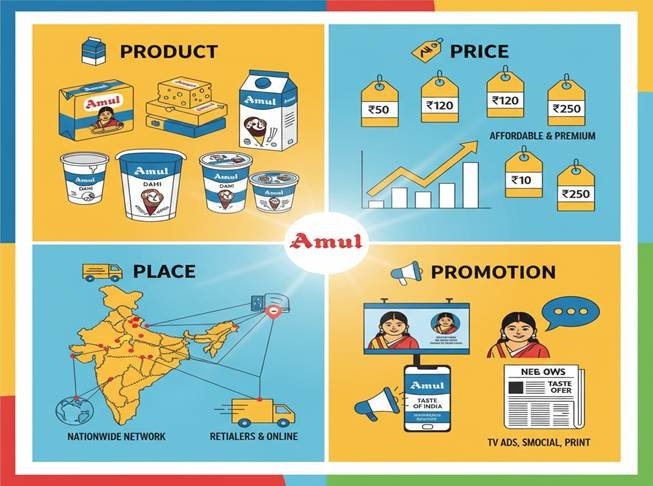
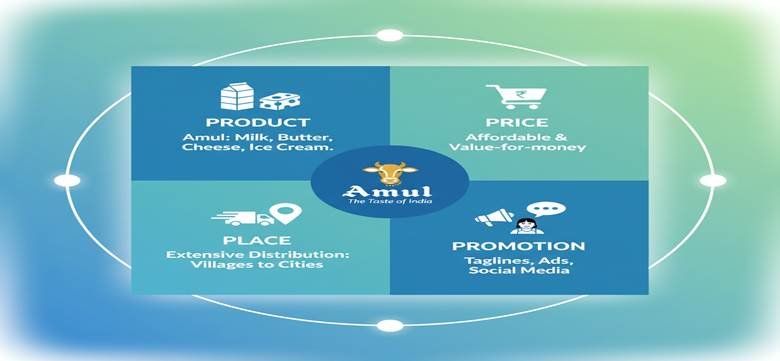
Case Study: Amul and the Indian Dairy Revolution

Amul, the iconic Indian dairy brand, transformed the socio-cultural landscape through its cooperative model:

  • Empowerment: Amul’s structure empowered millions of rural dairy farmers, especially women, providing steady income and improved livelihoods.
  • Cultural Relevance: Amul’s advertising campaigns (e.g., topical “Amul girl” ads) resonate with Indian audiences by blending humor and social commentary.
  • Nutritional Impact: Amul helped make milk and dairy products affordable and accessible, contributing to better nutrition.

Example: Titan and Cultural Nuances

Titan, a Tata Group company, successfully navigated India’s socio-cultural complexity:

  • Watches as Status Symbols: Titan positioned watches not just as utility items but as aspirational accessories, leveraging festivals and weddings.
  • Tanishq (jewelry brand): Tanishq’s marketing acknowledges traditional values while appealing to modern sensibilities, making it a trusted brand for Indian weddings and celebrations.

4. Technological Factors

Overview

Technological factors cover advancements in manufacturing, information technology, innovation, digital transformation, automation, and R&D.

Key Technological Factors in India

  • Digital India Initiative: Government push to increase digital infrastructure and connectivity.
  • Mobile Penetration: India has one of the world’s highest numbers of mobile users, fueling e-commerce and fintech.
  • Tech Startups: A robust startup ecosystem drives innovation in fintech, edtech, healthtech, and logistics.
  • Automation and AI: Increasing adoption in manufacturing, retail, and services.
  • R&D Investment: Multinational and Indian corporations invest in product and process innovation.

Case Study: Reliance Jio and the Telecom Revolution

Reliance Jio disrupted the Indian telecom sector in 2016 by offering free voice calls and extremely affordable data plans:

  • Mass Digitalization: Jio’s entry forced competitors to lower prices, leading to a data revolution and rapid internet adoption across urban and rural India.
  • Ecosystem Approach: Jio expanded into digital services (JioSaavn, JioTV, JioMart), leveraging its vast subscriber base.
  • Societal Impact: Affordable internet enabled e-learning, telemedicine, and digital payments, transforming daily life and business.

Example: Paytm and the Digital Payments Surge

Paytm, an Indian fintech pioneer, rode the wave of technological and regulatory change:

  • Demonetization Impact: The 2016 demonetization policy created a surge in demand for digital payments, and Paytm rapidly scaled its wallet and merchant acceptance.
  • Innovation: Continuous updates, UPI integration, and expansion into financial services made Paytm a household name.

Integrated PEST Analysis: How Indian Brands Navigate the Macro Environment

Indian brands must remain agile, adapting their strategies to the ever-changing macro environment. Often, the four PEST factors are deeply interlinked.

Example: Ola Cabs – Navigating PEST Forces

Ola Cabs (ANI Technologies) is a prime example of an Indian brand successfully navigating PEST challenges:

  • Political: Regulatory battles with state governments over licensing, surge pricing, and competition with traditional taxis.
  • Economic: Tapping into India’s urbanization and rising disposable incomes, Ola offers affordable mobility solutions.
  • Socio-Cultural: Addressing safety concerns (especially for women), offering regional language apps, and promoting ride-sharing to appeal to eco-conscious users.
  • Technological: Leveraging GPS, mobile payments, AI-driven demand prediction, and a robust app ecosystem.

Example: Dabur – From Ayurveda to Modern FMCG

Dabur, a 135-year-old brand, has thrived by aligning with macro trends:

  • Political: Benefited from pro-Ayurveda policies and easier regulations for herbal products.
  • Economic: Affordable product range caters to both rural and urban customers.
  • Socio-Cultural: Promotes health and wellness, leveraging India’s traditional affinity for natural remedies.
  • Technological: Invests in automation, e-commerce, and supply chain digitization.

Critical Challenges and Opportunities

While the macro environment offers opportunities, it also poses unique challenges:

Challenges

  • Policy Uncertainty: Sudden regulatory changes (e.g., GST rollout, demonetization) can disrupt business planning.
  • Income Disparities: Despite economic growth, income inequality persists, requiring adaptive pricing and distribution strategies.
  • Cultural Sensitivity: Brands must localize products and marketing to appeal to regional and linguistic differences.
  • Digital Divide: Despite rapid digital adoption, rural and low-income populations still face barriers to technology access.
  • Global Competition: Indian brands face intense competition from global players entering the market.

Opportunities

  • Government Schemes: Initiatives like “Startup India,” “Digital India,” and “Make in India” provide incentives and market access.
  • Demographic Dividend: A young population offers vast potential for new product categories and innovation.
  • Rural Expansion: Untapped rural markets present growth opportunities for FMCG, telecom, and digital services.
  • Sustainability: Growing environmental awareness opens avenues for green and sustainable products.

Conclusion

A robust understanding of PEST factors is essential for Indian brands aiming to thrive in a volatile and dynamic macro environment. The interplay of political support, economic growth, socio-cultural shifts, and technological innovation has driven the success of brands like Maruti Suzuki, Amul, Reliance Jio, HUL, Dabur, and Ola.

Indian businesses that remain vigilant, adaptable, and responsive to these macro forces will be best positioned to capture growth, mitigate risks, and build enduring brands in the world’s most diverse and exciting market.

Introduction

The microenvironment of a business comprises the internal and near-external factors that directly influence a company’s day-to-day operations and strategic decisions. Unlike the macro environment (which includes large-scale forces like the economy or politics), the micro environment is closer to the company and more controllable. For Indian brands, the microenvironment is shaped by unique market dynamics, management philosophies, and an intricate web of stakeholders and competition.


I. Management Structure

Definition & Importance

Management structure refers to the hierarchy, roles, and reporting relationships within an organization. It dictates how decisions are made, how information flows, and how strategy is executed. The right structure balances control with agility—crucial for Indian firms operating in a fast-changing market.


Common Structures in Indian Businesses

  1. Hierarchical (Traditional) Structure
    • Common in large, established firms and family-owned conglomerates.
    • Clear levels of authority.
  2. Flat Structure
    • Fewer layers, more direct communication.
    • Common in startups and creative agencies.
  3. Matrix Structure
    • Employees report to multiple managers (e.g., by function and by project).
    • Seen in large IT firms and ad agencies.

Indian Brand Example: Reliance Industries

Reliance Industries Ltd (RIL)

  • Type: Hierarchical conglomerate structure.
  • Details: The company is led by Chairman and Managing Director Mukesh Ambani, with separate verticals (petrochemicals, retail, telecom) headed by their respective CEOs.
  • Impact: This structure allowed Reliance to quickly launch Jio by leveraging expertise and resources from other verticals.

Case Study: Amul (Gujarat Cooperative Milk Marketing Federation)

  • Structure: Cooperative, three-tiered (village societies, district unions, and state federation).
  • How it works: Village-level societies collect milk, run by elected representatives; district unions handle processing; and the state federation (GCMMF) manages marketing and branding.
  • Outcome: Enables local empowerment, rapid scaling, and brand consistency, making Amul India’s largest dairy brand.

Takeaways for Indian Firms

  • Traditional structures suit large, capital-intensive businesses (Reliance, Tata).
  • Flat structures empower innovation (Flipkart and Zomato in their early days).
  • Cooperatives and hybrid structures can harness local talent and scale (Amul).

II. Marketing Channels

Definition & Importance

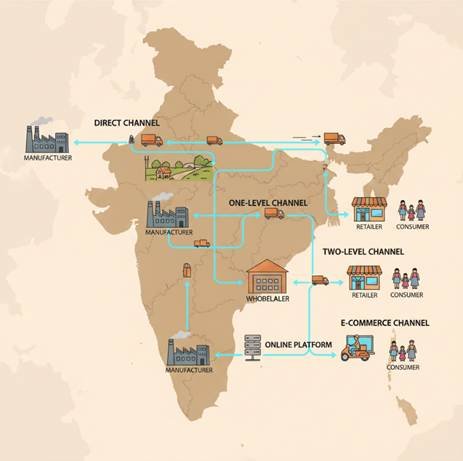
Marketing channels are the avenues through which products or services reach consumers. They can be direct (company to customer) or indirect (using distributors, retailers, agents). In India, due to its vast geography and diversity, channel choice is a key competitive differentiator.


Types of Marketing Channels in India

  1. Direct-to-Consumer (D2C) / E-Commerce
    • Selling via a brand website, apps, or platforms like Amazon or Flipkart.
  2. Retail Channels
    • Modern trade: Supermarkets, hypermarkets (Big Bazaar, D-Mart).
    • Traditional trade: Kirana stores, local markets.
  3. Distribution Networks
    • Layers of distributors, stockists, wholesalers, and retailers—especially in rural areas.
  4. Hybrid Channels
    • Using a mix of online and offline, often seen in FMCG and apparel.

Indian Brand Example: Dabur India Ltd

  • Urban Markets: Dabur products are found in modern retail outlets (Reliance Fresh, Nature’s Basket), pharmacies, and via its own website and e-commerce platforms.
  • Rural Markets: Dabur has one of India’s largest rural distribution networks, reaching over 6 million outlets, using regional distributors and local vans.

Case Study: Big Bazaar (Future Group)

  • Strategy: Combined international-style supermarkets with Indian pricing, festival offers, and local product mix.
  • Channels: Sourced directly from farmers and manufacturers, centrally warehoused, and distributed to stores nationwide.
  • Outcome: Transformed Indian grocery shopping for middle-class families and created a new retail format until its acquisition and integration into Reliance Retail.

Case Study: boAt (D2C Electronics Brand)

  • Channel Focus: Initially sold exclusively through e-commerce platforms (Amazon, Flipkart), then expanded to its own website and select retail partnerships.
  • Result: Fast sales growth, direct customer engagement, and cost savings on intermediaries.

Channel Challenges & Innovations

  • Rural reach: Brands like Colgate and HUL use “last-mile” distribution and mobile vans.
  • Omnichannel: Titan’s Tanishq uses both exclusive stores and e-commerce, giving customers flexibility.
  • Digital Payments: The rise of UPI and mobile wallets has revolutionized how small-format retailers transact.

III. Markets in Which a Firm Operates

Definition & Types

A market is a group of potential buyers with needs/wants that a company’s offerings can satisfy. For Indian businesses, understanding market segmentation is essential due to the country’s diversity.

Types of Markets

  1. Consumer Markets: Selling directly to end-users (e.g., HUL, Amul).
  2. Business Markets: B2B sales (e.g., Tata Steel to automakers, L&T to infra companies).
  3. Government Markets: Supplying to government agencies (e.g., Bharat Electronics to Indian Army).
  4. International Markets: Exports/operations abroad (e.g., Infosys, Tata Motors).

Indian Brand Example: Tata Motors

  • Consumer Market: Sells cars like Tiago and Nexon to individual buyers.
  • Business Market: Sells buses and trucks to logistics firms and state transport.
  • International Market: Exports vehicles to Africa, Southeast Asia, and Europe.

Case Study: Zomato

  • Consumer Market: Food ordering app for end users.
  • Business Market: Logistics for restaurants, cloud kitchens.
  • International Market: Operated in UAE, Southeast Asia, and others before focusing back on India.
  • Government Market: Partnered with state agencies during COVID-19 relief.

Case Study: Infosys

  • B2B Market: Provides IT services to Fortune 500 companies globally.
  • Government Market: IT solutions for Indian government projects (e.g., GSTN, passport seva).
  • Consumer Market: Through its fintech arm, it offers banking solutions to end users.

Key Considerations for Indian Firms

  • Urban vs. Rural: Product size, pricing, and communication change drastically.
  • Tiered Cities: Brands often launch in metros before expanding to Tier 2/3 cities.
  • Regulatory Requirements: Entering government markets requires compliance and certifications.

IV. Competitors

Definition & Types

Competitors are firms vying for the same customer base, either with similar products (direct) or substitutable products/services (indirect).

Types of Competition

  1. Direct: Same products (e.g., Pepsi vs. Coca-Cola).
  2. Indirect: Different products serving the same need (e.g., Domino’s Pizza vs. Swiggy for quick meals).
  3. Potential Entrants: New startups, international brands entering the market.

Indian Brand Example: Ola vs. Uber

  • Ola: Indian ride-hailing app, localized features (auto-rickshaw bookings, regional language support).
  • Uber: US-based, expanded in India with aggressive pricing and partnerships.
  • Competition: Led to innovation in payments (Ola Money, Uber’s integration with Paytm), safety features, and new services (Ola Electric, Uber Eats before acquisition).

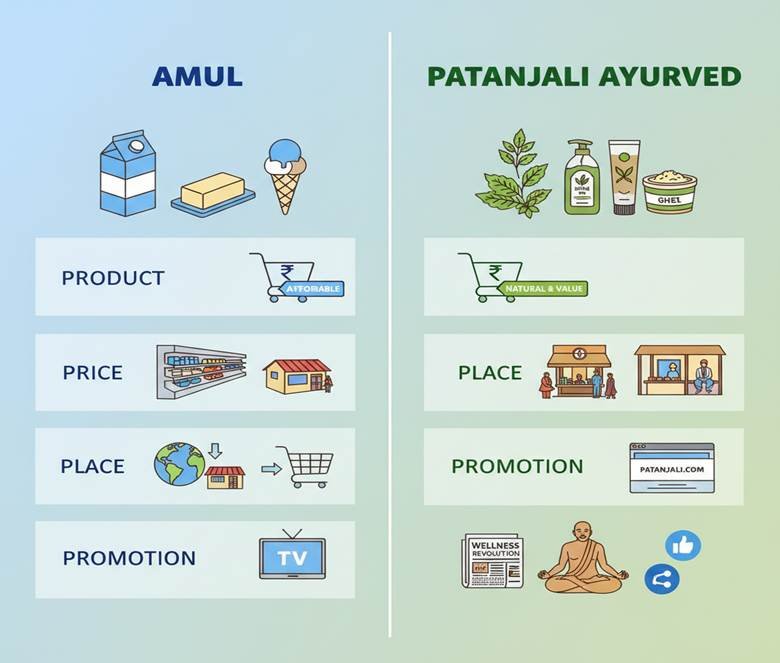
Case Study: Patanjali Ayurved’s Disruption

  • Background: Entered the FMCG market with herbal and Ayurvedic products.
  • Strategy: Swadeshi positioning, rapid product launches, and cost leadership.
  • Impact: Captured market share in toothpaste, ghee, and health drinks, challenging established giants like HUL and Dabur.
  • Outcome: Forced incumbents to launch “natural” product lines and rethink pricing.

Case Study: Jio vs. Airtel/Vodafone

  • Jio’s Entry: Free data, low prices, extensive 4G rollout.
  • Competitor Response: Airtel and Vodafone had to cut prices and invest in network upgrades.
  • Market Impact: Industry consolidation, innovation in digital services, and a massive jump in India’s internet subscriber base.

Competitive Strategies in India

  • Local Adaptation: McDonald’s “Maharaja Mac” and “McAloo Tikki” for Indian tastes.
  • Pricing Wars: Aggressive discounts in e-commerce (Amazon vs. Flipkart).
  • Innovation: Zomato’s hyperlocal delivery and Swiggy’s Instamart for groceries.

V. Stakeholders

Definition & Types

Stakeholders are any individuals, groups, or organizations that affect or are affected by a firm’s activities.

Types of Stakeholders

  1. Internal: Employees, management, owners.
  2. External: Customers, suppliers, distributors, government, NGOs, investors, community.

Indian Brand Example: Infosys

  • Employees: Learning and development programs, ESOPs.
  • Investors: Transparent communication, regular dividends.
  • Clients: Focus on quality and innovation.
  • Government: Compliance, tax payments, CSR initiatives.

Case Study: Nestlé India and the Maggi Crisis

  • Crisis: Maggi noodles banned for alleged excess lead content in 2015.
  • Stakeholder Response:
    • Consumers: Addressed safety concerns via transparent communication.
    • Retailers: Managed product recalls efficiently.
    • Government: Cooperated with regulatory authorities.
    • Media/Public: Regular updates and a campaign for relaunch.
  • Outcome: After months of testing and assurance, Maggi returned to shelves and recaptured market share, demonstrating strong stakeholder management.

Case Study: Tata Group’s COVID-19 Response

  • Stakeholders Engaged: Employees (job security), customers (essential services), government (healthcare donations), and community (free meals, PPE supply).
  • Result: Enhanced trust and reputation across stakeholder groups.

VI. Integration: How the Microenvironment Shapes Indian Business Success

Amul—A Microenvironment Success Story

  • Management: Cooperative, decentralized, yet coordinated.
  • Channels: Massive distribution—urban supermarkets to rural kiranas.
  • Markets: Dairy, beverages, ice cream, global exports.
  • Competitors: Regional brands, private players, multinationals.
  • Stakeholders: 3.6 million milk producers, employees, suppliers, and consumers.

Impact:
Amul’s ability to align all elements of its microenvironment has helped it become India’s most trusted food brand, resilient to competition and economic changes.


Strategic Takeaways for Indian Companies

  1. Structure for Scale and Agility: Choose a management system that matches your growth ambitions and market realities.
  2. Channel Innovation: Leverage both traditional and digital channels to maximize reach.
  3. Market Focus: Customize products and marketing for different segments (urban/rural, B2B/B2C).
  4. Competitive Edge: Monitor and react to competitor moves rapidly.
  5. Stakeholder Engagement: Build lasting relationships with all key groups, especially during crises.

Conclusion

The microenvironment—comprising management structure, marketing channels, markets, competitors, and stakeholders—forms the “engine room” of every successful Indian business.
By studying the journeys of Amul, Reliance, Ola, Nestlé, Dabur, Tata Motors, and more, we see that Indian brands thrive when they align their internal strengths and networks with the diverse needs and expectations of the Indian market.

In a fast-changing economy, the mastery of the microenvironment is what empowers Indian businesses to innovate, scale, and withstand external shocks—setting the stage for national and global leadership.

Business creation

  1. Sole proprietorship, partnership, LLP, and private limited company
  2. Pros and cons of each for media and film professionals
  3. Key legal terminology: entity, liability, director, shareholder, etc.
  4. Steps to register a media production company under MCA
  5. PAN, TAN, GST registration for film and media businesses
  6. ROC filing, MOA & AOA, annual compliances
  7. TDS, GST on production services and freelancer payments
  8. Government schemes, FFO incentives, and CSR fund usage in filmmaking

Business Creation for Media and Film Professionals in India

I. BUSINESS STRUCTURES IN INDIA

1. Sole Proprietorship

Definition and Overview

A sole proprietorship is the simplest form of business in India, owned and managed by a single individual. There is no legal distinction between the owner and the business entity; the owner receives all profits and is personally responsible for all losses and liabilities.

Features

  • Single ownership and control
  • Easy formation and closure
  • Minimal compliance and regulatory requirements
  • Business income is treated as the owner’s personal income
  • The business does not have a separate legal identity

Indian Example

Priya Malik, Freelance Film Editor (Mumbai):

Priya started her editing business under her own name. She registered for a Shop & Establishment License with the local municipal office, opened a current account in her name, and used her PAN for taxation. She billed small production houses and independent filmmakers directly.

Pros

  • Ease of formation: No formal registration required (aside from local licenses)
  • Complete control: Owner makes all decisions
  • Direct taxation: Profits are taxed as personal income, possibly at lower rates for small amounts
  • Minimal compliance: No requirement for annual ROC returns, board meetings, etc.
  • Full retention of profits

Cons

  • Unlimited liability: Owner’s personal assets are at risk for business debts and lawsuits
  • No perpetual succession: Business ceases upon owner’s death or incapacity
  • Limited fundraising: Cannot issue equity; banks may hesitate to lend
  • Credibility issues: Larger clients and corporations may hesitate to contract with sole proprietors

Indian Case Study

SoundScape Studios (Bangalore):

Rahul, an independent sound designer, started as a sole proprietor, working on ad jingles and short films. When he tried to expand into feature film post-production, he struggled to secure larger contracts: producers wanted GST invoices and proof of liability insurance, but as a sole proprietor, he couldn’t offer these easily. He eventually had to convert his business into an LLP to grow further.

2. Partnership

Definition and Overview

A partnership firm involves two or more people who co-own the business, share profits/losses, and jointly manage operations. Partnerships in India are governed by the Indian Partnership Act, 1932.

Features

  • Minimum two partners, maximum twenty
  • Partnership deed governs terms (profit-sharing, management, dissolution)
  • Registration is optional but recommended for legal standing
  • Partners share unlimited liability (joint and several)

Indian Example

Cinematic Creations (Delhi):

Two film graduates, Neha and Aakash, started a content production house together. They created a partnership deed outlining each partner’s investment, profit share, and roles. They registered the partnership to secure government contracts.

Pros

  • Shared resources and skills: Partners bring different expertise (e.g., one is a director, the other a producer)
  • Simple and low-cost formation: Only a partnership deed required (registration optional)
  • Taxation as a firm: Income taxed at firm rates, with profits distributed to partners
  • Flexible management: Decision-making shared among partners

Cons

  • Unlimited liability: Each partner’s personal assets are at risk for firm’s debts
  • Personal disputes: Differences can disrupt business continuity
  • No separate legal identity: Firm can’t own property in its name unless registered
  • Dissolution risk: Firm dissolves if a partner dies or withdraws (unless deed provides otherwise)
  • Limited external funding: Difficult to attract institutional or VC investment

Indian Case Study

Green Mango Films (Mumbai):

Started by two friends as a partnership to produce wedding films and ad shoots. Initially, both invested equally and split profits. As business grew, one partner wanted to invest in new camera gear while the other preferred to save. Disputes arose, leading to split and eventual dissolution. The experience highlighted the importance of a detailed, registered partnership deed clarifying exit and dispute resolution processes.

3. Limited Liability Partnership (LLP)

Definition and Overview

An LLP is a relatively new business structure in India (since 2008) that combines the flexibility of a partnership with the liability protection of a company. It is especially popular among creative professionals and service businesses.

Features

  • Separate legal entity: LLP can own property, sue/be sued in its own name
  • Limited liability: Partners’ liability is limited to agreed contribution
  • Minimum two “Designated Partners” (at least one Indian resident)
  • LLP Agreement: Governs profit sharing, management, partner roles, etc.
  • Perpetual succession: LLP continues even if partners change

Indian Example

Pocket Films LLP (Mumbai):

Formed by three digital content creators, Pocket Films LLP distributes short films and web series to digital platforms. The LLP structure allowed them to scale, bring in new partners, and limit personal risk.

Pros

  • Limited liability: Personal assets of partners protected
  • Separate legal entity: LLP can own assets, enter contracts, and sue/be sued
  • Flexible management: No minimum capital; profit-sharing as agreed in LLP Agreement
  • Lower compliance burden than companies
  • Perpetual succession: LLP continues despite partner changes

Cons

  • Moderate compliance: Annual statement of accounts and solvency must be filed with the Registrar
  • No option to issue shares: Cannot attract equity investment like a company
  • Public disclosure: Financials and partner details become public
  • Transferability limitations: Bringing in new partners or transferring ownership involves amending LLP Agreement

Indian Case Study

Indie Creators LLP (Kolkata):

A group of four media professionals (director, scriptwriter, DOP, and sound engineer) formed an LLP to produce a web series. When the director exited for a new project, the LLP structure made it easy to bring in a new partner and continue operations, with the departing partner’s liability ceasing from the date of exit. This flexibility and risk protection gave the team confidence to take on bigger projects.

4. Private Limited Company

Definition and Overview

A private limited company is the most formal and scalable business structure for film and media professionals in India, especially for those seeking to raise funds, secure large contracts, or build a production house with enduring legacy.

Features

  • Separate legal entity: Company can own assets and intellectual property
  • Limited liability: Shareholders’ liability is limited to unpaid share capital
  • Minimum two shareholders and two directors (can be the same people)
  • Shares not freely transferable: Must be approved by the board
  • Perpetual succession: Company continues regardless of changes in ownership

Indian Example

Red Chillies Entertainment Pvt Ltd (Mumbai):

Founded by Shah Rukh Khan and Gauri Khan, this company produces films, manages VFX, and handles distribution. Its structure enables it to raise funds, own IP, and enter into major contracts with studios and OTT platforms.

Pros

  • Limited liability: Shareholder risk limited to invested capital
  • Perpetual succession: Company exists beyond the founders
  • Access to funding: Can issue shares to raise equity; eligible for bank loans and VC investment
  • Credibility: Preferred by large clients, broadcasters, and international partners
  • Ownership of IP: Company holds copyright and trademarks

Cons

  • Complex and costly setup: Requires professional assistance, government fees, and more documents
  • High compliance: Annual ROC filings, statutory audits, board meetings, etc.
  • Ownership transfer restrictions: Shares can’t be freely sold without board approval
  • Public disclosure: Financial statements and director details are public

Indian Case Study

Phantom Films Pvt Ltd (Mumbai):

Founded by filmmakers Anurag Kashyap, Vikramaditya Motwane, and others, Phantom Films operated as a private limited company. This structure made it possible to bring in external investors, hold copyrights in the company’s name, and facilitate international co-productions. When the founders decided to part ways, the clear shareholding structure enabled a formal split of assets and liabilities, underscoring the value of a private limited company for large, collaborative media ventures.

II. PROS AND CONS FOR MEDIA AND FILM PROFESSIONALS—A COMPARATIVE PERSPECTIVE

When to Choose Each Structure

Sole Proprietorship

  • Best for: Freelancers, individual artists, or small-scale operators (editors, solo filmmakers, designers)
  • Avoid if: Planning to scale, hire staff, or raise external funds

Partnership

  • Best for: Small creative teams with mutual trust, e.g., two or three collaborators pooling resources or networks
  • Avoid if: Concerned about liability or want to bring in external investors

LLP

  • Best for: Professional teams (writers, directors, technicians) who want to limit risk, formalize profit sharing, and potentially expand (but don’t need to issue shares)
  • Avoid if: Raising VC/angel funding is a top priority

Private Limited Company

  • Best for: Ambitious production houses, agencies, or studios seeking credibility, funding, and long-term continuity
  • Avoid if: You want minimal compliance and are starting with small projects

Comparative Table

FeatureSole ProprietorshipPartnershipLLPPrivate Limited Company
Legal StatusNot separateNot separateSeparate entitySeparate entity
LiabilityUnlimitedUnlimitedLimitedLimited
No. of Members12–202+2–200
Perpetual SuccessionNoNoYesYes
ComplianceLowLowMediumHigh
FundraisingDifficultDifficultModerateEasy
Suitable forFreelancersSmall teamsSME collaborationsScalable businesses

Real-World Scenario: Evolving Your Business Structure

Case Study: Studio X Films (Delhi)

Three friends started as a partnership to produce indie documentaries. When they secured a web series deal, they realized the risks (liability, disputes) and converted to an LLP for better protection and professional image. As their business grew—attracting angel investors and needing to own IP—they transitioned to a private limited company. This journey illustrates how creative businesses often evolve structures as they scale up.

Key Lessons for Media and Film Professionals

  1. Start simple, but think ahead: Many creative professionals begin as sole proprietors or partnerships. As the business matures, consider transitioning to LLP or private limited company for credibility, risk protection, and scalability.
  2. Always formalize agreements: Even among friends, draft clear partnership deeds or LLP Agreements to avoid future disputes.
  3. Understand liability: Unlimited liability structures put your personal assets at risk—critical in a field with high financial stakes, such as film production.
  4. Plan for growth: If you foresee raising funds or dealing with large clients, set up a private limited company from the outset—even if compliance is higher.
  5. Legal advice pays off: Consult a company secretary or legal professional, especially when drafting partnership deeds, LLP Agreements, or incorporating a company.

Conclusion

India’s film and media sector is dynamic, offering vast opportunities for creative professionals. Choosing the right business structure—whether sole proprietorship, partnership, LLP, or private limited company—has a profound impact on your risk, growth, and long-term success. Real-world examples and Indian case studies demonstrate that while many start simple, those who formalize their business with LLP or private limited company structures are better positioned for growth, funding, and sustainability.

Carefully evaluate your goals, resources, and risk appetite before deciding. As you scale, don’t hesitate to transition to a more robust structure to unlock new opportunities in India’s vibrant film and media landscape.

III. KEY LEGAL CONCEPTS AND BUSINESS REGISTRATION FOR INDIAN FILM AND MEDIA COMPANIES

Understanding legal terminology is essential before setting up a media or film business in India. Here are the most relevant terms with examples from the Indian film industry:

1. Entity

A legally recognized organization.

Types:

  • Sole proprietorship, partnership, LLP, private limited company.

Example:
Red Chillies Entertainment Pvt Ltd is a legal entity registered as a private limited company.

2. Liability

The legal responsibility for debts and obligations.

  • Limited Liability: Owners/shareholders’ risk is limited to their investment.
  • Unlimited Liability: Owners’ personal assets are at risk.

Example:
Phantom Films Pvt Ltd: The liability of each shareholder is limited to the unpaid amount on shares held.

Case Study:

A partnership firm like Green Mango Films exposes personal assets of its owners to business debts, unlike an LLP or private company.

3. Director

A person appointed to manage and oversee company affairs.

  • Minimum two for a private limited company.

Example:
Shah Rukh Khan is one of the directors of Red Chillies Entertainment Pvt Ltd.

4. Shareholder

A person or entity owning shares in a company.

  • Shareholders are the real owners; directors manage the company.

Example:
Gauri Khan is a significant shareholder in Red Chillies Entertainment Pvt Ltd.

5. Partner

A co-owner in a partnership or LLP, sharing profits, losses, and management.

Example:
Three filmmakers form Indie Creators LLP as equal partners to produce web content.

6. MOA (Memorandum of Association)

A company’s charter outlining its main objectives and scope.

Example:
Dharma Productions Pvt Ltd’s MOA specifies film production, distribution, and allied activities as its primary business objects.

7. AOA (Articles of Association)

Rules for the company’s internal management (board meetings, share transfer, etc.).

Case Study:

When Phantom Films dissolved, the AOA outlined the process for asset division and director exit.

8. ROC (Registrar of Companies)

A government authority under the Ministry of Corporate Affairs (MCA) that registers and regulates companies and LLPs.

Example:
Excel Entertainment Pvt Ltd files annual returns and financial statements with the ROC.

9. PAN (Permanent Account Number)

A unique 10-digit tax identifier for all entities and individuals.

Example:
Every film production company, like Yash Raj Films, needs a separate PAN for tax compliance.

10. TAN (Tax Deduction and Collection Account Number)

Needed by businesses to deduct TDS (Tax Deducted at Source) from payments to actors, crew, or freelancers.

Example:
Balaji Telefilms Ltd uses its TAN to deduct TDS on payments to scriptwriters.

11. GST (Goods and Services Tax)

An indirect tax levied on goods and services, including film production services.

Example:
Viacom18 Studios charges 18% GST on its production invoices.

12. DIN (Director Identification Number)

A unique number allotted to every company director.

Example:
All directors of Red Chillies Entertainment Pvt Ltd have a DIN, recorded in ROC filings.

13. Designated Partner

A partner in an LLP responsible for regulatory and legal compliance.

Example:
In Pocket Films LLP, one partner acts as the designated partner, handling ROC filings.

14. Perpetual Succession

The entity continues to exist even if owners change or pass away.

Example:
Yash Raj Films Pvt Ltd continues operations after Yash Chopra’s passing due to perpetual succession.

IV. STEPS TO REGISTER A MEDIA PRODUCTION COMPANY UNDER MCA

Registering a media/film company as a Private Limited or LLP under the Ministry of Corporate Affairs (MCA) involves several steps:

1. Choose the Right Structure

  • Decide between Private Limited (for scalability, funding) or LLP (for flexibility, limited liability).
  • Decide on directors/shareholders or partners.

Example:
Red Chillies Entertainment Pvt Ltd chose the private limited structure for scalability and credibility.

2. Obtain Digital Signature Certificates (DSC)

  • Needed for all directors/partners to file documents online.

Example:
Directors of Phantom Films Pvt Ltd obtained DSCs through Certifying Authorities.

3. Apply for Director Identification Number (DIN)

  • Required for all proposed directors.

Case Study:

When Dharma Productions added a new director, they obtained a DIN for the appointee.

4. Name Reservation

  • Use the RUN (Reserve Unique Name) service on the MCA portal to propose and reserve a unique company name.

Example:
CineSpark Productions Pvt Ltd reserved its name through RUN before incorporation.

5. Draft MOA and AOA (For Companies) or LLP Agreement (For LLPs)

  • MOA specifies business objectives (e.g., film production, distribution).
  • AOA or LLP Agreement details internal rules, roles, and profit sharing.

Case Study:

Pocket Films LLP drafted an LLP Agreement specifying how partners share profits and manage creative rights.

6. File Incorporation Documents

For Private Limited:

  • Use SPICe+ integrated form (INC-32, e-MOA, e-AOA) on MCA portal.
  • Attach address proof, identity proof, consent, etc.

For LLP:

  • File FiLLiP form and submit the LLP Agreement within 30 days.

Example:
Excel Entertainment Pvt Ltd filed all required documents online for quick incorporation.

7. Pay Government Fees

  • Fees depend on authorized capital (company) or contribution (LLP).

8. ROC Verification and Certificate of Incorporation

  • ROC reviews documents and issues a Certificate of Incorporation with a unique CIN (Corporate Identification Number) or LLPIN (LLP Identification Number).

Example:
Red Chillies Entertainment Pvt Ltd received its CIN from ROC Mumbai.

9. Apply for PAN & TAN

  • PAN and TAN applications are integrated with SPICe+ form.

10. Open a Bank Account

  • Use the incorporation certificate, PAN, and board resolution.

11. GST Registration (If Required)

  • Mandatory if turnover exceeds ₹20 lakh (₹10 lakh in special states) or for interstate supply.

Case Study:

Dharma Productions Pvt Ltd registered for GST due to high turnover and pan-India operations.12. Post-Incorporation Compliances

  • Hold first board meeting within 30 days.
  • Appoint auditor.
  • Issue share certificates (companies).
  • File annual returns, maintain statutory registers, etc.

V. PAN, TAN, GST REGISTRATION FOR FILM AND MEDIA BUSINESSES

1. PAN (Permanent Account Number)

  • Mandatory for all business entities for income tax compliance.
  • Needed for bank accounts, contracts, and all financial transactions.

Example:
Yash Raj Films Pvt Ltd uses a unique PAN for all tax returns and business contracts.

2. TAN (Tax Deduction and Collection Account Number)

  • Mandatory for entities making payments that require TDS deduction (actors, technicians, freelancers, vendors).
  • File TDS returns quarterly.

Case Study:

Balaji Telefilms Ltd deducts TDS while paying actors and files Form 26Q using its TAN.

3. GST (Goods and Services Tax) Registration

  • Required if turnover crosses ₹20 lakh (₹10 lakh in special states) or for interstate business.
  • GST @18% applies to most media/film production services.
  • GST registration done online at gst.gov.in or during company incorporation (SPICe+).

Example:
Viacom18 Studios charges GST on invoices for production services and claims input tax credit on equipment purchases.

4. Case Study: End-to-End Registration for a Film Company

CineSpark Productions Pvt Ltd (Mumbai)

  • Step 1: Chose Private Limited structure for better funding opportunities.
  • Step 2: Obtained DSCs and DINs for directors.
  • Step 3: Reserved company name via RUN.
  • Step 4: Drafted MOA (objectives: film production, distribution, OTT content), AOA (internal rules).
  • Step 5: Filed SPICe+ (INC-32), e-MOA, and e-AOA with the ROC.
  • Step 6: Paid registration fees and received Certificate of Incorporation (CIN).
  • Step 7: Applied for PAN and TAN via SPICe+.
  • Step 8: Opened a current account at HDFC Bank.
  • Step 9: Registered for GST due to expected high turnover.
  • Step 10: Hired a CA to manage TDS compliance, GST returns, and annual ROC filings.

Conclusion

Grasping key legal terms and properly registering your media/film business (with PAN, TAN, GST) is vital for credibility, compliance, and sustainable growth in India’s film industry.
Real-world examples (like Red Chillies Entertainment, Pocket Films LLP, and Balaji Telefilms) show that success in media begins with a strong legal and regulatory foundation.

Advanced Compliance and Incentives for Indian Film Production Companies

VI. ROC FILING, MOA & AOA, AND ANNUAL COMPLIANCES

1. MOA (Memorandum of Association): The Company’s Charter

What is MOA?

  • MOA is the foundational document of a company, defining its constitutional framework.
  • It sets out the main and ancillary objects for which the company is formed, the state of registration, liability of members, share capital, etc.

Key Clauses:

  • Name Clause: Legal name of the company (e.g., “CineSpark Productions Pvt Ltd”)
  • Registered Office Clause: Address of the company
  • Object Clause: Main business activities (e.g., “to produce, distribute, and exploit feature films, TV serials, web series, and digital content”)
  • Liability Clause: Whether liability is limited or unlimited
  • Capital Clause: Authorized share capital

Indian Example:

Dharma Productions Pvt Ltd’s MOA includes main objects such as film production, distribution, and allied activities, which enables the company to expand into music, television, merchandising, and OTT content.

2. AOA (Articles of Association): The Rulebook

What is AOA?

  • The Articles of Association are the internal rules governing the management of the company.
  • Covers director’s powers, voting rights, share transfers, board meetings, dividend policies, etc.

Example Clauses:

  • Minimum quorum required for a board meeting
  • Procedures for appointing or removing directors
  • Rules for issuing new shares or transferring existing ones

Case Study:

Phantom Films Pvt Ltd had detailed AOA provisions on how to handle founder exits and the distribution of intellectual property. When the company was dissolved, the AOA guided the legal split and asset allocation.

3. ROC Filing: Annual and Event-Based Compliances

What is ROC?

  • Registrar of Companies (ROC) is the government body under the Ministry of Corporate Affairs (MCA) that regulates company compliance.

Annual Compliance Checklist:

  1. Board Meetings: At least two per year (four for public companies). First board meeting within 30 days of incorporation.
  2. Annual General Meeting (AGM): Within six months after the close of the financial year.
  3. Annual Return (Form MGT-7): Contains details of directors, shareholders, and changes during the year.
  4. Financial Statements (Form AOC-4): Audited balance sheet, profit & loss statement, and auditor’s report.
  5. Director KYC: Annual Know Your Customer update for all directors (DIR-3 KYC).
  6. Appointment of Auditors: Within 30 days of incorporation.
  7. Statutory Registers: Maintain registers for members, directors, contracts, loans, etc.
  8. Event-Based Filings: Changes in directors, share capital, registered office, etc., must be reported promptly.

Penalties for Non-Compliance:

  • Heavy penalties for late filing or non-compliance (ranging from ₹100/day to several lakh rupees).
  • Directors can be disqualified or held personally liable in cases of persistent non-compliance.

Indian Example:

Red Chillies Entertainment Pvt Ltd maintains rigorous annual compliance, with a dedicated legal team ensuring timely board meetings, ROC filings, and statutory register maintenance. This is crucial for retaining investor trust and eligibility for co-productions.

Case Study:

Balaji Telefilms Ltd failed to file one of its MCA annual returns on time in 2019, resulting in a penalty and a temporary freeze on certain corporate actions. This demonstrated to the industry the importance of timely ROC filings for uninterrupted business operations.

VII. TDS, GST ON PRODUCTION SERVICES AND FREELANCER PAYMENTS

1. TDS (Tax Deducted at Source): How it Works in the Film Industry

TDS Applicability

  • Section 194J: TDS @ 10% on professional services (directors, actors, scriptwriters, composers, editors, etc.)
  • Section 194C: TDS @ 2% (individuals/HUF) or 1% (others) on contract payments (e.g., set construction, catering, technical crew)

Thresholds:

  • TDS deduction required if single transaction payment exceeds ₹30,000 or aggregate exceeds ₹1 lakh in a financial year.

Workflow Example:

Viacom18 Studios hires a scriptwriter for ₹2 lakh. Payment is made after deducting ₹20,000 (10% TDS under 194J). The TDS is deposited to the government, and the scriptwriter receives a Form 16A as proof for tax credit.

TDS Returns and Compliance:

  • Quarterly TDS returns must be filed (Form 26Q).
  • Delay in deposit attracts interest, and late returns draw penalties.

Indian Example:

Excel Entertainment Pvt Ltd deducts TDS from all freelancer payments (directors, editors, VFX artists) and provides TDS certificates for tax filing.

Case Study:

In 2020, a major Mumbai-based production house faced a tax demand after failing to deduct TDS from payments to a celebrity choreographer. The company had to pay back taxes, interest, and a penalty, highlighting the critical nature of TDS compliance in the industry.

2. GST (Goods and Services Tax): Application in Film and Media

Applicability

  • GST @ 18% is applicable on most film and media production services.
  • Threshold: Registration mandatory if annual revenue exceeds ₹20 lakh (₹10 lakh in special category states) or if making interstate supply.

Key GST Concepts:

  • Input Tax Credit (ITC): Production houses can claim ITC on GST paid for equipment, set materials, or professional services.
  • Output GST: Charged to clients/TV channels/OTT platforms on the sale of production services or rights.
  • Reverse Charge Mechanism: In some cases, GST liability shifts to the recipient.

Practical Example:

Dharma Productions Pvt Ltd charges 18% GST on invoices raised to Netflix India for a web series. The company also claims ITC on GST paid for camera rentals and post-production software.

GST Returns:

  • Monthly/quarterly filing of GSTR-1 (outward supplies) and GSTR-3B (summary return).
  • Annual return (GSTR-9) mandatory if registered under GST.

Indian Example:

Pocket Films LLP produces digital content, bills YouTube and other OTT platforms with GST, and claims input credits on all eligible production expenses.

Case Study:

A Chennai-based animation studio lost significant input credits due to late GST filing and non-reconciliation of invoices submitted by vendors. This affected their cash flows and profitability, underlining the importance of timely, accurate GST compliance.

3. Freelancers and TDS/GST

TDS for Freelancers:

  • Freelancers earning above the threshold must have a PAN and provide it to clients.
  • Clients deduct TDS before making payments.

GST for Freelancers:

  • Freelancers with turnover above ₹20 lakh must register for GST and raise GST-compliant invoices.
  • They can claim ITC on business-related expenses.

Example:

A freelance editor working for Red Chillies Entertainment Pvt Ltd submits an invoice for ₹1,20,000 plus 18% GST. The company deducts TDS on the fee portion and pays GST separately.

Case Study:

A Delhi-based freelance cinematographer lost a lucrative assignment with a broadcaster because he lacked a GST registration, which was mandatory for the broadcaster’s vendor policy. He later registered for GST, which opened up new opportunities.

VIII. GOVERNMENT SCHEMES, FFO INCENTIVES, AND CSR FUND USAGE IN FILMMAKING

1. Film Facilitation Office (FFO) Incentives

What is FFO?

  • The Film Facilitation Office (FFO) under NFDC (National Film Development Corporation) is a government initiative to promote film shooting in India by streamlining permissions and offering financial incentives.

Key FFO Functions:

  • Single-window clearance for shooting permissions across central and state government agencies.
  • Assistance with customs, visas, and location scouting.
  • Financial incentives and rebates for both Indian and international productions.

Example:

“The Amazing Race” (US TV show) filmed multiple episodes in Rajasthan, India, utilizing FFO’s single-window system for quick permissions and logistical support.

Case Study:

A UK-based production, “Indian Summers,” received FFO support for location scouting, import of equipment, and expedited clearances for a period drama filmed in Shimla.

2. State-Level Incentives for Film Production

Key Features:

  • Many Indian states (Maharashtra, UP, MP, Gujarat, Rajasthan) offer:
    • Subsidies for local language and regional films
    • Cash rebates for spending in the state
    • Reduced fees for government location usage
    • Assistance with police/security, visas, crowd management

Example:

“Sairat” (Marathi film) received a production subsidy from the Maharashtra government for promoting local culture and language films.

Case Study:

The film “Pad Man” (starring Akshay Kumar) was partly shot in Madhya Pradesh, which provided location subsidies and logistical support to attract filming to the state.

3. Central Government Schemes and Funding

NFDC Schemes:

  • NFDC provides funding, co-production support, and marketing for Indian independent films.
  • Organizes Film Bazaar for networking, financing, and distribution opportunities.

Example:

“Court” (Marathi film) received NFDC support for development, which helped the film gain international distribution and awards.

4. CSR Fund Usage in Filmmaking

Legal Framework:

  • Section 135, Companies Act, 2013: Companies with a net worth of ₹500 crore+, turnover of ₹1,000 crore+, or net profit of ₹5 crore+ must spend 2% of profits on CSR.
  • Eligible CSR activities: Promotion of art, culture, and heritage, including film production with social messages.

How to Access CSR Funds for Filmmaking:

  • Nonprofits or production companies can approach corporates for CSR funding for documentaries or films with a social purpose (e.g., education, health, gender equality).
  • Must ensure the film aligns with Schedule VII of Companies Act (CSR policy).

Example:

A film on environmental awareness for rural India was fully funded by the CSR budget of a major FMCG company.

Case Study:

Tata Trusts funded and distributed short films on child health and education, using their CSR allocation. These films were later used for community outreach and advocacy.

5. Additional Support: Single Window Clearance, Co-Production Treaties, and Film Markets

Single-Window Clearance:

  • Many states and FFO provide a digital portal for all filming permissions, reducing red tape.

Co-Production Treaties:

  • India has bilateral co-production treaties with over 15 countries, allowing joint film projects to access grants and incentives from both nations.

Film Bazaars and Markets:

  • Platforms like NFDC Film Bazaar provide a forum for Indian filmmakers to pitch projects to investors, distributors, and government agencies.

Example:

“The Lunchbox” (India-France-Germany co-production) utilized Indo-European treaties for funding, distribution, and festival support.

6. Checklist: Leveraging Incentives and Compliance for Film Projects

  1. Register company as Private Limited or LLP with clear MOA/AOA (film production as main object)
  2. Maintain annual ROC compliance to stay eligible for state and central schemes
  3. Register for GST and TDS, and ensure freelancers’ compliance
  4. Approach FFO and state governments for location subsidies and single-window permissions
  5. Apply to NFDC and state film funds for production grants
  6. Align social film projects with CSR guidelines and pitch to eligible corporates

Conclusion

Success in Indian filmmaking today depends as much on regulatory compliance and funding strategy as on creativity. Leading studios like Red Chillies Entertainment, Dharma Productions, and even regional players like the producers of “Sairat” have all benefited from understanding and leveraging ROC compliance, GST regimes, TDS rules, and government/CSR funding mechanisms.

By building robust legal and financial systems, film professionals can unlock new funding streams, access global markets, and thrive in India’s competitive cinema landscape.

What is Self-Awareness?

Self-awareness is the ability to consciously recognize your emotions, thoughts, strengths, weaknesses, values, and motivations. It involves understanding how your behavior affects others and how external events influence your internal state. Self-aware individuals can more easily regulate their emotions, adapt to different situations, and make choices aligned with their values.

Example:
A college student notices they feel anxious before public speaking. By being self-aware, they recognize this pattern and can take steps—like practicing or breathing exercises—to manage their anxiety and improve performance.


What is Reflective Thinking?

Reflective thinking is the process of looking back at experiences, analyzing what happened, and considering why things occurred as they did. It involves questioning assumptions, identifying lessons learned, and planning how to apply those lessons in the future. Reflective thinking turns everyday experiences into opportunities for self-improvement and personal growth.

Example:
After completing a group assignment, a student reflects on the process. They realize that while they contributed ideas, they struggled to listen to others. By recognizing their shortcomings, they plan to develop better listening skills for future collaborations.


The Link between Self-Awareness and Reflective Thinking

Self-awareness and reflective thinking are closely connected. Self-awareness allows individuals to notice their feelings, biases, and behaviors in the moment, while reflective thinking enables them to analyze those experiences later and learn from them. Together, these skills foster emotional intelligence, adaptability, and lifelong learning.


Why Are These Skills Important?

  • Personal Growth: They help individuals recognize and build on their strengths while addressing weaknesses.
  • Better Decision-Making: Awareness of one’s motives and reflection on past outcomes lead to more thoughtful choices.
  • Healthy Relationships: Understanding oneself makes it easier to empathize with others and manage conflicts.
  • Professional Success: Reflective practitioners adapt, innovate, and continuously improve at work.

Case Study: Self-Awareness and Reflection in Leadership

Priya, a young manager in a Mumbai tech company, noticed her team was missing deadlines. Through self-awareness, she recognized that her communication style often came across as rushed and unclear. After each team meeting, she took time to reflect on her approach, asking herself what worked and what didn’t. Over time, Priya adopted a more open, supportive style—inviting feedback, clarifying expectations, and encouraging questions. As a result, her team became more engaged and efficient, and project delivery improved significantly.


How to Develop Self-Awareness and Reflective Thinking

  • Keep a Journal: Write regularly about your thoughts, feelings, and experiences.
  • Ask for Feedback: Seek honest input from peers, mentors, or supervisors.
  • Set Aside Reflection Time: After completing tasks or facing challenges, pause to consider what happened and why.
  • Practice Mindfulness: Meditation and mindfulness exercises can increase awareness of thoughts and emotions in the moment.

Conclusion:
Self-awareness and reflective thinking are vital skills for personal and professional fulfillment. By understanding oneself and learning from experience, individuals can grow, adapt, and lead more meaningful lives.
In the age of complex information and fast-paced change, the skills of critical thinking and reflective practice are indispensable for success—whether in academics, work, or personal decision-making. These skills empower individuals to analyze, adapt, and continuously improve themselves and their communities.


What is critical thinking?

Critical thinking is the process of objectively analyzing information, evaluating evidence, questioning assumptions, and drawing reasoned conclusions. It goes beyond memorizing facts or accepting information at face value. Instead, it involves a careful examination of arguments, recognition of biases, and the willingness to consider alternative viewpoints.

Key Components:

  • Analysis: Breaking down information into parts.
  • Evaluation: Judging the credibility and relevance of sources.
  • Inference: Drawing logical conclusions from data.
  • Explanation: Justifying one’s reasoning.
  • Self-Regulation: Assessing and correcting one’s own thinking.

Example:
A student is researching the effects of social media on youth. Instead of citing only popular news stories, she seeks out academic studies, compares different findings, questions whether the research is biased, and notes limitations before forming her own balanced conclusion.


What are Reflective Practices?

Reflective practice is the deliberate process of thinking about one’s actions, experiences, and decisions to learn and grow. It involves both looking back on what happened and planning future improvements.

Key Elements:

  • Self-awareness: Recognizing one’s feelings, biases, and strengths.
  • Critical Analysis: Examining what went well or poorly and why.
  • Learning Orientation: Willingness to change based on feedback or new insights.
  • Action Planning: Using lessons learned to improve future behavior.

Example:
After leading her first student club meeting, a college student realizes she spoke too quickly and didn’t invite enough input from members. She reflects on this and decides to prepare an agenda and ask open questions at the next meeting to encourage participation.


Why Are These Skills Important?

  • Better Decisions: They help avoid rash judgments and base choices on evidence.
  • Effective Problem-Solving: Enable systematic approaches to complex issues.
  • Personal Growth: Reflection transforms experiences into opportunities for continuous improvement.
  • Ethical Awareness: Encourage consideration of the broader impact of actions.

Case Study: Critical Thinking and Reflection in Education—Improving School Lunches

Background:
At a government high school in Tamil Nadu, students frequently complained about the quality and nutritional value of their midday meals. Rather than simply protesting, the school’s student council decided to investigate the problem using critical thinking and reflective practice.

Critical Thinking in Action:

  • The council began by analyzing the issue: They surveyed classmates, gathered information about the lunch menu, and compared it to recommended nutritional guidelines.
  • They evaluated sources: Speaking with kitchen staff, teachers, and health professionals to understand constraints, such as budget or supply shortages.
  • They inferred that while the meals met basic calorie requirements, they lacked fresh vegetables and variety, leading to both health concerns and student dissatisfaction.

Reflective Practice in Action:

  • After presenting their findings to the school administration, the students reflected on their approach. They recognized that only focusing on complaints didn’t motivate change.
  • They decided to act differently: The council proposed a solution—starting a small school vegetable garden to supplement the lunch program.
  • Over the semester, they regularly reflected on progress, noting which crops grew best, how to involve more students, and how to approach teachers for support.

Result:
Within a few months, the school was able to add fresh vegetables to its lunches, improving both nutrition and student morale. The council’s critical thinking and reflective practice turned a common complaint into a collaborative, sustainable solution.


Developing Critical Thinking and Reflective Skills

  1. Ask Questions: Who, what, when, where, why, and how?
  2. Consider Alternatives: Don’t settle for the first idea or answer.
  3. Reflect Regularly: After any major experience, spend time considering what worked and what didn’t.
  4. Embrace Feedback: Accept guidance and constructive criticism from others.
  5. Adapt and Apply Learning: Use insights to change future behavior or strategies.

Conclusion

Critical thinking and reflective practices are key for navigating life’s challenges and opportunities. By questioning assumptions, evaluating evidence, and learning from experience, individuals become better problem-solvers, collaborators, and leaders—skills that are vital for personal fulfillment and for making a positive impact on society.

Introduction

The digital revolution has fundamentally reshaped the way we communicate, interact, and express ourselves. Today, billions of people around the globe engage on platforms like Facebook, Twitter, Instagram, and WhatsApp, blurring the boundaries between public and private life. While the digital era offers unprecedented opportunities for connection and knowledge-sharing, it also raises critical questions about values, ethics, and responsible use.

This essay explores the core values that should guide behavior in digital spaces, focusing on social media ethics, the concept of the digital footprint, and the implications of online behavior. Through real-life examples and case studies (with a strong emphasis on India), we analyze both the opportunities and challenges posed by our networked world.


1. The Importance of Values in the Digital Age

Values are the guiding principles or standards of behavior that help us distinguish right from wrong, desirable from undesirable. In the digital era, traditional values—such as honesty, respect, empathy, and responsibility—take on new meanings and significance.

Why Do Values Matter Online?

  • Anonymity and Scale: The internet’s anonymity can weaken social restraints, making it easier to act unethically.
  • Permanence: Digital actions can have lasting consequences, as data is often permanent.
  • Speed and Reach: Information (both true and false) can spread worldwide in seconds, amplifying both positive and negative impacts.
  • Diversity: The global nature of digital spaces brings together people with different cultures and value systems, requiring sensitivity and mutual respect.

2. Social Media Ethics

Social media ethics refer to the moral principles that guide behavior on platforms like Facebook, WhatsApp, Twitter, and Instagram. Ethical use of social media is vital for building trust, preventing harm, and fostering a respectful online environment.

A. Key Ethical Principles for Social Media Use

  1. Authenticity and Honesty:
    • Posting true, accurate information; avoiding fake news and misinformation.
  2. Respect and Empathy:
    • Engaging politely, avoiding harassment, trolling, or hate speech.
  3. Privacy and Consent:
    • Respecting others’ privacy; not sharing personal information or images without permission.
  4. Responsibility and Accountability:
    • Owning up to mistakes and correcting them; understanding the impact of one’s words and actions.
  5. Fairness and Non-discrimination:
    • Avoiding bias, promoting inclusivity, and respecting diversity.

B. Examples of Social Media Ethics in Practice

Example 1: Fact-Checking Before Sharing

A user receives a WhatsApp message claiming a new government scheme is giving free laptops. Before forwarding, they check the official website and find it’s a hoax. By not spreading the message, they practice honesty and responsibility.

Example 2: Respecting Privacy in Group Photos

At a college event, a student asks everyone’s permission before posting group photos on Instagram, respecting both privacy and consent.

C. Indian Case Study: The #MeToo Movement

In 2018, the #MeToo movement gained momentum in India, with women using social media to share personal experiences of harassment. This empowered many to speak up, but also highlighted ethical dilemmas—such as the need to verify allegations, avoid naming and shaming without evidence, and respect both survivors’ and accused individuals’ rights.

Analysis:

  • Positive Impact: Raised awareness, gave voice to the marginalized, and forced institutions to act.
  • Ethical Challenges: Balancing freedom of expression with fairness, avoiding trial by media, and ensuring privacy.

D. Indian Case Study: Social Media Misinformation and Mob Violence

Background:
India has witnessed several incidents where fake news on WhatsApp led to mob violence. For example, in 2018, rumors of child kidnapping circulated widely, resulting in lynchings in Maharashtra and other states.

Analysis:

  • Ethical Failure: Lack of fact-checking, spreading panic, and endangering innocent lives.
  • Response: WhatsApp limited message forwarding, added labels for forwarded messages, and partnered with fact-checking organizations.

3. Digital Footprint

digital footprint is the trail of data each person leaves online—through social media posts, website visits, online purchases, emails, and more. This footprint can be active (content intentionally shared) or passive (data collected without explicit consent).

A. Types of Digital Footprints

  • Active Footprint: Posts, comments, likes, tweets, blog entries, uploaded photos.
  • Passive Footprint: Browsing history, cookies, location data, app usage statistics.

B. Why Is Digital Footprint Important?

  • Permanence: Digital content can be difficult or impossible to erase.
  • Reputation: Employers, universities, and others may search digital footprints before making decisions.
  • Privacy Risks: Personal data can be misused for identity theft, targeted ads, or surveillance.

C. Examples of Digital Footprint Management

Example 1: College Admissions

Many universities, in India and abroad, check applicants’ social media profiles. Inappropriate posts or offensive content can lead to rejection.

Example 2: Job Recruitment

Indian IT companies often conduct background checks, including reviewing LinkedIn, Facebook, and Twitter profiles. A candidate found posting hate speech or confidential company information may lose job opportunities.

Example 3: Political Campaigns
Politicians across the globe, including in India, have lost public trust due to the exposure of past tweets or posts containing controversial views or misinformation.

D. Indian Case Study: Aarogya Setu App and Data Privacy

During the COVID-19 pandemic, the Indian government launched the Aarogya Setu app to aid in contact tracing. While widely adopted, there were concerns about:

  • Data collection and how long information would be stored.
  • Potential surveillance of citizens.
  • Transparency about data usage.

Analysis:
This highlighted the importance of privacy, informed consent, and the need for clear data protection policies in the digital era.


4. Online Behavior

Online behavior encompasses all actions taken in digital spaces, including what we post, how we interact, and the tone we use. It is shaped by individual values, social norms, platform rules, and sometimes, the belief that “it’s just the internet.”

A. Positive Online Behaviors

  • Constructive Participation: Sharing knowledge, supporting others, positive engagement.
  • Digital Citizenship: Reporting abuse, standing up against cyberbullying, respecting platform guidelines.
  • Critical Thinking: Evaluating information before accepting or sharing it.

B. Negative Online Behaviors

  • Cyberbullying: Harassment, threats, or shaming others online.
  • Trolling: Deliberately provoking or upsetting people for amusement.
  • Hate Speech and Misinformation: Spreading falsehoods or inciting hatred.

C. Examples and Indian Context

Example 1: Cyberbullying
A study by Microsoft found that Indian teenagers face high rates of cyberbullying. Victims report anxiety, depression, and reluctance to use digital platforms.

Example 2: Online Activism

The “Save Aarey Forest” movement in Mumbai used Twitter and Facebook to mobilize public opinion and protest tree felling for metro construction. This positive online behavior led to increased public awareness and policy reconsideration.

D. Indian Case Study: “Digital India” and E-Governance

Background:

The Government of India’s “Digital India” initiative promotes digital literacy and access. However, with increased online participation comes the need for responsible online behavior.

Example:

E-governance platforms like the UMANG app allow citizens to access government services, but some users have abused these by posting fake grievances or using abusive language toward officials.

Analysis:

To maximize the benefits of digital governance, citizens need to follow ethical conduct, provide accurate information, and interact respectfully.


5. Challenges to Upholding Values in the Digital Era

A. Anonymity and Lack of Accountability

Many platforms allow users to hide their real identities, reducing fear of consequences for unethical actions.

Example:
Fake social media accounts are often used to spread rumors or harass others, making it hard to hold perpetrators accountable.

B. Information Overload and Misinformation

The sheer volume of online content makes it difficult to distinguish truth from falsehood.

Example:
During the COVID-19 pandemic, social media was flooded with unverified remedies, leading to confusion and, in some cases, harm.

C. Cultural and Generational Gaps

Older generations may struggle to adapt to digital norms, while youth may not fully grasp the consequences of online actions.

Example:
Elders falling victim to phishing scams due to lack of digital literacy.

D. Commercialization and Surveillance

Data is a valuable commodity. Companies often push ethical boundaries to collect, analyze, and monetize user information. Governments may also engage in surveillance.

Example:
Controversies over Facebook and Cambridge Analytica, where user data was harvested for political campaigns without informed consent.


6. Building Ethical Digital Citizens: Solutions and Recommendations

A. Digital Literacy and Education

  • Incorporate digital ethics into school curricula:
    Teach students about privacy, cyberbullying, misinformation, and respectful online conduct.
  • Workshops and awareness campaigns:
    NGOs like Cyber Peace Foundation run digital literacy programs across Indian schools and colleges.

B. Stronger Regulations and Platform Accountability

  • Data protection laws:
    The Indian government has proposed a Personal Data Protection Bill to safeguard citizens’ data rights.
  • Platform moderation:
    Social media companies must invest in better monitoring and prompt removal of harmful content.

C. Parental Guidance and Community Support

  • Open family discussions:
    Parents should talk to children about online risks and values.
  • Community workshops:
    Local organizations can provide resources and support for digital well-being.

D. Role of Individual Responsibility

  • Think before you post:
    Remember the permanence and potential impact of online actions.
  • Practice empathy:
    Treat others online with the same respect as face-to-face.
  • Fact-check:
    Don’t share information unless you are sure it is accurate.

E. Encouraging Positive Online Movements

  • Promote social good:
    Use digital platforms for awareness campaigns, volunteerism, and positive social change.
    Example:
    The “Plasma Donor” movement during COVID-19 in India, where WhatsApp groups and Twitter hashtags connected patients with plasma donors.

7. Case Studies: Values in Action

Case Study 1: The Power and Peril of Viral Campaigns – “Jago Grahak Jago”

Background:
The Indian government’s “Jago Grahak Jago” campaign uses digital media to educate citizens about consumer rights. Viral videos, memes, and social media posts have empowered millions to demand fair treatment and avoid scams.

Impact:
Raised awareness and promoted values of honesty and fairness. However, at times, misinformation about consumer rights also spread under the same hashtag, illustrating the double-edged nature of digital virality.


Case Study 2: Social Media, Elections, and Democracy

Context:
During the 2019 Indian general elections, social media played a central role in campaigning, mobilizing voters, and spreading information.

Issues:

  • Positive: Enabled increased youth participation, transparency, and real-time engagement.
  • Negative: Fake news, hate speech, and deepfakes threatened the integrity of the electoral process.

Response:
Election Commission of India partnered with platforms to flag fake news. Civil society groups launched fact-checking initiatives.


Case Study 3: The Sulli Deals and Bulli Bai Controversies

Background:
In 2021-22, apps called “Sulli Deals” and “Bulli Bai” targeted Muslim women in India by “auctioning” their images online without consent, leading to outrage and investigations.

Ethical Violations:
Gross invasion of privacy, hate speech, misogyny, and cyber harassment.

Response:
Swift action by law enforcement, widespread condemnation from across society, and increased advocacy for improved laws and digital platform accountability.


Case Study 4: The #GoodVibesOnly Movement

Background:
Indian influencers and mental health advocates used the hashtag #GoodVibesOnly to promote positive online culture, encourage kindness, and support those struggling with mental health issues.

Impact:
Created online support networks, reduced stigma, and fostered empathy and solidarity.


8. Conclusion

The digital era demands a re-examination and reinforcement of core values—honesty, responsibility, respect, and empathy. Social media ethics, awareness of one’s digital footprint, and mindful online behavior are not just personal choices, but social necessities.

India, as one of the world’s largest digital societies, faces unique challenges: rapid internet penetration, linguistic diversity, and varying levels of digital literacy. Progress is being made through education, regulation, and grassroots movements, but the responsibility ultimately lies with each user.

By embracing ethical principles and fostering digital citizenship, we can transform the digital landscape into a force for good—an inclusive, respectful, and empowering space for all.

Introduction

Life skills are essential abilities that enable individuals to manage daily challenges, interact effectively with others, and lead productive, fulfilling lives. Recognizing their importance, the World Health Organization (WHO) has identified a set of core life skills that are crucial for holistic development. These skills fall into three primary categories: cognitive skills, emotional skills, and social skills. This classification provides a framework for educational programs, youth development initiatives, and policy-making worldwide.

In this discussion, we’ll explore each category in depth, provide illustrative Indian examples, and examine relevant case studies to show how these skills are developed, applied, and nurtured in various contexts.


1. Cognitive Skills

Definition

Cognitive skills are mental capabilities that enable individuals to process information, think critically, make decisions, and solve problems. These are the skills that help us analyze situations and respond appropriately using logic and reasoning.

WHO Core Cognitive Life Skills

  • Problem-Solving
  • Decision-Making
  • Creative Thinking
  • Critical Thinking
  • Self-awareness

Detailed Explanation and Indian Examples

a. Problem-Solving

This skill involves identifying problems, generating solutions, and choosing the best course of action. It’s vital for overcoming challenges in academics, work, and daily life.

Indian Example:

In Indian schools, students often participate in science and math olympiads, which foster problem-solving abilities. For instance, the National Science Olympiad (NSO) challenges students to tackle complex scientific problems, encouraging them to think analytically.b. Decision-Making

Effective decision-making enables individuals to assess options and select the most suitable one. This skill is crucial in both personal and professional contexts.

Indian Example:

Students choosing between different streams after 10th grade (science, commerce, arts) are exercising decision-making. Career counseling workshops in cities like Mumbai and Bangalore guide students through this process, teaching them to weigh pros and cons and consider long-term impacts.

c. Creative Thinking

Creative thinking promotes innovation and the ability to approach situations from new perspectives.

Indian Example:

The ‘Atal Tinkering Labs’ initiative, launched by NITI Aayog, encourages students to develop creative solutions using science and technology. Young innovators from small towns have developed affordable irrigation systems and low-cost sanitary pads, demonstrating creativity in addressing local problems.

d. Critical Thinking

Critical thinking involves analyzing information objectively and evaluating arguments or claims.

Indian Example:

The Supreme Court’s promotion of legal literacy and critical analysis in law colleges encourages students to scrutinize laws, judgments, and social issues. Moot court competitions are a practical example where students use critical thinking to build and defend arguments.

e. Self-Awareness

Understanding one’s strengths, weaknesses, values, and beliefs is foundational for personal growth.

Indian Example:

Yoga and meditation programs, such as those promoted by The Art of Living foundation or in the school curriculum in states like Uttarakhand, help students develop self-awareness and mindfulness.

Case Study: Akanksha Foundation

The Akanksha Foundation, working in Mumbai and Pune, uses project-based learning to develop cognitive skills among underprivileged children. Through collaborative projects, students learn to identify community problems (like waste management), brainstorm solutions, and implement action plans. This hands-on approach nurtures problem-solving, decision-making, and critical thinking.


2. Emotional Skills

Definition

Emotional skills are those that allow individuals to understand, express, and manage their feelings and emotions effectively. These skills contribute to emotional intelligence and resilience.

WHO Core Emotional Life Skills

  • Coping with Emotions
  • Coping with Stress
  • Empathy

Detailed Explanation and Indian Examples

a. Coping with Emotions

This skill involves recognizing and regulating a range of emotions, such as anger, sadness, fear, or happiness.

Indian Example:

Schools like The Shri Ram School in Delhi provide life skills education that includes emotional regulation exercises. Students are taught to express emotions in healthy ways, such as through art, storytelling, and group discussions.

b. Coping with Stress

Being able to manage stress is crucial for maintaining mental health and well-being, especially in a high-pressure academic environment.

Indian Example:

The Central Board of Secondary Education (CBSE) conducts annual ‘Exam Stress Helpline’ programs, where trained counselors help students cope with exam anxiety and stress through relaxation techniques, time management tips, and positive thinking.

c. Empathy

Empathy is the ability to understand and share the feelings of others, crucial for building compassionate relationships.

Indian Example:

The ‘Buddy System’ in several Indian schools’ pairs senior students with juniors. Seniors are trained to listen, support, and guide their juniors through school life, nurturing empathy and a caring environment.

Case Study: Snehi Counselling Centre

Snehi, a Delhi-based mental health NGO, runs programs in urban schools to build emotional resilience. Through workshops and counseling sessions, students learn about emotional triggers, stress management, and empathy. The program has reported a reduction in bullying and improved peer relationships, as children become more aware of their emotions and those of others.


3. Social Skills

Definition

Social skills are interpersonal abilities that enable individuals to interact positively, communicate effectively, resolve conflicts, and build healthy relationships.

WHO Core Social Life Skills

  • Interpersonal Relationships
  • Effective Communication
  • Negotiation/Refusal Skills

Detailed Explanation and Indian Examples

a. Interpersonal Relationships

This involves forming and maintaining positive relationships with others, which is essential for teamwork, leadership, and social support.

Indian Example:

Scout and Guide movements in India, as well as National Service Scheme (NSS) activities in colleges, promote teamwork and leadership. Participants learn to work collaboratively, respect differences, and build supportive communities.

b. Effective Communication

Being able to clearly express ideas, listen actively, and interpret non-verbal cues.

Indian Example:

The Model United Nations (MUN) conferences, popular in urban Indian schools, are platforms where students practice public speaking, debate, and diplomatic communication, often on global issues.

c. Negotiation/Refusal Skills

These skills help individuals assert their rights, resist peer pressure, and resolve conflicts amicably.

Indian Example:

Adolescent education programs by organizations such as UNICEF India include sessions on saying ‘No’ to drugs, early marriage, and unsafe behaviors. Role-play and scenario-based learning help teens practice negotiation and refusal.

Case Study: Pravah (Youth Development NGO)

Pravah’s “SMILE” (Student Mobilization Initiative for Learning through Exposure) program works with youth across India to develop social skills. Through community immersion, group discussions, and leadership camps, participants build communication, negotiation, and relationship skills. Alumni of SMILE often take up leadership roles in social change initiatives, demonstrating the lasting impact of these skills.


4. Integration of Life Skills in Indian Education and Society

National Curricula and Policy

The National Education Policy (NEP) 2020 emphasizes life skills as a core component of the school curriculum, advocating for activity-based and experiential learning. CBSE, ICSE, and various state boards have incorporated life skills training in subjects and co-curricular activities.

Life Skills in Rural and Marginalized Communities

NGOs like Pratham and Room to Read deliver life skills education to children in rural and marginalized communities, using storytelling, games, and local examples to make concepts relatable.

Example:
In Jharkhand and Chhattisgarh, girls’ education programs include negotiation skills to help girls convince families to delay marriage and support their schooling.

Corporate Programs

Many Indian companies run life skills workshops as part of Corporate Social Responsibility (CSR) or employee development. For example, Tata Consultancy Services (TCS) has “Employability Programs” that combine technical skills with communication, decision-making, and teamwork training.


5. Challenges and Opportunities

Challenges

  • Societal Stigma: Discussing emotions or mental health can still be taboo in some parts of India.
  • Lack of Trained Educators: Not all schools have teachers skilled in life skills facilitation.
  • Urban-Rural Divide: Rural students may have less access to structured life skills programs.
  • Assessment Difficulties: Measuring the impact of life skills is harder than testing academic knowledge.

Opportunities

  • NEP 2020: A renewed focus on holistic development and skill-based education.
  • Digital Platforms: Initiatives like Diksha and e-Pathshala make life skills content accessible online.
  • NGO Partnerships: Collaboration between schools and NGOs brings expertise and innovation to life skills education.
  • Youth Leadership Movements: Programs like Teach For India, Young India Fellowship, and Ashoka Youth Venture nurture socially conscious leaders.

6. Conclusion

Life skills, as classified by the WHO into cognitive, emotional, and social skills, are essential for every individual’s development and societal progress. In India, these skills are being recognized and integrated through educational reforms, NGO initiatives, and policy changes. Real-life examples—from science olympiads and Atal Tinkering Labs to Snehi’s counseling work and Pravah’s youth programs—demonstrate how life skills build resilience, empathy, leadership, and adaptability.

For a diverse country like India, scaling life skills education can empower young people to face modern challenges, contribute positively to society, and lead fulfilling lives.
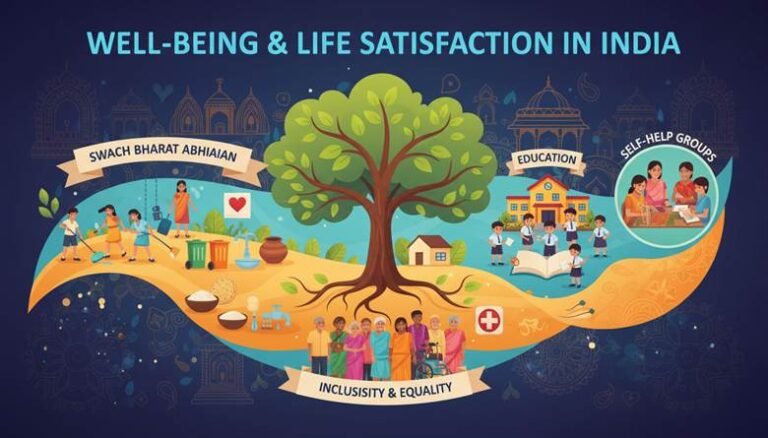
Introduction

Marketing is more than just sales or promotion; it is a holistic business philosophy that revolves around identifying, understanding, and satisfying human needs and wants profitably. The central tenets of marketing—needs, wants, demands, transactions, transfer, and exchanges—not only form the theoretical foundation of the discipline but also drive the practical strategies that organizations use to build brands, delight customers, and achieve competitive advantage. In this comprehensive discussion, we’ll delve deeply into each of these foundational concepts, illustrate them with real-world examples, and examine case studies from both Indian and global brands.


1. Needs, Wants, and Demands

A. Needs

Definition:
Needs are fundamental human requirements. They are innate and universal, rooted in biology, psychology, and society. Marketers do not create needs; they exist naturally as essential conditions for survival and well-being.

Types of Needs:

  • Physical Needs: Food, water, clothing, shelter, safety, health
  • Social Needs: Belongingness, affection, friendship, status
  • Individual Needs: Knowledge, self-expression, personal development, freedom

Discussion:
Needs are the underlying forces that motivate people to act. They are persistent and cannot be overlooked in the marketing process. Understanding customer needs is the starting point for every successful marketing strategy.

Example:
A person in a hot, arid climate has a need for hydration and protection from heat.

Case Study: Amul (India)

Amul, India’s largest dairy cooperative, was founded to address the nutritional needs of Indian families, especially children. By making milk and dairy products affordable and widely accessible, Amul met a critical physical need for nutrition in a country where protein and calcium deficiencies were prevalent.

Case Study: Unilever Lifebuoy

Unilever’s Lifebuoy soap was launched to meet the need for hygiene and health in developing countries. Its campaigns focus on handwashing to prevent disease, addressing a basic human need for health and cleanliness.



B. Wants

Definition:
Wants are the specific forms that needs take, shaped by culture, society, upbringing, and individual personality. While needs are universal, wants are diverse and influenced by external and internal factors.

Discussion:
Marketers influence wants by providing products and services that fulfill underlying needs in culturally relevant and aspirational ways. Wants evolve with trends, innovations, and societal changes.

Example:
A person who needs hydration in India may want a glass of nimbu pani (lemonade), while someone in the US may want an iced soda. Both fulfill the same need but are shaped by environment and preference.

Case Study: Paper Boat (India)

Paper Boat tapped into nostalgic wants by offering traditional Indian beverages like Aam Panna and Jaljeera. The drinks quench thirst (need) but also evoke fond childhood memories, showing how emotional and cultural factors shape wants.

Case Study: Coca-Cola

Coca-Cola markets not just a drink, but a feeling of refreshment, fun, and togetherness. People may need hydration, but they want the unique taste, experience, and brand association of Coca-Cola.


C. Demands

Definition:
Demands are wants backed by purchasing power—the willingness and ability to buy. Not all wants become demands; only those that can be acted on in the marketplace are considered effective demand.

Discussion:
Marketers gauge demand by analyzing market size, income levels, and consumer intent. Only when enough people can afford and are willing to buy does a want become a demand.

Example:
Many people want a luxury car such as a Mercedes-Benz, but only those with adequate resources can demand it.

Case Study: Apple iPhone

The desire for a smartphone (want) exists globally. However, demand for iPhones is concentrated among those who can afford its premium pricing and are willing to pay for Apple’s unique features, ecosystem, and prestige.

Case Study: Patanjali Ayurved

Patanjali identified that while Indian consumers wanted Ayurvedic products, many could not afford expensive alternatives. By offering high-quality products at affordable prices, Patanjali turned widespread wants into effective demands, leading to spectacular sales growth.


Synthesis of Needs, Wants, and Demands

The process begins with a need (e.g., hunger), which becomes a want (e.g., desire for pizza or traditional Indian food), and finally a demand when the consumer has the means and willingness to purchase (e.g., buying a Domino’s pizza).

Case Example: Maggi Noodles

  • Need: Hunger and nutrition, especially for children.
  • Want: Tasty, quick-to-make snack.
  • Demand: Maggi’s affordability and ubiquity make it the chosen product, converting widespread wants into substantial market demand.

2. Transactions

Definition:
A transaction is the basic unit of exchange—an event where two or more parties trade something of value, agree on conditions, and execute the deal. Transactions are countable, specific, and form the core of the marketplace.

Key Characteristics:

  • At least two parties (buyer and seller)
  • Something of value exchanged (goods, services, money, or barter items)
  • Agreement on conditions (price, delivery, terms)
  • Occurs at a specific time and place

Example:
A customer buys a book from a bookstore. Money is exchanged for the book—a straightforward transaction.

Case Study: Amazon India

Amazon enables millions of daily transactions, connecting buyers and sellers. Each order—say, of headphones—constitutes a transaction, complete with payment, shipping, delivery, and sometimes after-sales support.

Case Study: Big Bazaar

Big Bazaar attracts thousands of shoppers daily with bulk purchase promotions (like “Wednesday Bazaar”), leading to high-frequency transactions. These transactions are not just economic exchanges, but moments that reinforce the retailer’s value proposition and customer relationship.


3. Transfer

Definition:
A transfer happens when one party gives an item of value to another without expecting anything in return. Unlike transactions (which involve a reciprocal exchange), transfers are unilateral.

Types of Transfers:

  • Gifts
  • Donations
  • Grants
  • Free samples

Example:
Donating clothes to a disaster relief fund is a transfer. The giver expects no physical return.

Case Study: Tata Trusts

Tata Group, through its philanthropic arm Tata Trusts, regularly transfers resources—funds, scholarships, health services—to communities in need. These are not business exchanges but social contributions, enhancing Tata’s reputation as a responsible, caring brand.

Case Study: Corporate Social Responsibility (CSR)

Companies like Infosys and Reliance invest heavily in CSR, transferring resources to support education, healthcare, and environmental causes. While not transactional, these transfers help build goodwill, trust, and brand value.


4. Exchanges

Definition:
Exchange is the act of obtaining a desired product or service from someone by offering something in return. It is broader than a transaction—exchange is a process or relationship, while a transaction is a discrete event.

Five Conditions of Exchange (Philip Kotler):

  1. At least two parties
  2. Each party has something of value to offer the other
  3. Each party can communicate and deliver
  4. Each party is free to accept or reject the offer
  5. Each party believes the exchange is desirable

Example:
In rural India, bartering is common: a farmer might exchange a sack of wheat for a bag of rice.

Case Study: Flipkart Marketplace Model

Flipkart connects sellers and buyers in a digital marketplace. Sellers offer products; buyers offer money. Flipkart facilitates the exchange, ensuring trust, payment, and timely delivery.

Case Study: Uber

Uber’s platform enables value exchange: riders pay for transportation, drivers provide the service, and Uber orchestrates the communication and payment.


5. Interrelationship of Needs, Wants, Demands, Transactions, Transfer, and Exchanges

The sequence begins with needs, which become wants (influenced by culture and personality), which become demands when backed by purchasing power. These lead to exchanges when parties agree to swap value, realized through transactionsTransfers are one-way flows of value, often used for marketing or social good.

Example: FMCG Sector

  • Need: Cleanliness and hygiene.
  • Want: Branded soap with a pleasant fragrance.
  • Demand: Consumers buy Lifebuoy or Lux based on price, brand, and preference.
  • Exchange: Money for soap.
  • Transaction: A purchase at a supermarket.
  • Transfer: Distribution of free samples at health camps.

Case Study: Hindustan Unilever Limited (HUL)

HUL addresses the need for hygiene with multiple soap brands. By offering a range of prices and attributes, HUL meets diverse wants and demands. Its rural outreach initiatives often involve transfer (free samples), which can translate into future transactions and sustained exchanges as customers adopt the brand.


6. Expanded Case Studies: Real-World Applications

A. Maggi Noodles (Nestlé India)

Needs, Wants, and Demands:

  • Need: Hunger and nutrition for children and busy families.
  • Want: Quick, tasty snack.
  • Demand: Affordable, accessible Maggi noodles meet the market’s demand.

Transactions and Exchanges:

Every Maggi purchase is a transaction. These repeated transactions (millions daily) create a powerful brand-customer relationship.

Transfer:

After the Maggi crisis (2015), Nestlé distributed free samples and held community cooking events—transfers used to regain trust and rebuild demand.


B. Ola Cabs

Needs, Wants, and Demands:

  • Need: Transportation and mobility.
  • Want: Comfortable, reliable, and affordable rides.
  • Demand: Ola’s app-based booking and dynamic pricing turn wants into market demand.

Transactions and Exchanges:

Each cab ride is a transaction; the ongoing use of Ola is an exchange relationship.

Transfers:

Promotional rides (“first ride free”) are transfers that encourage initial adoption and foster loyalty.


C. Starbucks

Needs, Wants, and Demands:

  • Need: Caffeine and refreshment.
  • Want: Gourmet, customized coffee in a pleasant ambiance.
  • Demand: Customers pay a premium for Starbucks’ experience and brand promise.

Transactions and Exchanges:

Every coffee sold is a transaction, but the larger exchange is for a lifestyle and status symbol.

Transfer:

Starbucks offers loyalty rewards and free drinks—transfers that build customer relationships and stimulate repeat transactions.


D. Flipkart (India’s Digital Marketplace)

Needs, Wants, and Demands:

  • Need: Access to a wide range of goods.
  • Want: Convenient, reliable online shopping.
  • Demand: Flipkart’s affordable pricing, delivery reach, and service quality convert wants into actual demand.

Transactions and Exchanges:

Purchasing on Flipkart is a transaction; the ongoing customer relationship relies on repeated exchanges.

Transfer:

Festival sales, cashback, and first-purchase discounts are transfers designed to attract and retain customers.


E. Netflix

Needs, Wants, and Demands:

  • Need: Entertainment and leisure.
  • Want: On-demand streaming of movies and shows.
  • Demand: Millions willing to subscribe and pay monthly fees.

Transactions and Exchanges:

Each subscription payment is a transaction; the ongoing provision of content constitutes an exchange.

Transfer:

Free trial periods are transfers used to convert potential customers into paying subscribers.


7. Theoretical Insights and Evolving Perspectives

A. Psychological Aspects

Needs, wants, and demands are not static. Modern marketing draws from psychology to understand how new needs (e.g., digital privacy), wants (e.g., sustainable products), and demands (e.g., instant delivery) emerge as societies and technologies advance.

Example:
The rise of plant-based meat reflects evolving needs (health/environment), wants (taste/variety), and growing demand as disposable incomes rise.


B. Social and Cultural Influences

Culture and society play key roles in shaping preferences. What is considered a want or a luxury in one country may be a need in another.

Example:
Air conditioning is a want in temperate climates, but in the Middle East, it is nearly a need.


C. B2B vs. B2C Marketing

While the concepts apply across contexts, their manifestation differs. In B2B, needs may be technical (e.g., a manufacturer needs reliable machinery), and exchanges often involve complex contracts rather than simple transactions.

Example:
A hospital (B2B) may need advanced MRI machines (want: latest model, demand: when budget allows), leading to multi-stage transactions and after-sales service exchanges.


8. Strategic Implications for Marketers

Understanding these concepts empowers marketers to:

  • Identify latent and explicit needs: Use market research, ethnography, and data analytics to uncover unarticulated needs.
  • Shape wants: Through branding, storytelling, and innovation, marketers can transform basic needs into aspirational wants.
  • Stimulate and capture demand: Make products accessible, affordable, and desirable through pricing, distribution, and promotion.
  • Facilitate exchanges: Build systems (e-commerce platforms, marketplaces, loyalty programs) that make exchanges easy and trustworthy.
  • Leverage transfers: Use free samples, CSR, or trial offers to build awareness, goodwill, and eventually, market share.

9. The Digital Paradigm Shift

Digital marketing has amplified the speed and reach of these concepts. Needs can be identified in real-time (e.g., Google search trends), wants can be influenced instantly (through influencers and social media), and demand can be measured and fulfilled rapidly (via e-commerce).

Example:
Amazon’s use of algorithmic recommendations shapes wants and stimulates impulse demand, while one-click checkout facilitates seamless transactions.

Case Study: D2C Brands (Direct-to-Consumer)

Brands like Mamaearth or boAt in India have capitalized on digital platforms, using targeted content to identify needs (e.g., toxin-free skincare), shape wants (influencer endorsements), convert them to demand (flash sales), and facilitate fast exchanges (same-day delivery).


10. Conclusion

The core concepts of marketing—needs, wants, and demands; transactions; transfer; and exchanges—are the bedrock of all marketing activity. They explain why markets exist, how value is created and delivered, and how organizations can build enduring customer relationships.

Through the lens of Indian and global case studies—Amul, Maggi, Paper Boat, Ola, Starbucks, Flipkart, Apple, Netflix—we see that organizations that deeply understand and operationalize these concepts are able to innovate, adapt, and succeed even in the most competitive environments. Whether it’s meeting a basic human need or shaping new wants through branding and technology, the journey from need to demand, and transaction to ongoing exchange, is the essence of marketing.

Marketers who master these principles can anticipate trends, respond to evolving customer expectations, and create lasting value for both their organizations and society at large.

Introduction

Human values are the guiding principles, ideals, and beliefs that shape individual behavior and collective social life. They serve as the foundation for harmonious personal development and healthy social interactions. In a diverse society like India, where cultures, religions, and traditions intermingle, understanding and practicing human values is crucial for achieving holistic development at both the individual and community levels.


What Are Human Values?

Human values are ethical benchmarks that help individuals distinguish right from wrong and guide their thoughts, feelings, and actions. Common human values include:

1. Truthfulness (Satya)

  • Explanation: Telling the truth, being honest in words and actions, and standing by facts.
  • Example: Mahatma Gandhi made “Satya” (truth) the foundation of his philosophy and the freedom struggle. The Salt March (Dandi March) was a non-violent protest based on truthful resistance against unjust British laws.

2. Non-violence (Ahimsa)

  • Explanation: Avoiding harm to others in thought, word, and deed; resolving conflicts peacefully.
  • Example: During India’s freedom movement, Gandhi’s use of Ahimsa led to peaceful protests and civil disobedience, such as the Quit India Movement, inspiring global leaders like Martin Luther King Jr.

3. Compassion (Karuna)

  • Explanation: Feeling empathy for others’ suffering and acting to relieve it.
  • Example: Mother Teresa dedicated her life to caring for the poor, sick, and dying in Kolkata, embodying compassion through her Missionaries of Charity.

4. Honesty

  • Explanation: Being truthful, transparent, and free from deceit in all dealings.
  • Example: Dr. A.P.J. Abdul Kalam, India’s former President, was known for his honesty and simplicity. His refusal to misuse government facilities set a public example.

5. Respect

  • Explanation: Valuing others’ dignity, rights, and beliefs, regardless of differences.
  • Example: Touching elders’ feet is a common gesture in Indian culture, showing respect for elders and teachers. Festivals like Raksha Bandhan emphasize respect between siblings.

6. Responsibility

  • Explanation: Being accountable for one’s actions and fulfilling duties towards family, society, and the nation.
  • Example: During the COVID-19 pandemic, Indian citizens volunteering to distribute food and essentials, or following lockdown norms, demonstrated responsibility towards community welfare.

7. Justice

  • Explanation: Treating all individuals fairly, giving everyone their due rights, and opposing injustice.
  • Example: The Right to Information Act (RTI) empowers Indian citizens to demand accountability from officials, promoting transparency and justice in governance.

8. Gratitude

  • Explanation: Appreciating what one has received and expressing thanks to others.
  • Example: Indian festivals like Pongal and Makar Sankranti are harvest festivals where people express gratitude to farmers, the land, and nature for a good harvest.

9. Integrity

  • Explanation: Adhering to strong moral principles, being consistent in values, and not yielding to unethical pressure.
  • Example: Satyendra Dubey, an Indian Engineering Service officer, exposed corruption in highway projects. He lost his life for refusing to compromise on integrity, becoming a symbol of courage and uprightness.

These values are often rooted in cultural, spiritual, and philosophical traditions. For instance, Indian scriptures like the Bhagavad GitaUpanishads, and teachings of Mahatma Gandhi emphasize values such as selflessness, non-violence, and truth.

Summary Table

ValueMeaningIndian Example
TruthfulnessHonesty in words/actionsGandhi’s philosophy and Dandi March
Non-violenceAvoiding harm, peaceful resolutionGandhi’s Ahimsa in freedom struggle
CompassionEmpathy and helpfulnessMother Teresa’s work in Kolkata
HonestyFree from deceit, transparentDr. Kalam’s public service
RespectValuing dignity and beliefs of othersTouching elders’ feet, Raksha Bandhan
ResponsibilityFulfilling duties to others/societyCitizen action during COVID-19
JusticeFairness, giving due rightsRight to Information Act (RTI)
GratitudeExpressing thanks, appreciationPongal, Makar Sankranti harvest festivals
IntegrityMoral uprightness, consistencySatyendra Dubey’s stand against corruption

Significance of Human Values in Personal Life

1. Formation of Character

Values form the bedrock of character. An individual guided by values such as honesty, self-discipline, and respect develops positive traits and earns the trust and admiration of others.

Example:
A student who resists the temptation to cheat in exams, even when others are doing so and there is no risk of being caught, demonstrates integrity—a core human value.

2. Decision Making and Problem-Solving

Values provide a framework for making tough choices. When faced with dilemmas, individuals with strong values can refer to their internal moral compass.

Example:
Choosing not to pay a bribe for a driving license reflects the value of honesty and respect for law, even if it means facing inconvenience.

3. Emotional Well-being and Self-respect

Living in alignment with one’s values leads to a sense of inner peace and self-respect. Conversely, acting against these values causes guilt and stress.

Example:
A person who forgives rather than seeks revenge finds relief from anger and emotional turmoil.

4. Personal Growth and Fulfillment

Values like curiosity, perseverance, and gratitude encourage continuous learning and self-improvement.

Example:
Dr. A.P.J. Abdul Kalam’s humility, curiosity, and dedication to service made him not just a renowned scientist, but also “the People’s President” of India.


Significance of Human Values in Social Life

1. Social Harmony and Peace

Values such as tolerance, empathy, and justice are essential for coexistence in a pluralistic society.

Case Study:

The Dabbawalas of Mumbai—This world-renowned lunchbox delivery service is based on values like punctuality, reliability, and teamwork. Despite cultural, religious, and linguistic diversity among its workers, their shared values ensure trust and harmony, leading to an extremely low error rate and international acclaim.2. Building Trust and Cooperation

In social relationships, values like trustworthiness, fairness, and respect foster cooperation and collective progress.

Example:
Self-help groups (SHGs) in rural India empower women by promoting values of mutual trust and collective responsibility, enabling them to save money, access credit, and support one another.

3. Social Justice and Equality

Values inspire individuals and groups to challenge injustice and promote equality.

Case Study:
The Right to Information (RTI) Movement—Grassroots activists in Rajasthan, led by Aruna Roy, fought for the right to transparency in governance. Their value-driven activism resulted in the RTI Act, empowering citizens to demand accountability and fight corruption.

4. National Integration and Unity

In a nation as diverse as India, shared values like patriotism, secularism, and respect for diversity are necessary for unity and national integration.

Example:
During national crises—such as the 2004 tsunami or the COVID-19 pandemic—Indians from all backgrounds came together, setting aside differences to help those in need, demonstrating compassion and solidarity.


How Are Human Values Developed and Sustained?

1. Family and Early Socialization

Families are the primary transmitters of values. Children observe and learn from the behavior of parents, elders, and siblings.

Example:
Parents teaching children to greet elders, share with siblings, or help those in need instill values from a young age.

2. Education System

Schools and colleges play a vital role in values education. Moral science classes, value-based curricula, and role-model teachers reinforce ethical behavior.

Case Study:

The Kendriya Vidyalayas and other Indian schools often conduct morning assemblies with value-based stories and talks, promoting honesty, respect, and patriotism among students.

3. Religion and Spirituality

Most religions teach universal values such as compassion, honesty, and forgiveness.

Example:
The principle of Ahimsa (non-violence) is common to Hinduism, Buddhism, and Jainism, and has been a guiding value for Indian leaders like Gandhi.

4. Peer Groups and Media

Friends, social networks, and media significantly influence values—both positively and negatively.

Example:
Positive role models in films, literature, and sports can inspire values like perseverance, teamwork, and fairness. Conversely, exposure to negative influences can erode these values.


Challenges to Human Values in Contemporary Society

Despite their importance, human values are increasingly under strain due to:

  • Materialism: The pursuit of wealth and status often overshadows compassion and honesty.
  • Corruption: Erosion of values in public life leads to mistrust and social decay.
  • Social Media: The spread of misinformation, intolerance, and cyberbullying can undermine empathy and respect.
  • Globalization: While it brings exposure to diverse values, it can also cause a loss of cultural identity and traditional values.

Case Study:

Corruption in Public Life—Scams like the 2G spectrum or coal allocation scandals in India show how the neglect of values like honesty and responsibility can harm society at large.


Reviving and Promoting Human Values

  1. Value-based Education: Integrate human values into the curriculum at all levels of education. Use storytelling, role-play, service-learning, and discussions to make values relatable.
  2. Role Models: Leaders in politics, business, sports, and media should model ethical behavior.
  3. Community Initiatives: Encourage volunteering, community service, and interfaith dialogue to foster empathy and social cohesion.
  4. Policy Measures: Laws and policies should reward ethical behavior and penalize malpractices.

Conclusion

Human values are the foundation of a person’s character and the bedrock of a harmonious society. In personal life, they guide moral choices, shape character, and nurture fulfillment. In social life, they promote trust, justice, and collective progress. Indian society, with its rich heritage and diversity, both challenges and demonstrates the transformative power of values. By reinforcing these values through family, education, role models, and community action, India can continue to progress towards holistic development, social harmony, and inclusive growth.

INSTAGRAM