Uncategorized

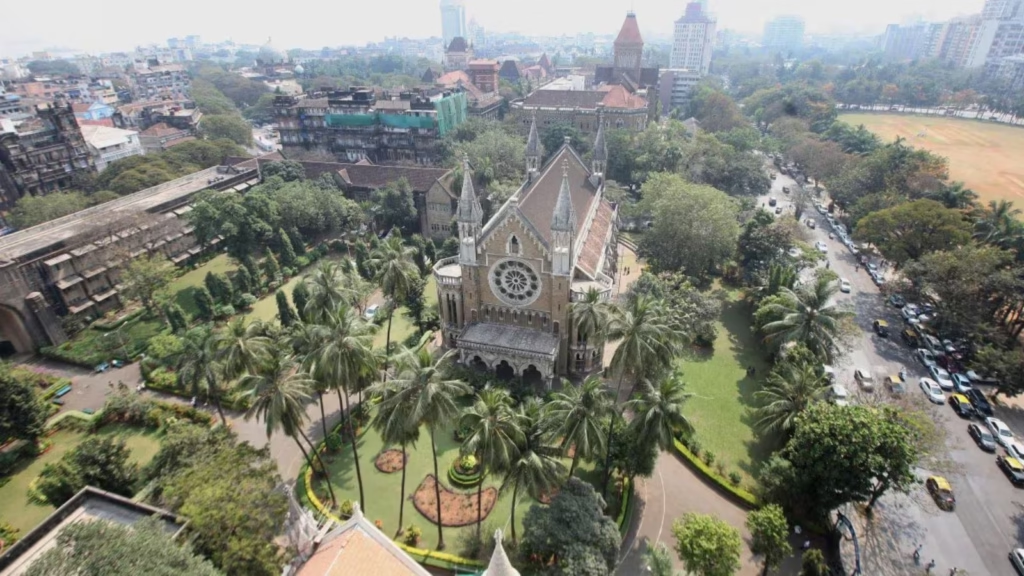
University of Mumbai
Ph.D. Regulations 2026
(w.e.f. 1st January 2026)

A comprehensive, scholar-centric framework designed to nurture original research, uphold the highest ethical standards, and produce independent thinkers who contribute meaningfully to the advancement of knowledge.

🌟 Preamble & Vision

The Ph.D. is the University’s highest academic honour — awarded only for rigorous, original research that demonstrates depth, creativity, and ethical integrity. These regulations emphasise time-bound progress, robust mentoring, continuous monitoring, and uncompromising academic honesty. The journey transforms a student into a competent, ethical researcher ready to join the global community of scholars.

đź“‹ Key Highlights at a Glance

AspectRequirementKey Notes
Minimum Duration3 years (including course work)From date of admission
Maximum Duration6 years (extendable)+2 years (total 8); women & PwD get further relaxation (total 10)
Course WorkMinimum 12 credits (180 hours)Research Methodology mandatory (≥4 credits)
PublicationsAt least 1 Scopus/Web of Science/ABDC paper + 2 presentations/patentJoint authorship with supervisor mandatory
Monitoring6-monthly RAC presentationsProgress reports compulsory

1. Eligibility for Admission (R.PhD.2)

Candidates must meet one of the following:

  • Master’s degree (1-year/2-semester after 4-year UG or 2-year after 3-year UG) → 55% (50% for SC/ST/OBC/EWS/PwD)
  • 4-year Bachelor’s (Honours with Research) → 75% (70% for reserved categories)
  • Equivalent foreign qualification or M.Phil. (as per UGC norms)
  • Special provisions for Commerce & Management (M.Com/MMS/MBA or CA/CS/ICWA)
  • Dual degrees not permitted simultaneously with Ph.D.

Distance-mode qualifying degrees are accepted if recognised.

2. Admission Process (R.PhD.4–R.PhD.9)

  • Entrance: PET (where NET/SET/GATE not conducted) OR exemption for NET/JRF, GATE, M.Phil., INSPIRE, etc.
  • Interview: Conducted at recognised Research Centres (max twice per academic year)
  • Reservation: Strictly followed (subject- & guide-specific)
  • Supervisor Allocation: Based on specialisation, vacancy, scholar’s interest, and reservation policy
  • Max scholars per supervisor: Professor (8), Associate Prof. (6), Assistant Prof. (4)

3. Research Journey Milestones

Step 1: Research Advisory Committee (RAC)
Formed within 3 months of admission

  • Chairperson: Head of Centre
  • Members: Supervisor + Co-Supervisor (if any) + 1 external expert
  • Responsibilities: Guide proposal, monitor progress, conduct mid-term assessment after 2 years

Step 2: Course Work

  • 12 credits (Research Methodology + domain-specific advanced courses)
  • Minimum 55% required
  • Exemption possible only for M.Phil. or second Ph.D. in same subject

Step 3: Research Proposal Approval

  • Submitted within 1 year of admission
  • Scrutinised by Research & Recognition Committee (RRC)
  • Minor/major modifications allowed with clear timelines

Step 4: Registration
Effective from payment of registration fee (after RRC approval)

Step 5: Regular Progress

  • 6-monthly presentations before RAC
  • Satisfactory progress mandatory for annual continuation

Step 6: Pre-Synopsis & Publications

  • At least 1 quality research paper + 2 presentations/patent
  • Joint authorship with supervisor compulsory

Step 7: Thesis Submission

  • Minimum 2 months after synopsis
  • Plagiarism check certificate mandatory
  • Language: English (or permitted Indian/classical language with English summary)

4. Evaluation & Award (R.PhD.20–R.PhD.25)

  • Two External Referees (at least one from outside Maharashtra) + Internal (Supervisor)
  • Thesis evaluated → Viva-Voce (Open Defence)
  • Viva conducted online (external referee & chairperson join virtually)
  • Only after both external referees recommend the thesis

Possible Outcomes:

  • Accepted outright
  • Major modifications → resubmission to same referee
  • Rejected → one-time resubmission allowed within 12 months

Final Award

  • Degree conferred after successful Open Defence and University approval
  • Thesis deposited with INFLIBNET (Shodhganga)

5. Ethics, Integrity & Conduct

  • Strict adherence to UGC Plagiarism Regulations 2018
  • Code of Conduct for Research applies
  • Immediate family members cannot be supervised by the same supervisor
  • Research data & records are University property

Special Provisions

  • Women & PwD (≥40% disability): Extra 2-year relaxation + 240 days maternity/child-care leave
  • Relocation of female scholars due to marriage allowed (data transfer permitted)
  • Posthumous Ph.D. possible
  • Co-Supervisor from outside permitted for interdisciplinary work

These regulations reflect the University’s commitment to quality over quantity, ethics above all, and timely completion of world-class research.

The Ph.D. journey at the University of Mumbai is not merely an academic exercise — it is a transformative quest for truth, innovation, and scholarly excellence.

“Understand the Universe” — the spirit that guides every scholar under these regulations.

Prepared as a ready reference for prospective scholars, supervisors, and research centres. All the best on your research odyssey! 🚀

By University of Mumbai

By Souvik Das

Let’s get one thing straight — what we are witnessing is not an LPG emergency. It’s a stress test. And India is not failing it.Every time there’s geopolitical turbulence, a section of political voices rushes to amplify fear. The current narrative around an alleged LPG crisis is one such example. Yes, supply chains are under pressure. Yes, global tensions are real. But calling it an “emergency” is not just exaggerated — it’s misleading.

India isn’t reacting. India is executing.

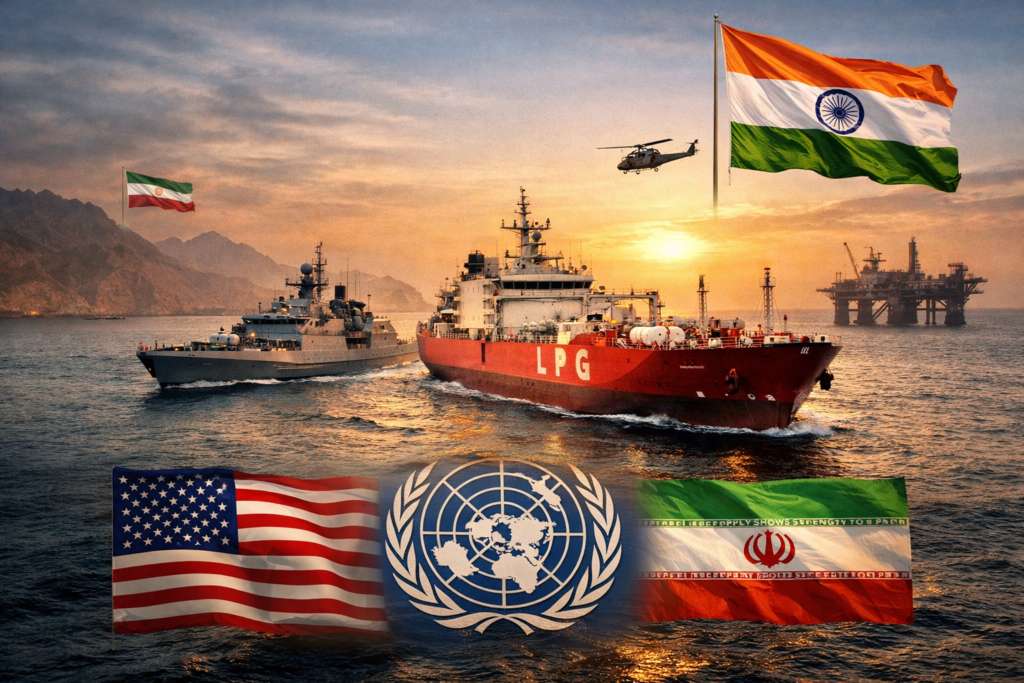
At the heart of this issue lies the strategically critical Strait of Hormuz — a chokepoint through which a significant portion of the world’s energy supply passes. With rising tensions involving Iran and Western powers, concerns over LPG shipments are understandable. But here’s what the panic narrative conveniently ignores: India is already ahead of the curve.

The government is in active diplomatic engagement with Iran to ensure safe passage for LPG tankers. This isn’t speculation — it’s policy in motion. Some vessels, including the naval-backed Shivalik, have already successfully crossed the Hormuz corridor. That’s not disruption. That’s controlled navigation through risk.

This is where India’s foreign policy muscle becomes visible.

Unlike reactionary states, India has maintained a balanced and pragmatic approach in international relations. It engages with all sides without becoming a pawn to any. Whether it is maintaining ties with Iran, managing strategic relations with the United States, or navigating tensions in West Asia — India is not choosing sides blindly. It is choosing stability.

And stability is power.

Let’s zoom out. This is not just India’s problem. The ripple effects of prolonged geopolitical conflicts are being felt globally. Energy markets are tightening. Freight costs are rising. Insurance premiums for maritime routes are increasing. Countries across continents are recalibrating their supply chains.

This is what a prolonged conflict looks like.

The ongoing standoff — shaped in part by the assertive posture of Donald Trump and the uncompromising stance of Iran’s newly elevated supreme leadership — is not de-escalating anytime soon. Both sides are signaling strength, not retreat. And when egos dominate diplomacy, the world pays the price.

But here’s the difference: strong nations prepare for impact. Weak narratives amplify fear.

India has diversified its energy basket, built strategic reserves, and strengthened naval capabilities to secure maritime routes. It is not dependent on a single corridor or a single partner. That’s not luck — that’s long-term planning.

Meanwhile, institutions that are supposed to maintain global peace are failing to deliver. The United Nations, once seen as the guardian of international stability, increasingly appears ineffective in preventing or resolving such prolonged conflicts. Statements are issued, meetings are held — but outcomes remain absent.

In a world where global watchdogs are losing bite, national strength matters more than ever.

So, let’s cut through the noise.

There is pressure — yes.
There is uncertainty — absolutely.
But there is no collapse.

India is not scrambling. It is negotiating, securing, and moving forward. The successful passage of LPG shipments through volatile waters is proof of capability, not crisis.

This moment doesn’t expose India’s weakness. It highlights its preparedness. Because in geopolitics, the real story isn’t who shouts the loudest — it’s who delivers under pressure. And right now, India is doing exactly that.

Introduction

Product planning and development is an essential measure of any successful product’s promotion and lifecycle. It is the process of starting new product experiences. In simple terms, it is nothing more than the established actions that put the entrepreneur’s idea into reality.

The product planning and development process is an idea for a product that can meet a need, deliver a service, or solve a problem. It starts with a known consumer need or with a basic product idea recognized through market research or other sources. The stages can vary depending on the specifics of the market and business. There are eight major steps in the new product development processes.

1. Idea generation

The new product development process starts with idea generation. It refers to the systematic search for a new product. Idea generation is a step of the creative problem-solving process that involves the entrepreneur generating and detailing ideas.

Usually, the process of developing a new product involves identifying a specific audience and determining which needs the product should address. The idea stage is the process of creating a solution to a particular problem. At the end of this step, the entrepreneur will have a list of innovative ideas. However, when an entrepreneur applies many ideas to a particular problem, it requires evaluating each one carefully before implementation.

2. Idea screening

The succeeding step in the new product development process is idea screening. This step is also called screening, and the key point is to set some criteria for new ideas and pick out beneficial ones. In other words, all ideas generated are screened to spot beneficial ones and drop poor ones as soon as possible. The purpose of this stage was to create a large number of ideas, and succeeding stages are to reduce that number. During this product planning process, entrepreneurs need to prove that the idea has a market to sell to.

3. Concept development and testing

After crossing two steps of the new product development process, you need to build a concept and confirm that there is a place in the market for the newly invented product. In this step, the entrepreneur needs to develop new attractive ideas into a product concept. Evaluate the costs of manufacturing, designing, distribution, and others that are required for leading product concepts and testing.

Concept development and testing steps are required to identify the human and capital resources as per the entrepreneur’s need and the essential features that must exist for a functioning product. In addition, begin to break out a potential marketing plan and larger business strategy, including revenues and market share for this product.

4. Marketing strategy development

In the marketing strategy development phase, a promising idea has been established and validated; now, it is time to create an initial marketing plan for the new product, which will be based on the product concept for its market introduction.

5. Business analysis

In this stage, once it finalizes the marketing strategy and product concept, the organization starts assessing the business appeal of the projected new product.

6. Product development

Product development involves the real manufacture and design of the product. It begins with the manufacture of a sample that eases the market testing. Grounded on the results of the tests, the business owner decides on whether to undertake large-scale production or not.

7. Commercialisation

Encouraging results in the product development stage pave the way for large-scale manufacture and commercialization. Here, the organization launches its promotion campaign for the new product. The market research conducted during the formation stage affects the location and timing of the product launch.

INSTAGRAM
error: Content is protected !!