

Marketing plan of the client
- The marketing brief
- Marketing audit
- Marketing objectives
- Marketing problem and opportunities reviews
- STP
- Executing the plan
- Evaluating the plan
II. MARKETING PLAN OF THE CLIENT
Introduction
A marketing plan is a tactical roadmap that companies use to complete, establish, shape, and track their marketing strategy in a particular time. It includes distinct marketing strategies for the several marketing players throughout the company, but all of them work in the direction of the same business goals.
The sole purpose of the marketing plan of the client is to develop the plans and approaches in an organized pattern. This will help to keep the marketing plan on track and help to measure the success of the company campaigns. However, depending on the client’s plan, it may change from company to company. In simple language, a marketing plan describes how a business will achieve particular goals, objectives, and their mission.
A marketing plan covers several marketing strategies. It is the structure from which all of the clients’ marketing approaches are shaped and helps clients to unite each strategy back to more marketing business goals and operations.
A. THE MARKETING BRIEF
The first step in any successful project is drawing up a brief plan with a clear objective. That’s why clients and marketers love creative briefs. Start with outlining a specific goal or the problem the client wants to solve by hiring the advertising agency. State it explicitly to prevent any misunderstandings.
By presenting it at the beginning of the brief, it allows the client to understand what they must do right away and helps them focus on finding a solution. Agencies must also provide detailed background information about the company, services, and products.
Whether an agency is producing a brand identity, public relations content, and brand campaigning, or anything else in between, and whether agencies are working alongside another stakeholder or staff is outsourced, taking the time to establish a marketing brief will result in a better-managed project and a better end result for the client. The idea of a marketing brief sounds simple, but it can be hard to wrap a bunch of details in a few points. The following points will guide and explain what information must be included in the marketing briefing.
1. Goals and objectives
In this first step, you need to outline exactly what you want to achieve with the campaign or project. In other words, increase awareness, trying to gain more attraction to highlight any potential risks associated with the project.
2. Brand background
The brand and its background are meant to set the tone of the marketing brief. It allows and helps the team and client that you understand their mission and project motivations. Set the scene with one or two sentences that give background on the brand and what led to the development of the project.
3. Target audience
In every marketing brief outline, find a section with the target market and information about the audience. This is one of the most important sections because it will explain exactly who you are trying to reach. Here, in this stage, try to be more specific or try to be better for your client or audience. It includes few important questions like
- Who is your customer?
- What are they interested in?
- What age/culture/sex/income group are they?
- What are they interested in?
4. Communication strategy
The communication strategy basically explains how you are going to get the client’s message to their customers. It could be any medium: print media, broadcast media, internet media, or social media marketing campaigns. This will all depend on the type of work your agency does.
5. Deliverable
In this stage, list out what finished products are expected to be included in the campaign. This may include logos, design, advertisements, landing pages, social media viral posts, and others.
6. Competition positioning
It deals with the competition and what they are doing. Identify the main competitors. How does a client project take advantage of the company’s strengths in the marketplace?
7. Project timeline
No matter how big the project is, you need to outline the timeframe for work expected. Here, agencies need to break down every step as much as possible. Set the target for when the campaign will launch and end.
8. Set the budget
Remember to outline the budget for the campaign. Start the project with a range and then map out expenses once the full execution plan is decided on.
9. Measurability
How are you going to measure the effectiveness of the campaign or expenses? Here, the agency needs to evaluate and measure the advertising campaign or budget for their client.
B. MARKETING AUDIT
A marketing audit is a plan precisely considered to help to adapt marketing efforts in the direction of what the target audience needs and wants. It is a designed survey of an organization’s marketing effort. It looks at the way marketing is well planned and managed. It asks what has been done and what else should be done. In simple words we can say, “What has worked?” And what has failed?
A marketing audit is an organized inspection of each part of the firm’s current marketing action and successes. It helps to regulate how well and cost-effectively each element helps the firm to come across its overall goals and objectives. It objectively analyzes the marketing functions of a business by looking in particular at the below points.
- Efficiency: It mainly helps to analyze how the marketing team is structured and their activities.
- Effectiveness: It is measured by the results of marketing activity and by looking at how the budget has been spent in relation to the original objectives.
- Quality: In this analysis, the quality of each work and activity is reviewed by calculating it against external opinions or estimations from clients and other stakeholders.
Importance features of marketing audit
- It gives access to managers to be directly involved in making the marketing judgments.
- It is logical and organized in case of an unstructured and random investigation.
- It was carried out timely and periodically.
- It is wide-ranging and broad in focus, wrapping the entire marketing environment of the enterprise.
What are the key elements that may be covered in a marketing audit?
- The SWOT analysis (Strengths, Weaknesses, Opportunities and Threats)
- Competitor landscape analysis
- Customer and prospect research
- Overview of external market factors covering the PESTLE analysis (Political, Economic, Social, Technological, Legal and Environmental)
- Review of current internal marketing activities assessing their impact and results in the past.
C. MARKETING OBJECTIVES
Introduction
Marketing is all about goals and objectives. Without them, organizations have no way of knowing whether or not their work is valuable and meaningful. It is a set out of what a business wants to achieve from its marketing activities. They need to be consistent with the overall aims and objectives of the business.
Marketing objectives are the approaches set to manage the overall development of the organizations. When it comes to a particular product, a company’s marketing objectives may include increasing product awareness, reducing consumer resistance, and providing information. They also provide an important focus for the marketing team. Provided the marketing objectives are relevant and achievable, there are some important business benefits from setting them and monitoring progress against them. It may include:
- Set significances for marketing resources and effort.
- Certify well-designed, consistent activities with corporate objectives.
- Make available incentives for the marketing team and measuring of success or failures.
- Provide a focus for marketing effort and decision-making.
Types of marketing objectives
- Profitability objective: A profitability objective is a marketing objective that controls the amount of probable income based on the promotional objectives.
- Construct demand: It works for creating the demand for services and products among the customers.
- Ensure effectiveness: It controls the amount of estimated revenue grounded on the marketing success and strategies.
- Customer happiness: The main purpose of a company is to satisfy the needs, wants, and desires of customers.
- Construct time and place utility: It makes sure that the product or service is available to the consumer whenever and wherever they need it.
- Increase sales volume: It is a demanding progression of increasing the sale of a product or service to create revenue.
- Increase product quality: Marketing pledges customer reviews and feedback to implement them for product development.
- Creating organizational goodwill: It describes the product and the company’s positive image in front of the customers.
D. MARKETING PROBLEMS AND OPPORTUNITIES REVIEWS
Introduction
Every marketing strategy is unique, just like every business is unique and has different strategies. With a wider remit than ever before, marketers today face a range of challenges. Nowadays, marketing jobs have more responsibility than ever, which helps marketers to direct a business towards growth in the face of uncertain times. Whatever the situation is, there’s always at least one area that businesses can stand where they improve and grow consistently.
1. Insufficient budget and time
Problem: Insufficient resources mean businesses face common issues like less budget and time to complete the marketing processes.
Opportunity: Here, businesses may try to promote their products and services in local marketing with a smaller budget. Even they can also hire agencies that make it possible on a small budget.
2. Failed to explain the product or service
Problem: A producer may be good at a particular product or service, but it doesn’t mean you are the right person to sell it.
Opportunity: Here, the producer needs an experienced and efficient staff to explain and sell the product or service to the consumer. Experienced staff helps to increase the opportunity of selling products and services in larger volumes.
3. New marketing trends
Problem: As new trends appear on the market, it can be difficult for marketing personnel to keep track of the changes and implement them in their own strategies.
Opportunities: Embracing and accepting new changes would be to their benefit. For example, in modern marketing, social media and internet media carry huge traffic. If a marketer uses these new trends, it helps to reach more of the target audience at the least cost and in the least time.
4. Pricing problem
Problem: The price of the product is crucial to the success of the company and should be supposed as right by consumers. There are number of factors involved in setting price for final product, like competitor product price, profit margin, cost of production, promotional expenses, etc.
Opportunities: The marketers may use different pricing methods to set the price of the product. For example, a well-known brand using a skimming pricing strategy to take all the cream in a short period. In the case of a new brand, they use a penetration strategy to enter into a competitive market.
E. STP (Segmentation, Targeting, Positioning)
Introduction
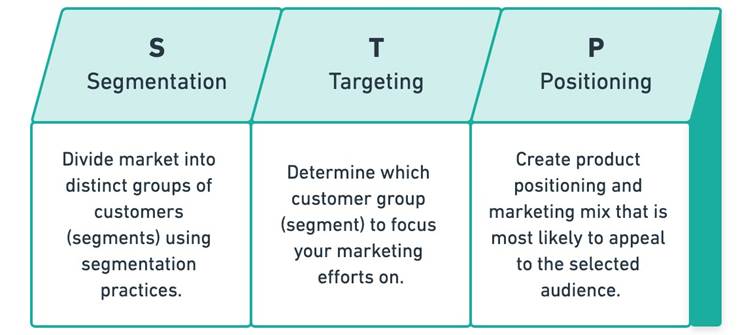
The STP model is a central concept in marketing that is absolutely key to servicing a market successfully. Discovering customers and targeting them is the concept that stands behind the STP modelling. The acronym stands for the following key part of the concept.
1. Segmentation
Common segmentation variables include
- Demographic: Age gender, ethnicity, marital status, etc.
- Values: Religion, politics, cultural beliefs, etc.
- Geography: Country, state, region, climate, etc.
- Psychographics: Habits, attitude, lifestyle, customer loyalty, etc.
- Behaviours: Likes, dislikes, interests, tastes, etc.
- Life stages: Educational status, work status, old stage, etc.
2. Targeting
Targeting refers to defining which, if any, of the segments discovered should be targeted and made the focus of an all-inclusive marketing program. According to Philip Kotler (1984), for market segmentation to be effective, all segments must be:
- Accessible: Buyers must be able to reach through appropriate promotional activities and distribution channels.
- Measurable: The segment must be easy to identify and measure
- Profitable: Each segment must clearly differ from the other segments, which makes different marketing mixes necessary.
- Distinct: Each segment must clearly differ from other segments, which makes different marketing mixes necessary.
3. Positioning
The last part of the STP model is positioning, which means to ensure that a brand occupies the right spot in the mind of target consumers. It mainly places the product in the right place, and positioning in marketing means where your products stand in the market. There are three standard ways you can position your product to achieve a competitive advantage.
- Experiential positioning: It refers to focusing on those elements of your product or brand that connect emotionally with your customers.
- Symbolic positioning: It refers to enhancing the self-image, ego, and belongingness needs of customers. For example, luxury cars, watches, etc., are themselves using symbolic positioning.
- Functional positioning: It refers to solving a problem or providing a benefit to customers.
F. EXECUTING THE PLAN
Execution is an easy concept to talk about, but it’s a hard one to apply. The major problem is how to measure and manage a concept. The execution phase is the longest in duration because there are three major steps, as follows:
- Sharpen the focus: Focuses deliver the precision to make decisions that support the most significant goals. It results in a noticeably defined pathway to success.
- Build competency: Competency incorporates all the necessary skills, processes, systems, and other tools to achieve the client’s goals. It is a talent to promise, obligate, measure, and hit the targets.
- Ignite passion: Passion produces a sense of connectedness. It shapes an association between teammates, a connection to our human need for meaningful work, and a connection to each individual’s sense of contribution and value.
G. EVALUATING THE PLAN
Evaluating marketing performance guides future marketing creativities and supports businesses to achieve their aim.
- Set goals: When launching a campaign, marketers need to set clear goals for the marketing campaign. It is like a compass that guides the marketer throughout their campaign and helps to measure performance.
- Branding: Does your brand image reflect or redefine itself? It is important to bring together the what, who, and why of the campaign and other things under the brand because the brand is the face of the companies’ businesses and manufacturing products.
- Market research: Market research tends to always be ignored, but it is one of the most significant factors in re-evaluating marketing campaign research.
- Look at the numbers: it means return on investment. In times of evaluating a marketing campaign or strategy, every business wants to look at the end factor—what they gain in numbers. Here, the numbers may include profit amount, sales unit, reaching of consumers, etc.
- Marketing progress: Observing marketing progress in the direction of its annual ends.
About the Author