

Introduction
An advertising agency, frequently stated as a creative agency or an ad agency, is a business dedicated to creating, planning, and handling advertising and sometimes other forms of promotion and marketing for its clients. Private and public sector businesses use advertising agencies when they need help spreading the word about their products and services. Such agencies vary in size and regularly concentrate on specific types of advertising tasks. Typical ad agency clients include businesses and corporations, nonprofit organizations, and private agencies.
Normally speaking, most advertising agencies generate visuals and supervise media buying and advertising campaign planning. They also deliver consultation services and implement branding plans. Agencies may be hired to produce television advertisements, radio advertisements, online advertising, out-of-home advertising, mobile marketing, and AR advertising as part of an advertising campaign.
1. ROLE OF ADVERTISING AGENCIES
- Give advice & guidance on marketing strategies.
- Give advice & guidance on advertising and media strategies.
- Organize & develop print, outdoor, and electronic advertisements.
- Bring out surety of various substances such as display material & other display material.
- I also provide assistance with sales promotion and other communication tasks.
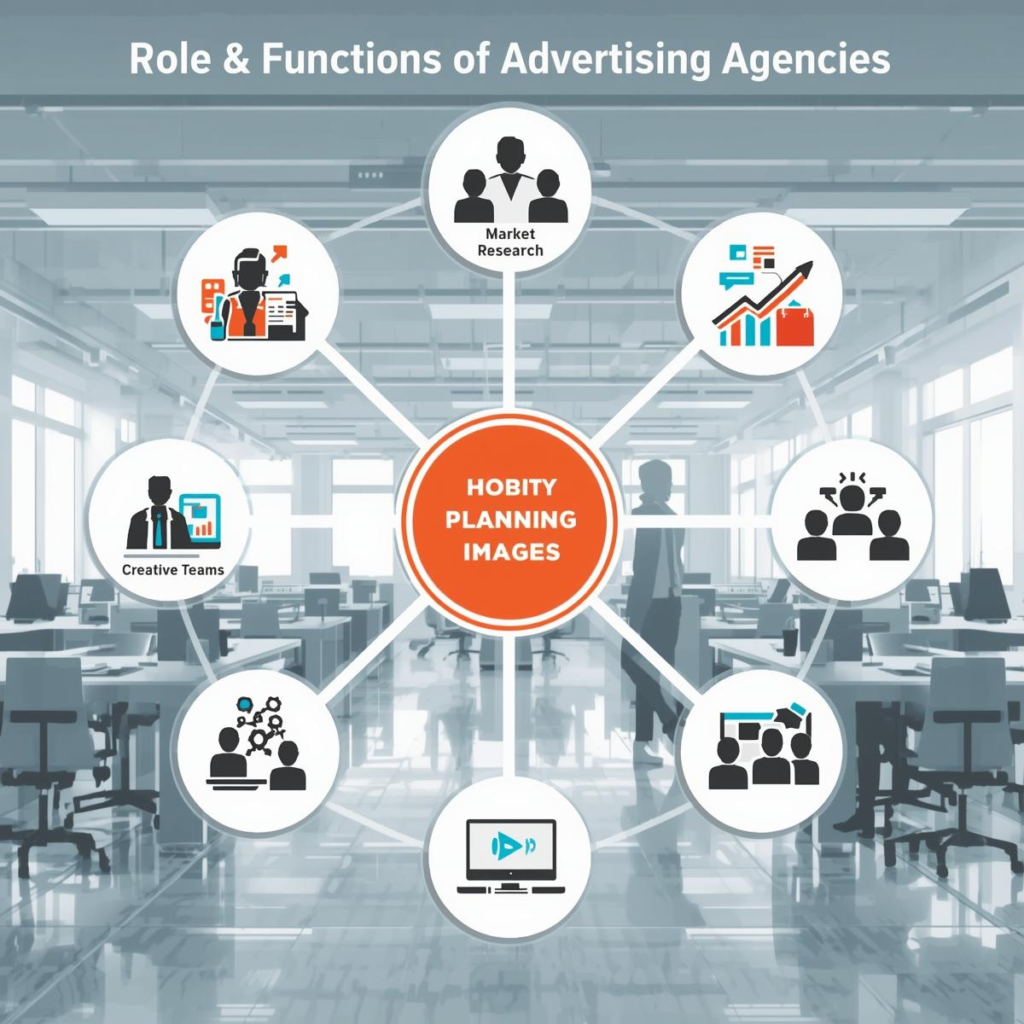
2. FUNCTIONS OF ADVERTISING AGENCIES
Introduction
Understanding the advertising industry begins with a grip on how the agencies work. Advertising agencies have a number of key departments that service their clients. An advertising agency must have an appropriate internal organizational structure to keep functioning properly with a smooth workflow. Advertising firms are unique businesses that use creativity and business hand in hand.
One of the best ways to understand how the advertising world functions is to understand how an advertising agency works. In advertising agencies there are many different types of advertising agencies. The departments work together to accomplish the agency’s goals. There are a lot of departments that can exist in an agency. Some work on acquiring and maintaining clients, while others write and develop the promotional materials and advertisements. Some departments also manage various support functions in advertising firms, such as keeping track of bills, payments, and office expenses. Whatever department you work for in an advertising agency, expect to collaborate with other fellow employees in a team environment.
1. Account handling department
Account handling department Client management, project management, and deadlines—all of these things and a few more are handled by the account service department. The person who works in the area of contact and communication between the agency and the client is known as the account executive. In a large agency he could be part of a larger group, which is known as the account service group. It would include specialists in different fields, such as media, art and copy, research and production, and so on.
The account department works with clients to utilize their target markets. They are working to guarantee that a client’s money is being used as efficiently as possible and to make sure that the clients are satisfied. They also manage the other departments working on a project. Usually, it’s their purpose to manage a client and their happiness with their services.
2. Production department
As the name implies, it is concerned with the production of the advertising material. Mostly in large advertising agencies, such as full-service agencies, they may hold an in-house production department to handle the execution of the client’s campaign. The production team’s main responsibility is the campaign’s logistics.
The production department are the ones who are responsible for tasks such as setting schedules, talking to printers, photo shoots, and hiring directors for videos and commercials. They work very carefully with the media-buying team to make sure a campaign idea is successfully performed. Moreover, in the case of smaller agencies, the job of the production unit may be subcontracted to an external agency or combined with the media buying team’s role. The production department in such cases would come in mainly in the management area.
3. Art department
The art department of the advertising agency uses the power of creativity to make this department more attractive and agreeable. An art director heads the art department, aided by a team of artists, layout men, and visualizers. It improves visuals and layouts, billboards, and calendars for advertisements.
The art department is concerned with the overall look and feel of the advertisement, from choosing the headline, text, size, and type of the font to the pictures, visuals, logo, and the photographic treatment of the commercials with originality and extraordinary talent. It is important that the art and creative departments are closely joined. The art department and the creative department work together, guided by the vice-president of creative services, and devise the final copy of the advertisement. Some ad agencies outsource their artwork to freelance artists.
4. Copy Department
The main responsibility of a copy department of an advertising agency is to make a striking copy of an ad. The copy director heads this department and guides the functioning of it. The major responsibility of this department is to create a striking ad copy. The ad copy is very important and is called the soul of the advertising because it carries the advertising message to its consumers without any deviation.
The copy team comprises copywriters and supervisors who use their creative skills while making an advertising copy. The copy department is mostly the largest department of an advertising agency, which consists of dedicated, qualified, and experienced team members.
5. Public Relations Firms
Many large companies use both advertising agencies and public relations (PR) firms. PR agencies are best for organizations looking to improve the public’s awareness of the brand or their public image. Public relations firms develop and implement programs to manage an organization’s. For example, publicity, image, affairs with consumers, and other relevant publics, including employers, suppliers, stockholders, government, labor, and the general public.
6. Human resource department
You need new people, people with specific talents and skills? These guys have got your back. They are also there to resolve any collaboration problems within the team. There is no denying the importance of the HR department in any business. Like in any other organization, the HR department monitors the hiring and firing of employees, sick leaves, and the overall well-being of the office. They also ensure that all processes carried out by the company are in line with state and national regulations. The human resources department generally consists of HR managers who report to the head of HR.
7. Media Department
The media department is in control of spacing where and when commercials will show up and purchasing space or time in daily papers, magazines, radio, TV, computerized media, and outside media, for example, blurb locales and bulletins. In a small agency, one individual may consolidate the arranging and purchasing parts. In large agency organizations have a media office controlled by a media chief who supervises the work of a group of organizers and purchasers. The media group may combine experts in print, telecast, or computerized media.
8. Finance department
Finance sits at the most strategic level in an organization. It’s incredibly important for Finance to understand the strategic nature of the work your marketing team does. They determine how much money a department receives and whether the investment will grow or shrink and at what rate. They have a responsibility to manage that money effectively.
Financial departments analyze large financial overviews in spreadsheet format, often utilizing P&L reports, balance sheets, and cash flow overviews. All monetary transactions of the advertising agency go through this department. The finance division is responsible for handling staff payments, vendor costs, day-to-day expenses, employee benefits, and any other cost that may be borne by the advertising agency. A finance manager and finance executives/accountants generally head the department.
9. Creative department
The creative department of an advertising agency is responsible for developing and designing the campaign for the client across various mediums. Their job is to come up with ideas that create a demand for the customer’s product within their target audience.
10. Client department
Client department is also called “account executives.” It acts as the link between the agency and the client. He suggests exactly what the client wants to his ad agency. He is the person who carries the client brief and is also responsible for the approvals.
11. Research department
In fact, the research department functions before and after a commercial is made for pre-testing and post-testing of media, respectively. Consumer insights and brand usages are also tested at times, according to the client in many instances.
About the Author