

Introduction
It is likely to cultivate a model of consumers’ cognitive and intellectual structure that will provide a picture of all of these features. Means are objects (like products and services) or activities that people engage in (reading, running, travelling, etc.). Ends are valued states of being, such as happiness, security, and accomplishment.
A means-end chain is well-defined as comprising an interconnected set of cognitive components that permits an individual to select objects or activities that enable him to achieve his desired end states. Thus, the means-end chain permits focusing on the basic aims consumers have in life while not losing sight of how these aims influence choices in specific situations.
The process of categorization is proposed as the mechanism by which consumers organize thinking about specific product alternatives so as to create selections of products that will be instrumental in helping them achieve their values. If this connection can be made, the bases consumers have for creating sets of similar products will be understood more systematically.
Elements of Means-End Theory
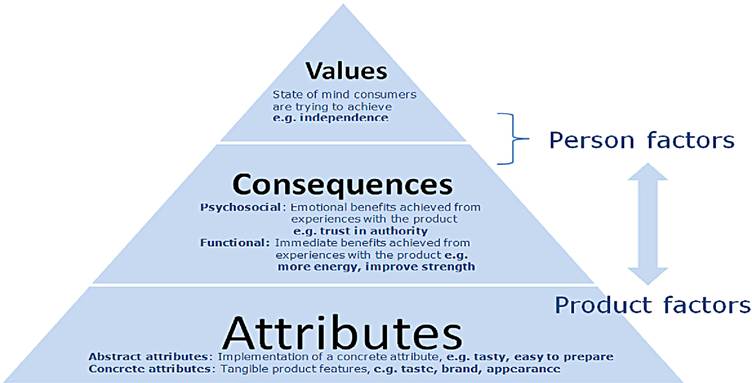
1. Attributes
Attributes are the basic characteristics of the product, such as physical or technological. For example: A person who buys a tablet device because it offers the same capabilities as his laptop.
2. Benefits and consequences:
Benefits and consequences Consider how useful the products are.
For example, a person who travels a lot for his job. He buys a tablet because it is easier to carry around than his heavy laptop. The benefit is that he no longer has to carry the heavier laptop.
3. Values
Values consider your customers’ ego.
Ego is the amount of pride that is associated with using branded products (like Apple brand).
For example, when a person buys Apple Company’s tablet because it is new and sensational, and carrying it from one place to another makes him/her feel like he/she is a part of a high-class club.
A company is most effective and prosperous when they are able to use all three components of the means-end methodology in their marketing. This means that a company should consider features, benefits and consequences, and values when introducing a new product or transforming an old one.
About the Author