Introduction
In publishing more commonly, the term “copy” refers to the text in books, magazines, and newspapers. In books, it means the text as written by the author, which the copy editor then prepares for typesetting and printing. This is also referred to as “editorial copy,” which is said to have two subdivisions, the body copy and the adjuncts to the body copy.
The term’s usage can be demonstrated in the way an editor decides to embed advertising material directly into the editorial copy, which means that the ad would use the same font, layout presentation, and feel as the editorial copy it is being integrated into. This concept underscores how the copy can also refer to the identity of the newspaper or the magazine since the method of composition and layout can define its brand and positioning.
In general, copy is written text of any kind in various genres. Many of you familiar with the HBO smash hit “Mad Men” knew that “copy” referred to advertising copy (or text). Ad copy means text written specifically to sell something. But there are other kinds of copy, including body copy and just plain copy.
A. Headline
Introduction
The headline summarizes the story’s main idea, which the lead expands upon. It should clearly express a complete thought. Headlines have become essential in today’s society; people tend to look only at headlines rather than reading complete stories. Writing headlines takes practice. You need to select words sensibly and use strong writing in order to motivate the audience to read the article. Create the headline after you finish writing the article so that you have a complete understanding of the story. Focus on how you can communicate the main idea in a manner that will capture the reader’s attention.
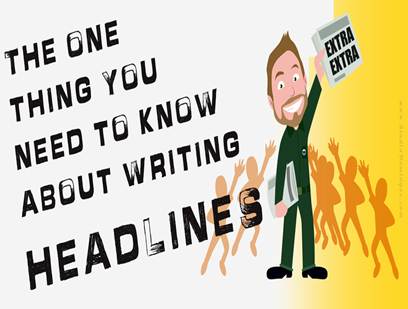
Headlines are crucial to your content. The famous advertising revolutionary, David Ogilvy, knew that headlines are the most important element of your copy. His famous quote is as follows: “On the average, five times as many people read the headline as read the body copy. When you have written your headline, you have spent eighty cents out of your dollar.”
Often described as the “Original Mad Man” and “The Father of Advertising,” Ogilvy is known largely for his advertising work while serving as the founder of Ogilvy & Mather. In addition to building a multibillion-dollar company, he also helped create hugely successful campaigns for clients such as Dove, Shell, and Rolls-Royce.
1. Go Big or Go Home
Don’t bunt. Aim out of the ballpark. Aim for the company of immortals. -David Ogilvy
The product you represent is depending on you, and if you allow yourself to take shortcuts or present a less than compelling argument, then you’ve failed. As an entrepreneur or business owner, you simply cannot afford bad copy. If you cannot achieve perfection on your own, then you should hire someone who can.
2. Do Your Homework
Advertising people who ignore research are as dangerous as generals who ignore decodes of enemy signals. -David Ogilvy
Ogilvy spent years working for George Gallup, founder of the Gallup Poll, and it was during this time that he realized the true value that comes with knowing exactly what your target audience is thinking.
You cannot write copy unless you know:
- Who you’re writing it for
- How that person thinks
- What that person needs
If you haven’t done your research, then you’re simply faking it, and it’s that type of copy that gets marketers in trouble, either with the government or with their boss.
To write great copy, you need to understand your audience to the letter so that you know how you can best serve them. Nothing else will do.
3. Never talk down to your customers.
A consumer is not a moron. She’s your wife. Don’t insult her intelligence, and don’t shock her. -David Ogilvy
This is a wonderful Ogilvy quote (for the video, click here), speaking on behalf of consumers everywhere. As excellent as your product may be, speaking down to your audience is going to turn them away, and as much as you’d love them to be infatuated with your charming pitch, understand that, at the end of the day, they simply want to solve a problem.
Treat your customer with respect and dignity. You’re on equal footing, or perhaps a bit lower, considering you’re the one who needs the sale. Please ensure that your copy accurately reflects that position.
4. The Headline is 80%
On average, five times as many people read the headline as read the body copy. When you have written your headline, you have spent eighty cents out of your dollar. -David Ogilvy
Headlines are as close to a magic bullet as you’re going to get, and if you’re going to be perfect in only one place, do it here. Write a strong headline that works.
- Use headline templates, which are based on headlines that have worked in the past
- Start with a compelling benefit that entices readers to continue.
- If you can, split test different headlines to see what works best
5. Don’t Get Distracted from Making the Sale
If it doesn’t sell, it isn’t creative. -David Ogilvy
Couldn’t be truer. Marketers love to be adorable and funny, original and innovative, but it’s also dangerous.
People don’t set aside time to read ads; they are probably in a hurry, just taking a quick glance before they move on to something else. If your point isn’t immediately obvious, chances are they won’t get it, and you’ll lose them forever.
If you want people to buy, you need them to see your product in their hands and be able to envision how it’ll improve their lives. Everything else is secondary. If you can awe them with your words in the process, fine, but don’t do it at the expense of the sale.
6. Explain Why They Should Buy
The more informative your advertising, the more persuasive it will be. -David Ogilvy
You’ve got their attention with the headline and are telling them about the product, but before they buy, they want to know:
Why is the product important? Why is it a beneficial deal? Why should they be interested? Why should they buy it from you? Why should they buy it now, rather than later? Why should they trust you?
Consciously or subconsciously, all of those questions are going through a customer’s head. If you want them to act, you need to answer them, and that means making your copy informative.
7. Your Copy Is Important. Treat It That Way.
Like a midwife, I make my living bringing new babies into the world, except that mine are new advertising campaigns. -David Ogilvy
All too often, business owners treat their sales copy like an afterthought. They scribble down a few notes, have someone check it to make sure it’s grammatically correct, and send it out. Then they wonder why it doesn’t get results.
On the other hand, David Ogilvy treated each of his campaigns as if they were his own children. He nurtured them, fought for them, and helped them develop. And he produced some of the best-selling campaigns in the history of advertising.
The truth is, writing outstanding copy takes time and energy. Some of the best copywriters will spend weeks just crafting the headline, and they might take months to write the body copy.
It’s not because they’re slow. It’s because they know the importance of getting it right.
Are you committed to that type of excellence?
If not, you should be.
There are different types of headlines with different objectives to them; for example:
- Current News Advertisements – Introducing a new product.
- Identifying the product or service—telling the audience what the brand is selling and developing brand value.
- Offers news—asking the audience to take action towards the advertisement.
- Create interest—make the audience think about what the advertisement is really about.
- Gives knowledge—telling the audience to get it NOW!
- Offers an experiment—asking the audience to try it and see a difference.
- Establish tone and emotions—evoke emotions in the audience.
- Making a claim towards the benefit of the product—letting the audience know about what is best, why they should get it, and the results of the product.
B. Sub-headline
Introduction
A subheadline is a smaller, secondary headline that usually elaborates on the main headline above it. To simplify, subheadlines come in two common forms, subject to what type of content you’re writing. The rules are more or less the same, but the place and purpose vary. The headline could announce the launch of a new product, and a subheading could give more specific details about the product’s features.
After the headline, the next is the sub-headline. If the headline has rightly suggested the value of the product, the job of the subheadline becomes quite easier. A sub-headline helps the reader to have more knowledge about the product. For e.g., the sub-headline used in the Horlicks ad—Dudh Mein Horlicks Milao, Dudh Ki Shakti Badhao.

Here are three things that we do with our subheadline:
- Describe extra. If your product or service requires a bit more description, then try to expand on it with your subheadline.
- Tell benefits. Benefit-focused headlines are more effective. This is achieved by emphasizing how a product or service will enhance the user’s life.
- Motivate action. A subheadline is also a great way to get consumers to do something. If you effectively inspire action, it’s only a short hop for them to pursue product and service.
The nature of your subheadline depends on your headline. You can choose one of the techniques above or split test different varieties to see which one is best for your users.
C. Layout
Introduction
Layout may be defined as the organizing of the various elements of advertising, such as illustration, text matter, product, and name of the company. A successful advertisement is a mixture of both copy and art.
According to Business Dictionary, a master plan or blueprint of a printed or published work (such as an advertisement, book, magazine, newspaper, or website) that lays out the arrangement of its different graphic elements (such as body copy, colors, headlines, illustrations, and scale). It establishes the overall appearance, relative importance, and relationships between the graphic elements to achieve a smooth flow of information (message) and eye movement for maximum effectiveness or impact. Often alternative layouts (called roughs) are prepared to explore different arrangements before the final layout is made for printing or production.
So layout is the way you use the space and where you place the various elements, how they overlap, what colors they are, how they contrast, and where the setup leaves the reader. Some important components of a good ad layout are as given below.
- Border
- Heading
- Illustrations
- Price
- White space
- Body copy
- Signature
- The one-second test
- Colour
- Creativity
- Composition
Principles of Design and Layout
The following five principles of good arrangement are essential to everyone who makes or assesses the advertisement:
a. Balance
A layout may be called balanced if equal weights or forces are intermediate at a reference point. The principle of balance is inherent in nature. The reference point is the optical center of the advertisement. The artists with a given area or space are to place all the elements within this space. It is called the reference layout for the advertisement.
b. Proportion
Proportion is closely related to balance since it refers to the division of space among layout elements for a pleasing visual effect. If the major appeal in an advertisement is the product’s price. The price should be displayed in a proportionate space position.
c. Contrast and Emphasis
Contrast means variety. It gives life to the whole composition and adds emphasis to selected important elements. An advertisement with good contrast may attract the attention of customers Contrast may be visible in a number of ways. It may be witnessed through sizes, shapes, and colors.
d. Eye Movement
Eye movement is the design principle that helps move the eyes of the readers from element to element in the order given in the hierarchy of effects model for effective communication of the message in advertising. An effective ad uses planned eye movement and should follow the established reading patterns too, such as the tendency to start at the top left corner of a page and read through to the lower right corner. The eyes also move naturally from large items to small, from dark to light, and from colors to non-colors.
e. Unity or Harmony
Unity or harmony is another important design principle. Although each element should be considered as a separate unit in striving for balance, proportion, contrast, and eye movement. The complete layout or design should appear as a unified composition. Common methods of securing unity in layouts are
- Use of consistent typographical design.
- Repetition of the same shapes and motifs is another common method.
- The overlapping of elements.
- Use of a border to hold elements together.
- Avoidance of too much space between various elements.
Functions of an Advertisement Layout
The main functions of advertisement layout are
a. Arranging different Parts or elements
The important function of layout is to collecting and arrange the various elements of an advertisement: illustration, headline, sub-headlines, slogans, body text, the identification mark, etc.
b. Opportunity of Change
The layout deals with the creative teams, agency management, and the advertiser and suggests change before its last endorsement and actual construction, and then production begins.
c. Estimating Costs
The layout estimates costs, and it monitors the engravers, typographers, and other craft workers to follow in producing the advertisement.
D. Body Copy
Introduction
The body copy of a print advertisement tells the complete story. It is a logical continuation of the headline and subhead. It also contains words that stimulate interest, desire, and action. It is usually set in smaller type sizes than the subhead. The text should relate to the campaign appeal and to the readers’ interest. It must explain the benefits the product has for the reader. It may concentrate on a single benefit (the big idea) or several benefits as they relate generally to the target audience. The body copy is written in a conversational style, as if one is talking to a known person. This will make the individual reader feel the personal effect of the message. It is important to note the following in writing a good body copy:
- Don’t beat about the bush
- Avoid superlatives/clichés
- Be truthful and make truth fascinating
- Be enthusiastic and friendly
Elements of the body copy
a. Lead-in paragraphs
Once the headline captures readers’ attention, the lead-in paragraphs shift their focus to the product by introducing the sales message.
b. Interior paragraphs: These offer evidence to support the claims and promises made in the headline. The key to an interior paragraph is credibility.
These provide proofs for claims and promises. The key to an interior paragraph is credibility. The proofs may come in form of research, testing, usage or guarantee
c. Trail close
This part of the body copy urges readers to make a purchase/buying decision before they get bored.
d. Close
The close asks readers to do something and tells them how to do it. This is the part of the print ad where a sale is made or prompted. The close can be direct or indirect. It can range from subtle suggestion to direct command. The final purpose of a close is to reinforce the readers’ positive thoughts concerning the product/service.
Types of Body Copy
Experts have identified 12 body copy types
- Emotive body copy
- Factual, hard-selling body copy
- Factual, educative body copy
- Narrative body copy
- Prestige body copy
- Picture and captive body copy
- Dialogue and monologue
- Gimmick body copy
- Reader- and editorial-style body copy
- Testimonial body copy
- Quotation body copy
- Back selling (black integration)
E. Types of copy and slogan
Introduction
Advertising copy is the specific wording of an advertisement of a brand of good or service, which highlights the ‘theme’ or ‘message’ the advertisement is intended to convey to prospective buyers or users of that product. Advertising copy may be pitched to appeal to consumers in general or targeted to attract the attention of a particular type of buyer.
The advertisement copies can be divided into six main types:
1. Human interest ad copy
Human interest copy attracts the emotions and senses of its potential customers. This advertisement copy describes the product to people instead of sticking to facts. Human interest copy gets to the selling part indirectly or unwillingly. It focuses on people’s unending interest in themselves, their families, and their friends. The most significant forms of human interest copy are humorous copy, fear copy, predicament copy, and story copy.
2. Educational ad copy
An educational ad copy tries to inform, update, and influence its clients to buy a product by educating the potential customers. It is planned to educate the public about the features of the product. Introductory ad copies are usually created in thiamongIt is the responsibility of every manufacturer to educate the prospects regarding the product and bear a sincere welcome among its clients. Such an ad copy indicates the benefits and special features of the product.
3. Reason why? ad copy
Why advertising Copy offers reasons as to why the consumers are likely to buy the product of a specific brand. The reason why copy appeals more directly to the intellect or the judgment of an individual than to the emotions. It tries to explain the product qualities and benefits by giving evidence in the form of testimonials, guarantees, customer experiences, and so on.
4. Institutional ad copy
Institutional copy doesn’t sell its goods and services. Institutional ad copy aims at promoting the selling house. It focuses on building a strong reputation for the selling house. The main objective of this type of ad copy is to create, maintain, and increase the goodwill through its philosophy, objectives, and policies so that the prospective customers register it in their minds. Institutional copy invites the target customers to the selling outlet. It is also called prestige or corporate advertising.
5. Suggestive ad copy
A suggestive copy suggests trying to deliver the message to the readers directly or indirectly and motivate them to purchase the product. Suggestive ad copy works best when the reader is confused regarding the quality of the product and is juggling with decision-making regarding his purchase.
6. Expository ad copy
Expository copy conflicts with the suggestive copy. An expository copy doesn’t hide anything about the product but instead reveals the facts that are clear and appropriate. It describes the product features, uses, merits, operation, and benefits of the products or services.
Characteristics of Advertising Copy
- Attractive pictures
- Attractive headlines
- Innovation of the product
- Uniqueness
- Message size and position (how long, how short, how it is put, etc.)
- Colour
- Shape
- Movement
Factors Affecting Advertising Copy
An advertising copy must be based on the following factors:
- Is advertising believable?
- Is advertising reliable?
- Does it appeal to the consumers’ needs and wants?
- Does it explain the benefits of a product realistically?
- Is it based on creativity? etc.
F. Creating a storyboard
Introduction
A storyboard is a graphic organizer in the form of illustrations or images displayed in sequence for the purpose of pre-visualizing a motion picture, animation, motion graphic, or interactive media sequence. The storyboarding process, in the form it is known today, was developed at Walt Disney Productions during the early 1930s, after several years of similar processes being in use at Walt Disney and other animation studios.
Many large-budget silent films were storyboarded, but most of this material was lost during the reduction of the studio archives during the 1970s and 1980s. [citation needed] Special effects pioneer Georges Méliès is known to have been among the first filmmakers to use storyboards and pre-production art to visualize planned effects. However, storyboarding in the form widely known today was developed at the Walt Disney studio during the early 1930s. [2] In the biography of her father, The Story of Walt Disney (Henry Holt, 1956), Diane Disney Miller explains that the first complete storyboards were created for the 1933 Disney short Three Little Pigs.
According to John Canemaker, in Paper Dreams: The Art and Artists of Disney Storyboards (1999, Hyperion Press), the first storyboards at Disney evolved from comic-book-like “story sketches” created in the 1920s to illustrate concepts for animated cartoon short subjects such as Plane Crazy and Steamboat Willie, and within a few years the idea spread to other studios.
One advantage of using storyboards is that it allows (in film and business) the user to experiment with changes in the storyline to evoke a stronger reaction or interest. Flashbacks, for instance, are often the result of sorting storyboards out of chronological order to help build suspense and interest. Another benefit of storyboarding is that the production can plan the movie in advance. In this step, things like type of camera shot, angle, and blocking of characters are decided.
The process of visual thinking and planning allows a group of people to brainstorm together, placing their ideas on storyboards and then arranging the storyboards on the wall. This fosters more ideas and generates consensus inside the group.
What is a storyboard?
A storyboard is a group of cells that each represents an image and together relates a story or journey. Generally, storyboards were most regularly used in media or film production, but product developers are now integrating storyboarding into their processes. Producing a storyboard allows developers to think through a process in a step-by-step manner, allowing them to design efficient user experiences.
Why Is Storyboarding Important?
- It helps you organize your thoughts.
- It helps you plan your video more effectively.
- It helps you communicate your ideas to other people.
- It simplifies everything that comes later.
Steps of storyboard
1. Draw your blank thumbnails
The first step is straightforward—draw your storyboard thumbnails. Thumbnails are blank squares or rectangles where you illustrate the images that represent each stage of your story.
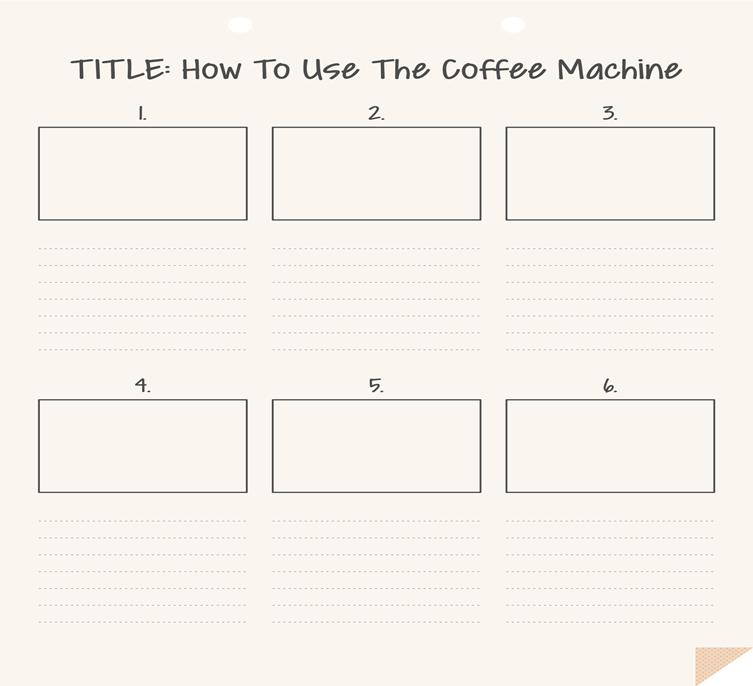
Don’t forget to leave room for the title, number your thumbnails, and have space underneath for you to name your scene and what action will be taking place within it. You can additionally add a space for the script, annotations, audio, or any other steps you want to include.
2. Add your title, scene name, action
Start filling out your blank thumbnails by first adding in your course title as well as the scene name, the action that will be taking place in each box, and any script that corresponds to the scene.
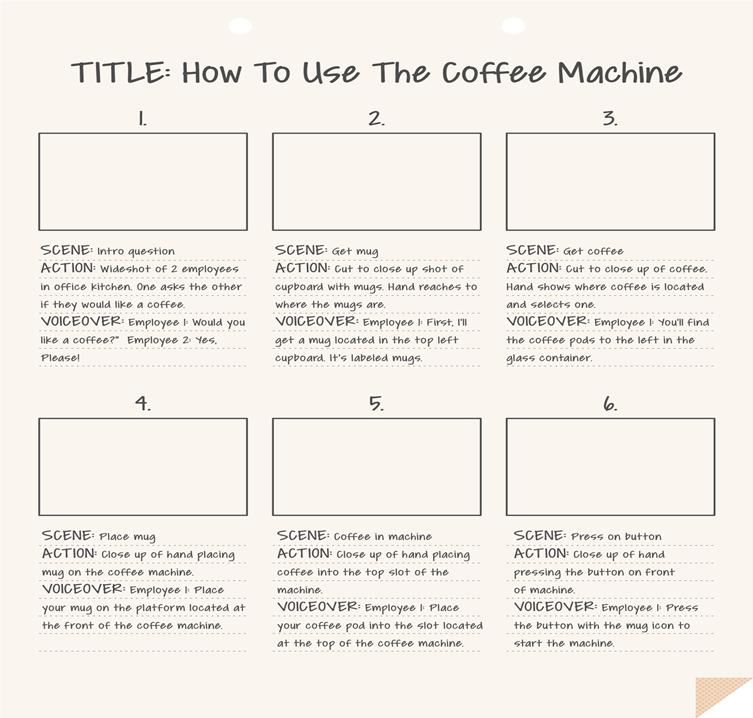
The action description should be a concise explainer that sums up what is happening in each scene. If you find it’s too difficult to explain the action, then perhaps you need to break that scene down into 2 or 3 separate thumbnails. Remember, it’s show, not tell, so it’s okay to have multiple thumbnails in your storyboard!
3. Start Sketching
Now you’re ready to start drawing the storyboard.
Here, you are mapping out how your idea looks visually. It doesn’t have to be highly detailed, but it should give an overall sense of everything that’s happening in each thumbnail.

Some suggested aspects you should include are the point of view from which the learner will be seeing the course and the characters, images, or words that will be featured on screen.
Don’t worry if you’re no Picasso; as long as you’re creating a clear picture, you’re on the right track. You can also pair your script, annotations, and audio at this stage too.
4. Critically assess and adjust
After you’ve finished drafting your storyboard, it’s clever to look at it with a critical eye. Rarely are storyboards perfect after the first attempt; therefore, it’s recommended you go back and ask yourself the questions suggested above again.
This also enables you to ensure your story makes sense or, if not, identify where it needs to be added to or edited. Just keep fine-tuning your storyboard until you’re happy.
5. Start production
Now it’s time for you and your team to start production!
It may seem like a lot of work or even a daunting task; however, storyboards can benefit you and your learners. Give it a try and see how they can work for you.
Have you ever used storyboards before? Let us know your tips and opinions in the comments below.
About the Author