

Introduction
Marketing is more than just sales or promotion; it is a holistic business philosophy that revolves around identifying, understanding, and satisfying human needs and wants profitably. The central tenets of marketing—needs, wants, demands, transactions, transfer, and exchanges—not only form the theoretical foundation of the discipline but also drive the practical strategies that organizations use to build brands, delight customers, and achieve competitive advantage. In this comprehensive discussion, we’ll delve deeply into each of these foundational concepts, illustrate them with real-world examples, and examine case studies from both Indian and global brands.
1. Needs, Wants, and Demands
A. Needs
Definition:
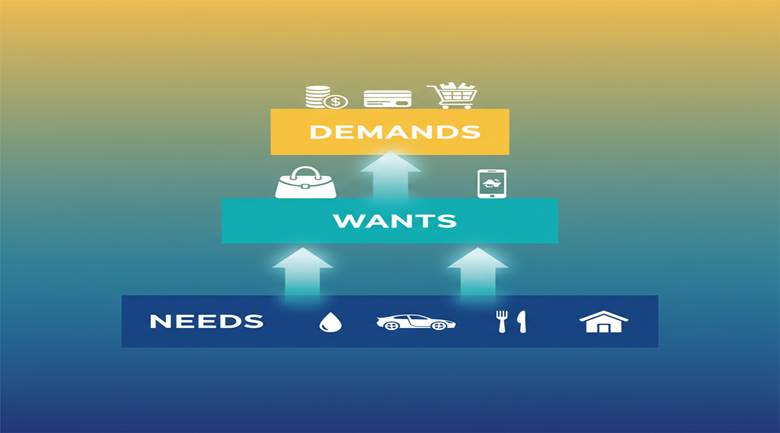
Needs are fundamental human requirements. They are innate and universal, rooted in biology, psychology, and society. Marketers do not create needs; they exist naturally as essential conditions for survival and well-being.
Types of Needs:
- Physical Needs: Food, water, clothing, shelter, safety, health
- Social Needs: Belongingness, affection, friendship, status
- Individual Needs: Knowledge, self-expression, personal development, freedom
Discussion:
Needs are the underlying forces that motivate people to act. They are persistent and cannot be overlooked in the marketing process. Understanding customer needs is the starting point for every successful marketing strategy.
Example:
A person in a hot, arid climate has a need for hydration and protection from heat.
Case Study: Amul (India)
Amul, India’s largest dairy cooperative, was founded to address the nutritional needs of Indian families, especially children. By making milk and dairy products affordable and widely accessible, Amul met a critical physical need for nutrition in a country where protein and calcium deficiencies were prevalent.
Case Study: Unilever Lifebuoy
Unilever’s Lifebuoy soap was launched to meet the need for hygiene and health in developing countries. Its campaigns focus on handwashing to prevent disease, addressing a basic human need for health and cleanliness.
B. Wants
Definition:
Wants are the specific forms that needs take, shaped by culture, society, upbringing, and individual personality. While needs are universal, wants are diverse and influenced by external and internal factors.
Discussion:
Marketers influence wants by providing products and services that fulfill underlying needs in culturally relevant and aspirational ways. Wants evolve with trends, innovations, and societal changes.
Example:
A person who needs hydration in India may want a glass of nimbu pani (lemonade), while someone in the US may want an iced soda. Both fulfill the same need but are shaped by environment and preference.
Case Study: Paper Boat (India)
Paper Boat tapped into nostalgic wants by offering traditional Indian beverages like Aam Panna and Jaljeera. The drinks quench thirst (need) but also evoke fond childhood memories, showing how emotional and cultural factors shape wants.
Case Study: Coca-Cola
Coca-Cola markets not just a drink, but a feeling of refreshment, fun, and togetherness. People may need hydration, but they want the unique taste, experience, and brand association of Coca-Cola.
C. Demands
Definition:
Demands are wants backed by purchasing power—the willingness and ability to buy. Not all wants become demands; only those that can be acted on in the marketplace are considered effective demand.
Discussion:
Marketers gauge demand by analyzing market size, income levels, and consumer intent. Only when enough people can afford and are willing to buy does a want become a demand.
Example:
Many people want a luxury car such as a Mercedes-Benz, but only those with adequate resources can demand it.
Case Study: Apple iPhone
The desire for a smartphone (want) exists globally. However, demand for iPhones is concentrated among those who can afford its premium pricing and are willing to pay for Apple’s unique features, ecosystem, and prestige.
Case Study: Patanjali Ayurved
Patanjali identified that while Indian consumers wanted Ayurvedic products, many could not afford expensive alternatives. By offering high-quality products at affordable prices, Patanjali turned widespread wants into effective demands, leading to spectacular sales growth.
Synthesis of Needs, Wants, and Demands
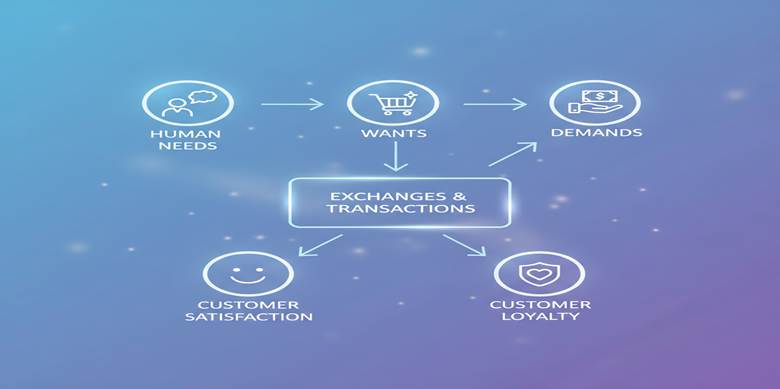
The process begins with a need (e.g., hunger), which becomes a want (e.g., desire for pizza or traditional Indian food), and finally a demand when the consumer has the means and willingness to purchase (e.g., buying a Domino’s pizza).
Case Example: Maggi Noodles
- Need: Hunger and nutrition, especially for children.
- Want: Tasty, quick-to-make snack.
- Demand: Maggi’s affordability and ubiquity make it the chosen product, converting widespread wants into substantial market demand.
2. Transactions
Definition:
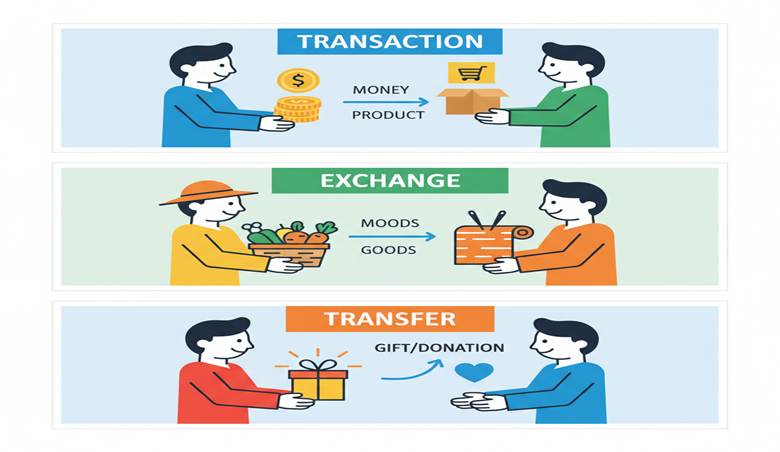
A transaction is the basic unit of exchange—an event where two or more parties trade something of value, agree on conditions, and execute the deal. Transactions are countable, specific, and form the core of the marketplace.
Key Characteristics:
- At least two parties (buyer and seller)
- Something of value exchanged (goods, services, money, or barter items)
- Agreement on conditions (price, delivery, terms)
- Occurs at a specific time and place
Example:
A customer buys a book from a bookstore. Money is exchanged for the book—a straightforward transaction.
Case Study: Amazon India
Amazon enables millions of daily transactions, connecting buyers and sellers. Each order—say, of headphones—constitutes a transaction, complete with payment, shipping, delivery, and sometimes after-sales support.
Case Study: Big Bazaar
Big Bazaar attracts thousands of shoppers daily with bulk purchase promotions (like “Wednesday Bazaar”), leading to high-frequency transactions. These transactions are not just economic exchanges, but moments that reinforce the retailer’s value proposition and customer relationship.
3. Transfer
Definition:
A transfer happens when one party gives an item of value to another without expecting anything in return. Unlike transactions (which involve a reciprocal exchange), transfers are unilateral.
Types of Transfers:
- Gifts
- Donations
- Grants
- Free samples
Example:
Donating clothes to a disaster relief fund is a transfer. The giver expects no physical return.
Case Study: Tata Trusts
Tata Group, through its philanthropic arm Tata Trusts, regularly transfers resources—funds, scholarships, health services—to communities in need. These are not business exchanges but social contributions, enhancing Tata’s reputation as a responsible, caring brand.
Case Study: Corporate Social Responsibility (CSR)
Companies like Infosys and Reliance invest heavily in CSR, transferring resources to support education, healthcare, and environmental causes. While not transactional, these transfers help build goodwill, trust, and brand value.
4. Exchanges
Definition:
Exchange is the act of obtaining a desired product or service from someone by offering something in return. It is broader than a transaction—exchange is a process or relationship, while a transaction is a discrete event.
Five Conditions of Exchange (Philip Kotler):
- At least two parties
- Each party has something of value to offer the other
- Each party can communicate and deliver
- Each party is free to accept or reject the offer
- Each party believes the exchange is desirable
Example:
In rural India, bartering is common: a farmer might exchange a sack of wheat for a bag of rice.
Case Study: Flipkart Marketplace Model
Flipkart connects sellers and buyers in a digital marketplace. Sellers offer products; buyers offer money. Flipkart facilitates the exchange, ensuring trust, payment, and timely delivery.
Case Study: Uber
Uber’s platform enables value exchange: riders pay for transportation, drivers provide the service, and Uber orchestrates the communication and payment.
5. Interrelationship of Needs, Wants, Demands, Transactions, Transfer, and Exchanges
The sequence begins with needs, which become wants (influenced by culture and personality), which become demands when backed by purchasing power. These lead to exchanges when parties agree to swap value, realized through transactions. Transfers are one-way flows of value, often used for marketing or social good.
Example: FMCG Sector
- Need: Cleanliness and hygiene.
- Want: Branded soap with a pleasant fragrance.
- Demand: Consumers buy Lifebuoy or Lux based on price, brand, and preference.
- Exchange: Money for soap.
- Transaction: A purchase at a supermarket.
- Transfer: Distribution of free samples at health camps.
Case Study: Hindustan Unilever Limited (HUL)
HUL addresses the need for hygiene with multiple soap brands. By offering a range of prices and attributes, HUL meets diverse wants and demands. Its rural outreach initiatives often involve transfer (free samples), which can translate into future transactions and sustained exchanges as customers adopt the brand.
6. Expanded Case Studies: Real-World Applications
A. Maggi Noodles (Nestlé India)
Needs, Wants, and Demands:
- Need: Hunger and nutrition for children and busy families.
- Want: Quick, tasty snack.
- Demand: Affordable, accessible Maggi noodles meet the market’s demand.
Transactions and Exchanges:
Every Maggi purchase is a transaction. These repeated transactions (millions daily) create a powerful brand-customer relationship.
Transfer:
After the Maggi crisis (2015), Nestlé distributed free samples and held community cooking events—transfers used to regain trust and rebuild demand.
B. Ola Cabs
Needs, Wants, and Demands:
- Need: Transportation and mobility.
- Want: Comfortable, reliable, and affordable rides.
- Demand: Ola’s app-based booking and dynamic pricing turn wants into market demand.
Transactions and Exchanges:
Each cab ride is a transaction; the ongoing use of Ola is an exchange relationship.
Transfers:
Promotional rides (“first ride free”) are transfers that encourage initial adoption and foster loyalty.
C. Starbucks
Needs, Wants, and Demands:
- Need: Caffeine and refreshment.
- Want: Gourmet, customized coffee in a pleasant ambiance.
- Demand: Customers pay a premium for Starbucks’ experience and brand promise.
Transactions and Exchanges:
Every coffee sold is a transaction, but the larger exchange is for a lifestyle and status symbol.
Transfer:
Starbucks offers loyalty rewards and free drinks—transfers that build customer relationships and stimulate repeat transactions.
D. Flipkart (India’s Digital Marketplace)
Needs, Wants, and Demands:
- Need: Access to a wide range of goods.
- Want: Convenient, reliable online shopping.
- Demand: Flipkart’s affordable pricing, delivery reach, and service quality convert wants into actual demand.
Transactions and Exchanges:
Purchasing on Flipkart is a transaction; the ongoing customer relationship relies on repeated exchanges.
Transfer:
Festival sales, cashback, and first-purchase discounts are transfers designed to attract and retain customers.
E. Netflix
Needs, Wants, and Demands:
- Need: Entertainment and leisure.
- Want: On-demand streaming of movies and shows.
- Demand: Millions willing to subscribe and pay monthly fees.
Transactions and Exchanges:
Each subscription payment is a transaction; the ongoing provision of content constitutes an exchange.
Transfer:
Free trial periods are transfers used to convert potential customers into paying subscribers.
7. Theoretical Insights and Evolving Perspectives
A. Psychological Aspects
Needs, wants, and demands are not static. Modern marketing draws from psychology to understand how new needs (e.g., digital privacy), wants (e.g., sustainable products), and demands (e.g., instant delivery) emerge as societies and technologies advance.
Example:
The rise of plant-based meat reflects evolving needs (health/environment), wants (taste/variety), and growing demand as disposable incomes rise.
B. Social and Cultural Influences
Culture and society play key roles in shaping preferences. What is considered a want or a luxury in one country may be a need in another.
Example:
Air conditioning is a want in temperate climates, but in the Middle East, it is nearly a need.
C. B2B vs. B2C Marketing
While the concepts apply across contexts, their manifestation differs. In B2B, needs may be technical (e.g., a manufacturer needs reliable machinery), and exchanges often involve complex contracts rather than simple transactions.
Example:
A hospital (B2B) may need advanced MRI machines (want: latest model, demand: when budget allows), leading to multi-stage transactions and after-sales service exchanges.
8. Strategic Implications for Marketers
Understanding these concepts empowers marketers to:
- Identify latent and explicit needs: Use market research, ethnography, and data analytics to uncover unarticulated needs.
- Shape wants: Through branding, storytelling, and innovation, marketers can transform basic needs into aspirational wants.
- Stimulate and capture demand: Make products accessible, affordable, and desirable through pricing, distribution, and promotion.
- Facilitate exchanges: Build systems (e-commerce platforms, marketplaces, loyalty programs) that make exchanges easy and trustworthy.
- Leverage transfers: Use free samples, CSR, or trial offers to build awareness, goodwill, and eventually, market share.
9. The Digital Paradigm Shift
Digital marketing has amplified the speed and reach of these concepts. Needs can be identified in real-time (e.g., Google search trends), wants can be influenced instantly (through influencers and social media), and demand can be measured and fulfilled rapidly (via e-commerce).
Example:
Amazon’s use of algorithmic recommendations shapes wants and stimulates impulse demand, while one-click checkout facilitates seamless transactions.
Case Study: D2C Brands (Direct-to-Consumer)
Brands like Mamaearth or boAt in India have capitalized on digital platforms, using targeted content to identify needs (e.g., toxin-free skincare), shape wants (influencer endorsements), convert them to demand (flash sales), and facilitate fast exchanges (same-day delivery).
10. Conclusion
The core concepts of marketing—needs, wants, and demands; transactions; transfer; and exchanges—are the bedrock of all marketing activity. They explain why markets exist, how value is created and delivered, and how organizations can build enduring customer relationships.
Through the lens of Indian and global case studies—Amul, Maggi, Paper Boat, Ola, Starbucks, Flipkart, Apple, Netflix—we see that organizations that deeply understand and operationalize these concepts are able to innovate, adapt, and succeed even in the most competitive environments. Whether it’s meeting a basic human need or shaping new wants through branding and technology, the journey from need to demand, and transaction to ongoing exchange, is the essence of marketing.
Marketers who master these principles can anticipate trends, respond to evolving customer expectations, and create lasting value for both their organizations and society at large.
About the Author