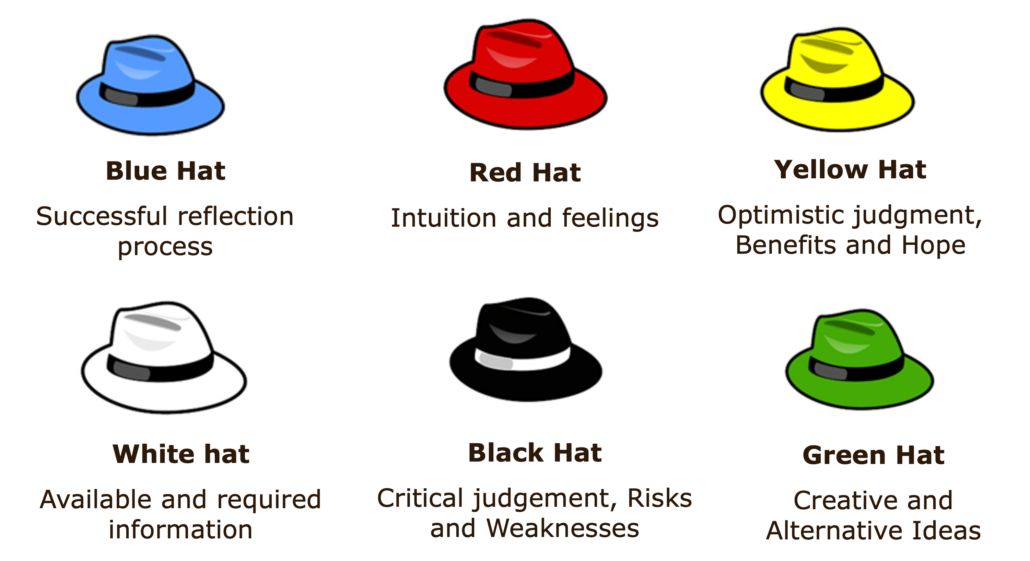


1. Six thinking hats
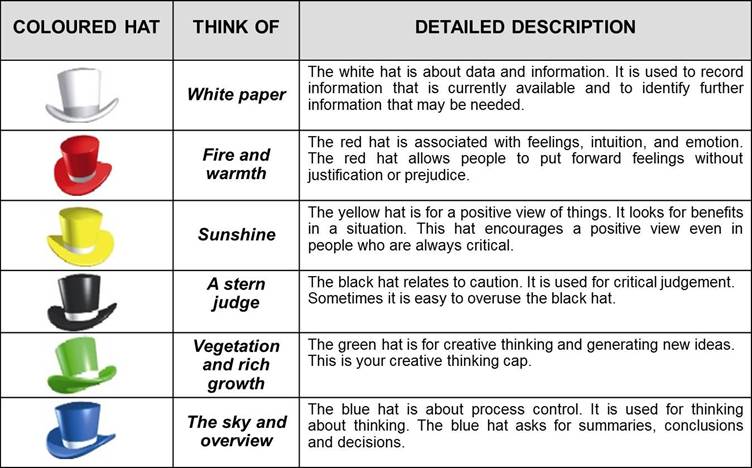
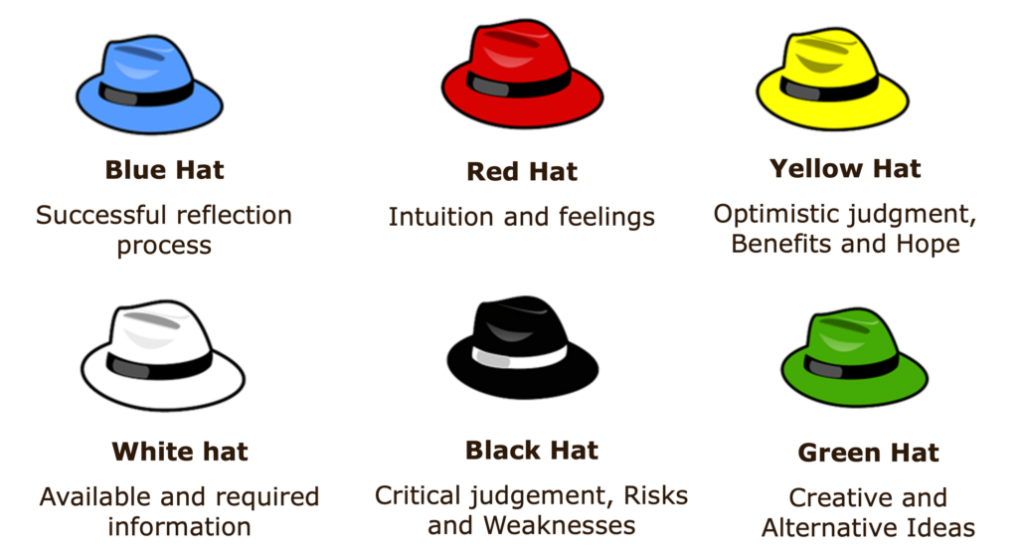
The six types or “Thinking Hats,” are
2. Brainstorming
The brainstorming method yields measurable significance by generating a large quantity of thoughts and ideas. This collection provides a diverse range of possible answers to the problem.
3. Problem inventory analysis
The problem inventory method is a method for obtaining new ideas and solutions by focusing on problems. Here, instead of creating new ideas, the consumers are provided with a list of problems and discuss them. After discussing various issues with consumers, this method either addresses all problems with solutions or helps develop an entirely new product and idea.
4. Focus group
In this technique, a group of individuals provide information in a structured format. Mediators lead a group through an open discussion and ask direct questions or ask for member responses and actions.
5. Reverse thinking
This problem-solving method or technique asks us to think differently. Instead of working on the problem in front of us, problem solvers work on the opposite of it.
6. Mind mapping
Mind mapping is a technique of presenting the information. It is very common in various creative fields. In this technique, an individual or leader writes down the problem on a whiteboard and then surrounds it with words that point out the things that you feel you may need in order to solve it.
7. Synectic
George M. Prince and William J.J. Gordon established this technique. In this technique, an individual takes a thing apart and then puts it back together. In this way, it helps to have a healthier idea of how things work. It is generally categorized as a creative problem-solving method along with lateral thinking and brainstorming.
8. Lateral thinking
Lateral thinking is a method of philosophy that looks for a solution to a determined issue through conventional methods that would generally be ignored by logical thinking. It may also be defined as a way to solve problems by an indirect approach.
About the Author