


The response process
- Traditional response hierarchy models: AIDA
- Communication objectives
- DAGMAR: An approach to setting objectives
A. TRADITIONAL RESPONSE HIERARCHY MODELS: AIDA
AIDA (Attention or Awareness, Interest, desire, and Action)
Introduction
The AIDA marketing model is a marketing, advertising, and sales approach methodology designed to provide insight into the customer’s mind and represent the steps needed to cultivate leads and generate sales. The AIDA model is widely used in marketing and advertising to describe the steps or stages that occur from the time when a consumer first becomes aware of a product or brand through to when the consumer trials a product or makes a purchase decision.
Businessman Elias St. Elmo Lewis introduced the AIDA model in the late 19th century. As an acronym, AIDA breaks down into the steps required for successful marketing: Attention, Interest, Desire (or, in some variations, Decision), and Action. Modern marketing relies heavily on the AIDA marketing model, believing that omitting one step almost guarantees an unsuccessful outcome. Currently, many modified alternative models are in use. During the past 100 years, the model has undergone many refinements and extensions, such that today there are many variants in circulation.
Definition
AIDA is a model of communication that is designed to capture the process that firms go through to reach prospective buyers to sell their products and services. It is an acronym for Attention, Interest, Desire, and Action that demonstrates the successive stages buyers pass through in a linear hierarchy (Belch, 2008). Following the original conception, a further factor of ‘S’ was added to recognize the importance of customer ‘satisfaction’ as the ultimate aim of products/services, forming the acronym AIDAS (Kotler and Armstrong, 2011). The AIDA model has served many marketers as an enduring process for creating everything from sales letters to TV ads.
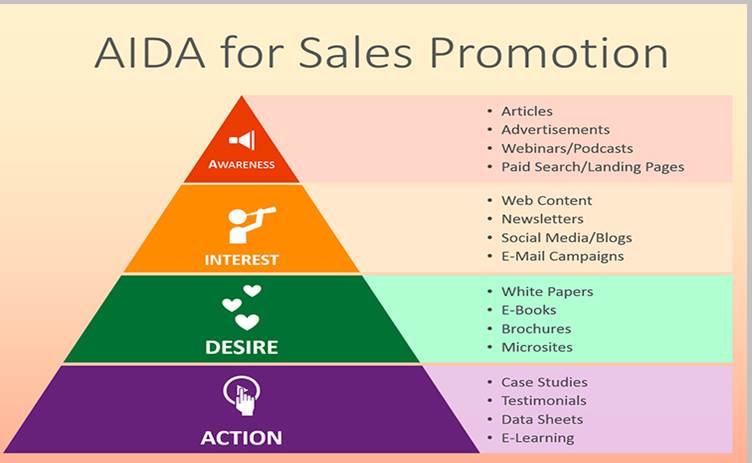
The method of AIDA
- Attention: Attention is usually grabbed by the use of image, colour, layout, typography, size, celebrity, model, etc.
- Interest: Once attention is grabbed, it’s necessary to create interest in the viewer’s mind so that they will read more about the brand being advertised. By the use of an attractive subhead, interest can be invoked
- Desire: The element of desire is usually created by the use of body copy where you write in detail about the necessity of buying the brand, thereby explaining the features of the brand, facts and figures
- Action: Towards the end, the contact information of the brand will be given where they expect the viewers to take action immediately. It can be in the form of a shop address, toll-free numbers, or a website address.
B. COMMUNICATION OBJECTIVES
Introduction
The wide-ranging field of agencies and companies needs continuous contact with stakeholders, customers, media professionals, or their own staff and personnel. The communication objectives are varied, and it joins with other areas of a company, like advertising, marketing, public relations, and others. In principle, communication is a basic requirement for both small and big agencies and organizations. That is why communication is the major factor that ensures better relations among the clients, employees, stakeholders, and others.
Communication is demarcated as activities; it includes both internal and external communication in an organization. In internal communication, it may include personal, face-to-face communication and intercom office communication by phone, fax, email, memos, and feedback. It is used for ordering, discussion, or passing information to all levels of employees within the organization. In external communication, it includes communication with customers, buyers, vendors, stakeholders, investors, distributors, competitors, governmental departments, etc. Reports are prepared for coordination, negotiation, dealings, cooperation discussions, and others, which pave the way for smooth functioning of the organization.
An uprising or changing setup in the business scene has forced the businesses to change and familiarize themselves with the current business setting. In this situation communication plays an essential role in producing value to the organization. It includes the principles, values, beliefs, words, philosophy, and visuals that are used by agencies to communicate both internally and externally. It is a significant measure of agencies to create a positive image of the organization among the investors, stakeholders, distributors, employees, consumers, and others.

Objectives of communication
- It provides an intellect to order and control the organization.
- It aims to share inspirational information and messages with the subordinate staff.
- It is generally used to educate and update on the current or future changes occurring in market trends.
- It is an effective internal and external communication tool for agencies to achieve successful brand positioning for their clients.
- It helps to create consistency in the message, which is important to retain the brand image and reputation.
- It is a key driver that influences the decision-making process of consumers.
- It is a strategy that leads to achieving the client’s purposes and commitment in an efficient manner.
- It creates a real-time value for client products through effective advertisements and promotions.
- Except for the above-mentioned objectives of communication, many other things are required, like managing staff, smooth functioning of internal and external processes, direction and forecasting, and others that are needed at all levels of agencies and organizations.
C. DAGMAR: An approach to setting objectives
Introduction
The DAGMAR model was entitled ‘Defining Advertising Goals for Measured Advertising Results.’ The model was developed by Russell Colley in 1961 for setting advertising objectives and measuring advertising results.
Russell Colley prepared a report for the Association of National Advertisers in the year 1961. In this report Colley developed a model for setting advertising objectives and measuring the results of advertising campaigns.
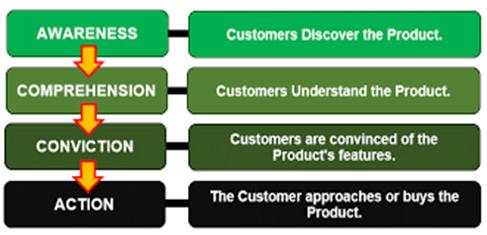
The DAGMAR model is based on the communication objective of advertising. According to this model, it advocates a marketing campaign that guides the consumer through four phases; it includes awareness, comprehension, conviction, and action.
- Awareness: In the first stage, making the consumer aware of the existence of the brand or company.
- Comprehension: In the second stage, making the consumer understand the product and its uses.
- Conviction: In the third stage, it persuades the consumer to buy the product.
- Action: In the last fourth stage, getting the consumer to actually purchase the product.
All the above-mentioned stages make it very clear that the first-stage task of the advertisement is to gain awareness of the brand presence in the market. The second stage is to make consumer understand and learn about the brand; that is, the consumer will learn about product features, methods of uses of product, place of availability, etc.
The third stage is to convince the consumer to buy the product. In this stage, the prospective buyer will be made to feel that the advertiser’s brand is better than the competitor’s brand through highlighting the best features of the product. In the last stage, consumers come to a final selection and are made to actually buy the products. Thus, according to the DAGMAR model, the target audience passes through all four stages while making the final decision to buy particular brand products.
An approach to setting objectives
Advertising objectives should be clear, precise, measurable, and specific. These objectives must be communicated to the creative specialists who develop the advertising message, and media objectives help define other important questions, such as the who, where, and when of the target audience in the context of an overall plan and budget. It will help to direct advertising activities towards attainment of advertising objectives. Objectives should be measurable. It will help in evaluating the advertising effectiveness. Let’s discuss the media objectives and creative objectives in detail.

1. Media objectives
Media objectives define the who, where, and when of the target audience in the context of an overall marketing plan and budget. However, it is important to note that media objectives don’t state which media will be used, because how advertisers reach the audience is part of setting a media strategy. Elements of media objectives includes
- Who: Target audience objectives
- Where: Geographic objectives
- When: Scheduling, timing, frequency, and reach objectives.
- Money: Media budget objectives
- Marketing co-ordination: Sales promotion objectives
2. Creative objectives
The creative objectives deal with the form and content of the advertising. It defines the key elements of objectives; it may include the following:
- What do you want to say? (For example: a message to communicate to a consumer or trying to convince)
- How do you say it? (For example: Emotional, fearful, exciting tone, etc. in advertising)
- What does the advertising look like? (For example: informative, entertaining, knowledgeable, funny, etc.)
The creative objective might agree that the advertising will support present features of the brand personality, transform traditional perceptions of the brand, or instill new brand characteristics.
About the Author