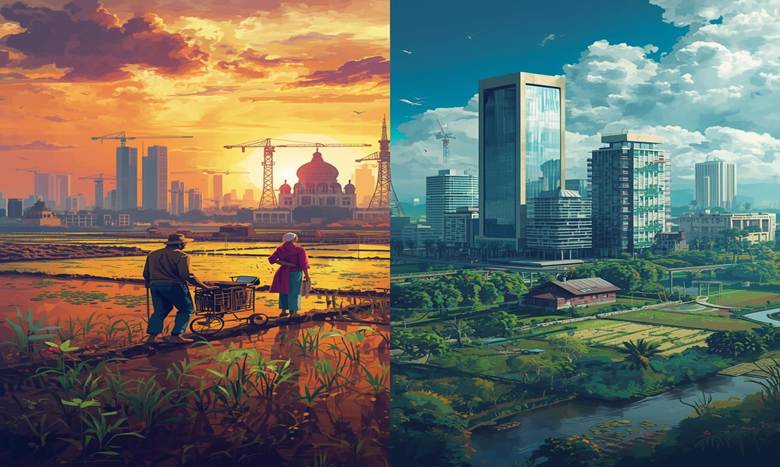


Agriculture was the primary driving force behind industrialization in the majority of industrialized and developed nations. It is crucial to the Indian economy. More than 70% of rural households rely on agriculture for their livelihood. Moreover, it plays a crucial role in all economies, irrespective of their level of advancement. It fulfills essential human needs by addressing both food and non-food needs. Indian agriculture has experienced remarkable growth in recent years. Examining the influence of agriculture on economic development is crucial to assess its significance in the Indian economy.
A. Concepts and characteristics of the rural economy
Concept
Rural development is the process of making people’s lives better and their finances better, especially those who live in thinly populated or remote places. In the past, rural growth was based on misusing natural resources that needed a lot of land, like farming and forestry. But now, more and more people live in cities, and changes in global production networks have changed the way rural places work.
The progress of rural areas is still crucial to the growth of the whole country. More than two-thirds of the population in the country depend on farming for their livelihood, with one-third of rural India still living in poverty. Because of this, it is important for the government to work diligently and give them enough facilities to raise their level of living.
The actions that are taken to make rural areas better places to live and work to boost the economy are called rural development.
Characteristics of rural economy
- The village is an institution: the village is the main institution in the rural community, and it meets almost all of their needs. People who live in rural areas feel like they belong and are united with each other.
- Dependence on Agriculture: An important part of the country’s economy is nature and farming. In rural places, farming and related jobs are the main source of income.
- Life in the Country: People who live in the country have basic lives. There are insufficient public services available, such as housing, schooling, health and sanitation, transportation and communication, banking, roads, and markets. Faith, traditions, and old ways of doing things are critical to people who live in rural areas. Most rural people have very low standards of life, which is sad. The rural sector lags significantly behind in terms of production methods, social organization, and political action. In the past few years, more people have been drinking booze.
- Population Density: The number of people living in one square kilometer is very low, and houses are spread out all over the villages.
- Employment Opportunities: In rural places, there is unemployment, seasonal unemployment, and underemployment. Individuals who are ready and able to work but cannot find work are said to be unemployed. Underemployment, which is also known as “disguised unemployment,” is when people are working more than they need to. When people work but production doesn’t go up, the condition is called “masquerading unemployment.” In rural places, both of these things constantly happen.
- Poverty: People are poor when their basic needs aren’t met, like getting food, clothes, and a place to live. The figures for 2011–12 show that about 22 crores of people in rural areas are poor and live below the poverty line.
- Debt: People in rural areas have a lot of debt because they are poor and don’t have enough jobs. This is because farm and non-farm jobs are scarce, the jobs pay little, and output is seasonal. In 1925, the famous British author Sir Malcolm Darling said, “An Indian farmer is born in debt, lives in debt, dies in debt, and leaves debt behind.” The villagers can’t get formal loans, so they have to rely on local moneylenders, who take advantage of them like parasites. As a result, many people in the village kill themselves.
- Rural Income: People in rural areas earn little because the rural economy is too weak to provide jobs or self-employment opportunities. Many trained workers and laborers are underemployed, and there aren’t many ways for them to make more money.
- Dependence: Most rural households rely on social grants and money sent back from family members who work in cities and towns.
- Dualism: Two very different things existing together in the same place, such as developed and underdeveloped, organized and disorganized, traditional and modern, controlled and unregulated, poor and rich, skilled and unskilled, and other situations that seem to go against each other. People who live in country areas often have these traits.
- Inequality: The distribution of income, wealth, and assets is uneven for individuals residing in rural areas. Numerous factors in history, society, and politics contribute to this imbalance. Landlords and owners control most of the operations in rural areas. A small group of people own land, animals, and other things.
- Migration: People from rural areas have to leave their homes and move to cities in search of work to make a living. Cities are made possible by the way that growth works in this way. Bad relationships and a lack of basic amenities lead people to migrate from rural areas to cities. For Schumacher, this is like “double poisoning” because on one side, the farms are empty, and on the other, the towns are crowded. In his book “Small is Beautiful,” he discusses the problems with the way things are growing now.
B. Factors affecting rural economy
1. Rising level of knowledge
More reading and writing skills mean more job opportunities. According to the NSS, the literacy rate in rural areas in 2014 was 72.3% for men and 56.8% for women. This number is better than the rate in 2000, which was 68% for men and 43% for women.
Literacy rates are going up every year. Through SWAYAM and eVIDYA, the government has started to offer online classes. Through programs like Sarva Shiksha Abhiyan (SSA) and Rashtriya Madhyamik Shiksha Abhiyan (RMSA), the government has tried to get more people to go to school.
2. Work on infrastructure
For rural areas to grow, they need to have excellent infrastructure. Some of the most important signs of rural growth are roads, ways to communicate, electricity, clean water, irrigation systems, drainage lines, and decent places to live. In rural India, there have been more building projects and public service announcements in the past 20 years.
3. Adding new job opportunities
India’s rural areas have grown thanks to different policies, which have created new job possibilities. This kind of program is called TRYSEM (Training Rural Youth for Self-Employment). The main goal of this strategy was to teach young people technical skills.
The most recent example is the Atma Nirbhar Bharat Abhiyan, in which Hon. PM Modi asked companies to receive money to build prototypes. This will lead to more jobs over the next ten years.
4. The growth of mass media
People in rural areas are more aware now that there are more ways to communicate, like TV, social media, and radio. They can now seek employment, learn new skills, and talk to people outside the town thanks to cell phones and the internet.
Many people in rural places now know about government programs that can help them with farming and other activities. This is because of the growth of mass media.
5. Research in agriculture
The Indian Council of Agricultural Studies (ICAR) is in charge of agricultural studies in India. Research helps us figure out how food yield changes when the weather and soil are different, as well as how using certain fertilizers can boost production. Farmers have been helped by the use of new scientific tools. The green revolution came about because of this.
6. The effect of cities
Social media and other forms of communication have brought people from rural areas closer to people from cities. People in cities have an effect on people in the country. It changed how they lived and what they bought, which made more people want to buy consumer things.
Many industries and MNCs joined the rural market because of higher demand. MNCs worked to deliver their products to people at prices they could pay. More purchases contributed to the market’s growth. MNCs also started hiring locals, which raised the rate of employment.
7. Initiatives by the government
India’s government has done a lot to help rural areas grow and improve. Here are a few examples:
- For self-sufficiency, Operation Flood and the White and Blue Revolution
- The Integrated Rural Development Program (IRDP)
- REP—Rural electrification program for providing an electricity supply
- PSU and Banks lending money to farmers
- Banks and the PSU Getting farmers loans
8. Contract farming
Contract farming is when businesses give farmers high-yield seeds and expect them to grow crops and send them back to the business. In this way, farmers don’t have to use their money to grow.
C. Basics needs of rural economy
Rural development is crucial for the comprehensive growth and advancement of the Indian economy for the following reasons.
- A significant portion of the population resides in rural areas, and their growth and contributions play a crucial role in supporting the nation-building efforts. India cannot achieve development by keeping rural areas underdeveloped.
- The rural economy aids the urban sectors by providing essential resources such as drinking water, milk, food, and raw materials. The underdevelopment of the rural sector will significantly hinder the overall economic advancement.
- Enhancements in education, health, and sanitation in rural areas can prevent certain urban issues such as begging, scavenging, and the formation of roadside slums.
- Agriculture and related activities are essential for creating employment opportunities in rural regions and enhancing total food output.
- Developing rural areas can help decrease the negative effects of brain drain and rural-urban migration.
- Developing the rural economy is necessary to make better use of underused and underutilized resources.
- Rural development should reduce the disparity in infrastructure provision between rural and urban areas.
- To enhance the country’s position in the global sphere regarding economic metrics such as the Human Development Index (HDI), Women Empowerment Index (WEI), Gender Disparity Index (GDI), Physical Quality of Life Index (PQLI), and Gross National Happiness Index (GNHI), these factors should be prioritized.
D. Rural-Urban disparities and Policy interventions.
Introduction
Rural development requirements differ from urban development demands and vary across different geographic locations and regions. Rural development in India largely focuses on the development of resources necessary for daily activities in a large and divided country. The main reason for a limited sectoral approach to rural development is the illogical placement of manufacturing facilities, inadequate infrastructure, and various other issues. The focus is on electrification, jobs, basic healthcare, and water management. Development work is carried out for a specific group or area within a cluster using a cluster management approach.
Urban development involves improving systems, traffic management, transportation, infrastructure, building management, and institutional management. The attitude, literacy, desire to adapt, and flexibility of target audiences vary in each scenario. Rural and urban development are interdependent for achieving comprehensive economic growth.
Should India change its focus?
Mahatma Gandhi’s statement, “India lives in its villages,” remains accurate in the present day. Rural communities have not benefited from development despite rising urbanization. These regions continue to experience challenges such as malnutrition, lack of education, joblessness, and inadequate infrastructure, including schools, universities, hospitals, and sanitary facilities.
The significant difference in living standards clearly indicates the contrasting aspects of India, which is a rapidly rising economy and one of the largest in the world. Rural Indian communities must develop concurrently with metropolitan regions, and the quality of life there must be enhanced for inclusive growth to take place.
The following are some disparities between rural and urban regions:
1. Disparities in Education
Urban areas undoubtedly boast superior infrastructure and educational systems compared to their rural counterparts. At both the elementary and secondary school levels, educational institutions in urban areas are extremely advanced, and the urban area education system is designed to provide students with a more enjoyable learning environment.
Conversely, in rural regions, students are deprived of even the most fundamental services and infrastructure; private schools and colleges are nonexistent, and teachers in government schools rarely attend classes. Only in such circumstances do students have the opportunity to receive an appropriate education.
2. Urban versus Rural Health Disparities
This section will cover healthcare disparities. Overall, urban health and medical systems are superior to their rural counterparts. The health sector in urban areas is more advanced and developed than that in rural areas.
In the rural healthcare sector, there is a dearth of appropriate medical equipment, inadequate infrastructure, and the majority of practitioners engage in fraudulent practices. This is the rationale behind the preference of individuals residing in rural regions to seek medical services in urban areas. The Indian government has been diligently operating in an effort to reduce the disparity between urban and rural health.
3. Employment Opportunity Disparities
In this regard, the contrast between urban and rural areas is likely the most pronounced. The rural populace relies heavily on agriculture for sustenance. Additionally, approximately sixty percent of the nation’s populace is involved in agricultural pursuits. Work restraint in the secondary and tertiary sectors or in the non-agricultural sector.
Certainly, those with an interest in pursuing careers in the tertiary or secondary sectors will find more favorable opportunities in urban settings. Over the past few years, rural areas have witnessed the emergence of several employment opportunities beyond farming. These include working in the marketplace, mining, teaching, small-scale industries, and more.
4. Architectural Disparities
In rural regions, the majority of inhabitants inhabit modest dwellings constructed from mud, thatched roofs, and huts; these structures are typically uncomplicated and impermanent, rendering them susceptible to damage from natural calamities such as heavy rainfall, floods, or tsunamis.
Conversely, an urban region predominantly comprises expansive apartments, while houses in this sector are built utilizing cement, cutting-edge technologies, and contemporary machinery, none of which are susceptible to damage.
5. Lifestyle Disparities
The rural populace generally leads a very uncomplicated way of life. Due to the prevalence of day-to-day employment in the agriculture or dairy industries, rural residents typically lack access to electricity in their dwellings and rely on ovens to prepare their meals. The lifestyle in urban areas is characterized by greater development and improvement.
Individuals in urban areas earn higher wages as a result of increased employment opportunities, which in turn raises the demand for shopping, food, and new digital technologies. Consequently, novel products and services are imported from other nations, and new categories of items have emerged in urban areas, all of which contribute to the enhancement of the lifestyle of urbanites.
E. Role of Agriculture in the Economic Development of India.
Agriculture’s significance in India’s economic development cannot be ignored, despite the crucial role performed by industries. This section will outline the seven crucial roles of agriculture in economic development.
1. Meets the growing food demands of the nation
Agriculture in India plays a crucial part in providing food. Agriculture meets the increasing food demands of the growing population. Food production is rapidly expanding, putting a heavy burden on surplus labor markets like India. If agriculture cannot continually increase its surplus of food grains, a catastrophe is likely to happen. Several developing countries are currently experiencing this phase, and agricultural practices will be enhanced to fulfill the increasing food requirements.
2. Distribution of raw materials to agricultural-based industries
Agriculture supplies raw materials to many agro-based industries like sugar, cotton textiles, jute, and vanaspati. Agriculture is crucial to the food processing business. The expansion of these industries is crucial for agriculture and farmers.
3. Improving Rural Quality of Life
Greater agricultural surpluses resulting from higher agricultural production have a positive impact on society welfare, particularly in rural areas.
4. Facilitates capital accumulation
There is a general agreement on the necessity of capital formation. Agriculture plays a crucial role in the economic growth of emerging countries like India by speeding capital formation due to its significance as the primary industry. If it does not comply, the entire economic growth process will face a setback.
5. Industrial Product Market
Rural purchasing power expansion is essential for industrial development, as villages are home to two-thirds of the Indian population. Big farmers had an increase in spending power due to their higher revenues and minimal tax obligations following the green revolution.
6. Contributes to the national Gross Domestic Product (GDP)
Agriculture has always played a vital part in contributing to India’s national GDP. In 1950-51, agriculture and related sectors contributed around 59% to the total national income. Although the share of agriculture has decreased steadily due to the growth of other industries, it remains comparatively high compared to industrialized nations worldwide.
7. Infrastructure Development
Agriculture’s involvement in economic development requires the establishment of infrastructure such as roads, postal services, marketplaces, warehouses, shipping facilities, and other components to facilitate the rise of industries and the commercial sector.
About the Author