


Introduction
According to Richard Nordquist, a weasel word is a modifying word that undermines or contradicts the meaning of the word, phrase, or clause it accompanies, such as “genuine replica.” This term is also referred to as weaselism.
More broadly, “weasel word” may refer to any word that’s used with the intention to mislead or misinform. The term was coined by author Stewart Chaplin in 1900 and popularized by Theodore Roosevelt in a speech in 1916. The weasel claim is the most popularly used advertising trick. The words are phrases used in advertising (or press releases) that convey an impression of meaning without actually saying it.
It involves using “weasel words,” or words that are meant to trick the audience into thinking the product is better than it really is. Words such as “virtually,” “fights,” and “helps” are all weasel words. The weasel claim uses weasel words to take what could be a solid claim and make it worthless by weakening any bold assertion with words such as “helps,” “probably,” “refreshes,” “fights,” “strengthens,” “virtually,” “like,” “almost,” and so on. Example:
- Steakies taste almost as delicious as they sound.
- Head & Clean helps stop dandruff completely.
- Persil makes your dishes virtually spotless.
- Probably the best beer in the world.
- We could make you look like a real celebrity.
Weasel advertisements in India
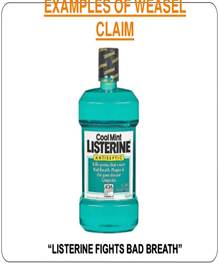
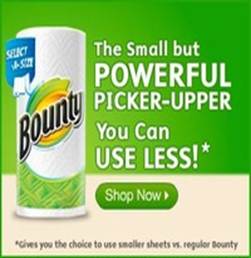

Uses of weasel advertising
We use weasel words to instill an idea in readers’ minds that surpasses the actual claim. Working from vague, indeterminate facts (or no facts at all), you can generate perceptions that may be completely at odds with reality without making a definite, absolute, or concrete claim that could be open to challenge.
- Help to: In conjunction with ‘can’ (see below), ‘help to’ positions your product or service as part of the solution to a problem without taking sole credit. For example, Crunchaflakes can help to reduce weight as part of a calorie-controlled diet.
- Can and could: Use ‘can’ and ‘could’ for indefinite claims that you want to sound definite. For example, while traditional fan heaters have an average lifetime of 10–15 years, the Room Heater 32 can keep on pumping out heat for decades.
- Hundreds and thousands: Look again at the example above. What period does ‘decades’ actually denote? Dunno, but it sounds like ages—just as words like ‘dozens,’ ‘hundreds,’ and ‘thousands’ sound like big quantities.
- Fractions: Closely related is the word ‘fraction,’ as in ‘now available at a fraction of the original price.’ 99/100ths is a fraction, but your audience will think of the ones they learned at school, like 1/2, 1/3, and 1/4, which will make them think you’re offering a huge discount.
- Relative improvement: Whiter teeth. Improved search engine rankings. Increased sales. Shinier hair. Whatever it is you’re offering to do, make it relative and unquantified, not absolute and specific. That way, even the tiniest improvement fulfills the promise.
- Up to: ‘Up to’ or ‘as much as’ are used when you want to quote a numerical or statistical claim but can only substantiate it within a certain range.
- ‘As much as’ and ‘as little as: For a rhetorical twist, use ‘as much as’ or ‘as little as’ to imply that the figure you’re quoting is particularly high or low. For example: The iPhone is now available for as little as £35 per month.
About the Author