

Introduction
The marketing mix is a foundational model for businesses, guiding them to effectively market their products and services. Traditionally composed of the 4P’s—Product, Price, Place, and Promotion—this model has evolved into the more customer-centric 4C’s—Customer Solution, Cost, Convenience, and Communication. Understanding both frameworks and how they interrelate is vital for designing successful marketing strategies in today’s dynamic marketplace.
The 4 Ps of Marketing
The 4 Ps represent the controllable elements businesses use to satisfy customer needs, influence demand, and achieve their objectives.
1. Product
Definition:
The tangible good or intangible service offered to satisfy customer needs and wants.
Example:
Apple’s iPhone is a product dethat features regular updates, aleek design, and advanced technology.
Key Product Decisions:
- Key product decisions include features, quality, design, brand name, packaging, services, and guarantees.
2. Price
Definition:
The amount of money customers must pay to acquire the product or service.
Example:
Netflix uses tiered subscription pricing, catering to different audience segments.
Key Price Decisions:
- Key price decisions include pricing strategy (premium, competitive, penetration), discounts, payment plans, and psychological pricing.
3. Place (Distribution)
Definition:
The channels and locations that make the product available to customers.
Example:
Amazon’s vast distribution network ensures that it delivers products quickly, even to remote Indian towns.
Key Place Decisions:
- Distribution channels, market coverage, inventory, logistics, retail locations, and e-commerce.
4. Promotion
Definition:
The activities that communicate the product’s value and persuade customers to purchase.
Example:
Cadbury’s Diwali campaigns use emotional storytelling and media to boost chocolate sales during festivals.
Key Promotion Decisions:
- Advertising, sales promotions, public relations, direct marketing, digital marketing, and influencer partnerships.
The 4 Cs of Marketing
The 4C’s framework shifts focus from the business to the customer, emphasizing value creation, cost, convenience, and open communication.
1. Customer Solution (vs. Product)
Definition:
Understanding and providing solutions to customer problems rather than just selling a product.
Example:
BYJU’S offers interactive learning solutions, not just educational content, making online study engaging for students.
2. Cost to Customer (vs. Price)
Definition:
The total cost that a customer incurs, including price, shipping, time, and psychological costs.
Example:
Flipkart’s “No Cost EMI” and hassle-free returns reduce the financial and mental cost of online shopping for customers.
3. Convenience (vs. Place)
Definition:
Making it as easy as possible for customers to acquire and use the product or service.
Example:
Swiggy’s user-friendly app and quick delivery make ordering food extremely convenient.
4. Communication (vs. Promotion)
Definition:
Two-way dialogue with customers, focusing on engagement, listening, and relationship-building.
Example:
Zomato uses social media not only for promotion but also to respond to feedback and connect with users.
Table: 4P’s vs. 4C’s
| 4P’s | 4C’s | Example |
| Product | Customer Solution | BYJU’S learning platform |
| Price | Cost | Flipkart’s No Cost EMI, free shipping |
| Place | Convenience | Swiggy’s doorstep food delivery |
| Promotion | Communication | Zomato’s social media engagement |
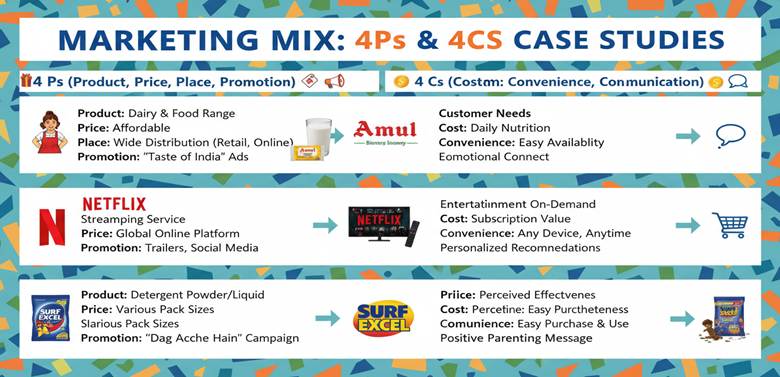
Case Study 1: Amul—Mastering the 4P’s and 4C’s
Background:
Amul is India’s largest dairy brand, known for its diverse product range, strong rural network, and iconic advertising.
Application of 4 Ps:
- Product: Offers a wide range—milk, cheese, butter, yogurt, ice cream. Constant innovation (e.g., Amul Kool, Amul Dark Chocolate).
- Price: Affordable pricing to reach all segments, with value packs and festival discounts.
- Place: Nationwide distribution, from major cities to rural villages, through 10,000+ distributors and 1 million+ retailers.
- Promotion: Famous Amul Girl ad campaigns, topical billboards, TV ads, digital presence.
Application of 4C’s:
- Customer Solution: Healthy, affordable dairy options that address Indian dietary needs.
- Cost: Focuses on affordability, easy availability, and bundling to reduce customer expense.
- Convenience: Products available everywhere—from supermarkets to local kirana stores.
- Communication: Engages with consumers through clever ads, social media, and public events.
Result:
Amul has built unmatched brand loyalty, expanded across India and abroad, and uplifted millions of rural dairy farmers through its cooperative model.
Case Study 2: Netflix – Customer-Centric Marketing
Background:
Netflix revolutionized entertainment with its on-demand streaming model.
4P’s:
- Product: Vast, diverse content library; regular new releases.
- Price: Multiple subscription levels; affordable plans for the Indian market.
- Place: Available worldwide, accessible on any internet-enabled device.
- Promotion: Digital ads, social media, personalized recommendations.
4C’s:
- Customer Solution: Solves the problem of limited entertainment choices and rigid TV schedules.
- Cost: No long-term contracts, affordable monthly payments, free trials.
- Convenience: Watch anytime, anywhere; offline downloads.
- Communication: Uses viewer data to recommend shows, invites user feedback, and adapts content per audience tastes.
Result:
Netflix’s customer focus has made it the global leader in streaming, with growing market share in India through local content and pricing.
Case Study 3: Surf Excel – Emotional Marketing
Background:
Surf Excel, a detergent brand from Hindustan Unilever, excels at connecting with its audience through emotional storytelling.
4P’s:
- Product: High-quality detergent, various variants (liquid, powder, bar).
- Price: Competitive pricing, discounts during festivals.
- Place: Widely distributed—urban supermarkets, rural shops, e-commerce.
- Promotion: The “Daag Acche Hain” (Stains are Good) campaign uses emotional stories of children learning values.
4C’s:
- Customer Solution: Removes tough stains, cares for clothes, and resonates with family values.
- Cost: Value packs, affordable refills, and promotional offers.
- Convenience: Available everywhere and in different sizes.
- Communication: Two-way engagement via social media and customer care.
Result:
Surf Excel is a market leader in India, known for its memorable campaigns and strong customer loyalty.
4P’s and 4C’s in Practice: Real-World Applications
Digital Startups
- Example: Paytm
- Product/Customer Solution: Secure, rapid digital payments.
- Price/Cost: Free wallet, low charges for merchants.
- Place/Convenience: Accepted at millions of stores; app-based.
- Promotion/Communication: Cashback offers, festival campaigns, customer support.
Global FMCGs
- Example: Coca-Cola
- Product/Customer Solution: Variety of beverages for every taste.
- Price/Cost: Small packs for price-sensitive markets.
- Place/Convenience: Available in every major country, even in remote locations.
- Promotion/Communication: Localized ads, global campaigns, community engagement.
Conclusion
The 4P’s and 4C’s frameworks remain central to modern marketing. The 4P’s help businesses structure their offerings, pricing, reach, and messaging, while the 4C’s ensure the focus remains on solving customer problems, minimizing cost, maximizing convenience, and fostering open communication.
Indian brands like Amul and Surf Excel, and global leaders like Netflix and Coca-Cola, succeed because they seamlessly blend both approaches—offering great products at the right price, making them easy to access, and communicating in a way that builds trust and loyalty.
Aspiring marketers should master both the 4P’s and 4C’s—adapting them to new technologies, market dynamics, and customer behaviors for success in the ever-changing world of business.
About the Author