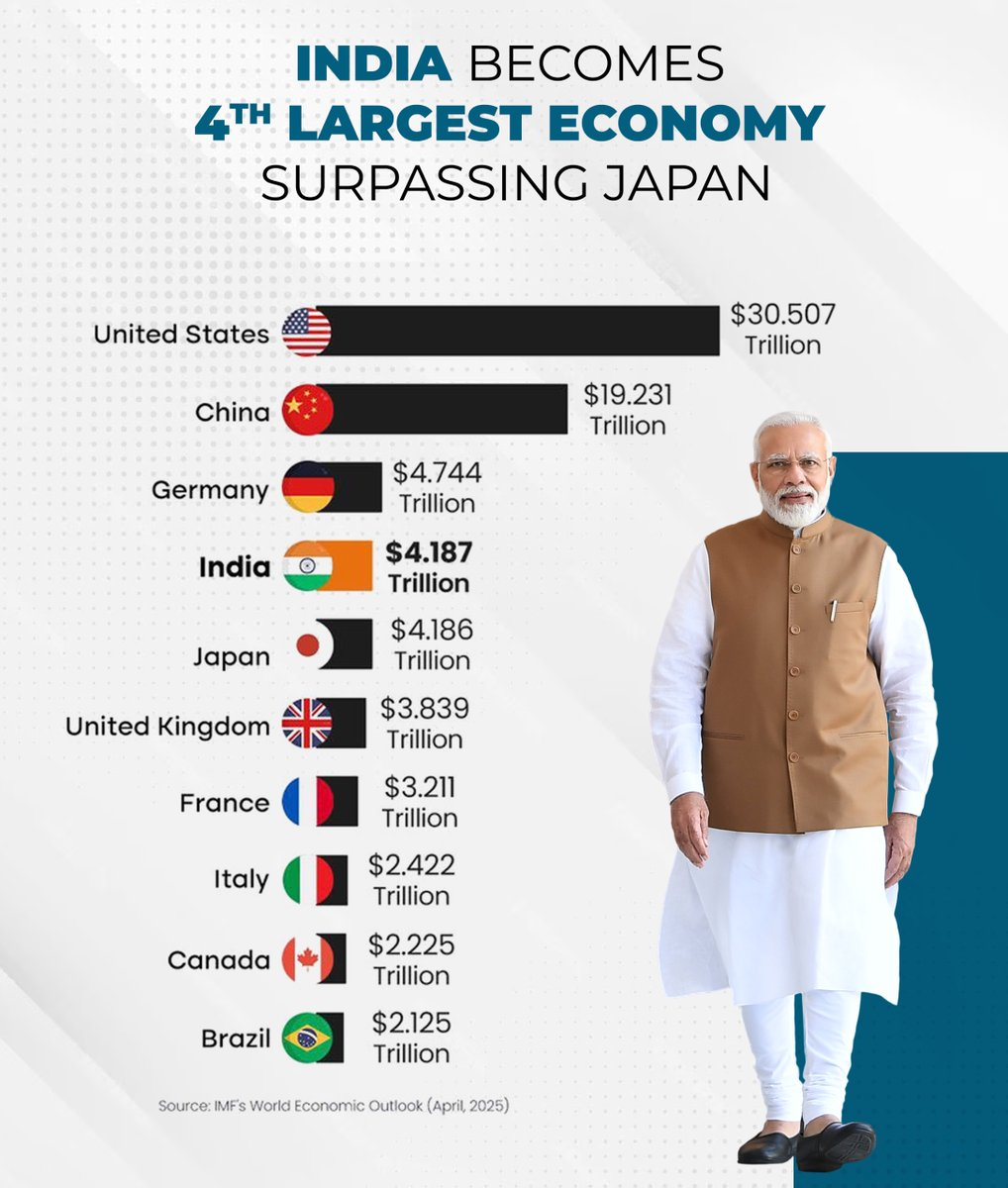


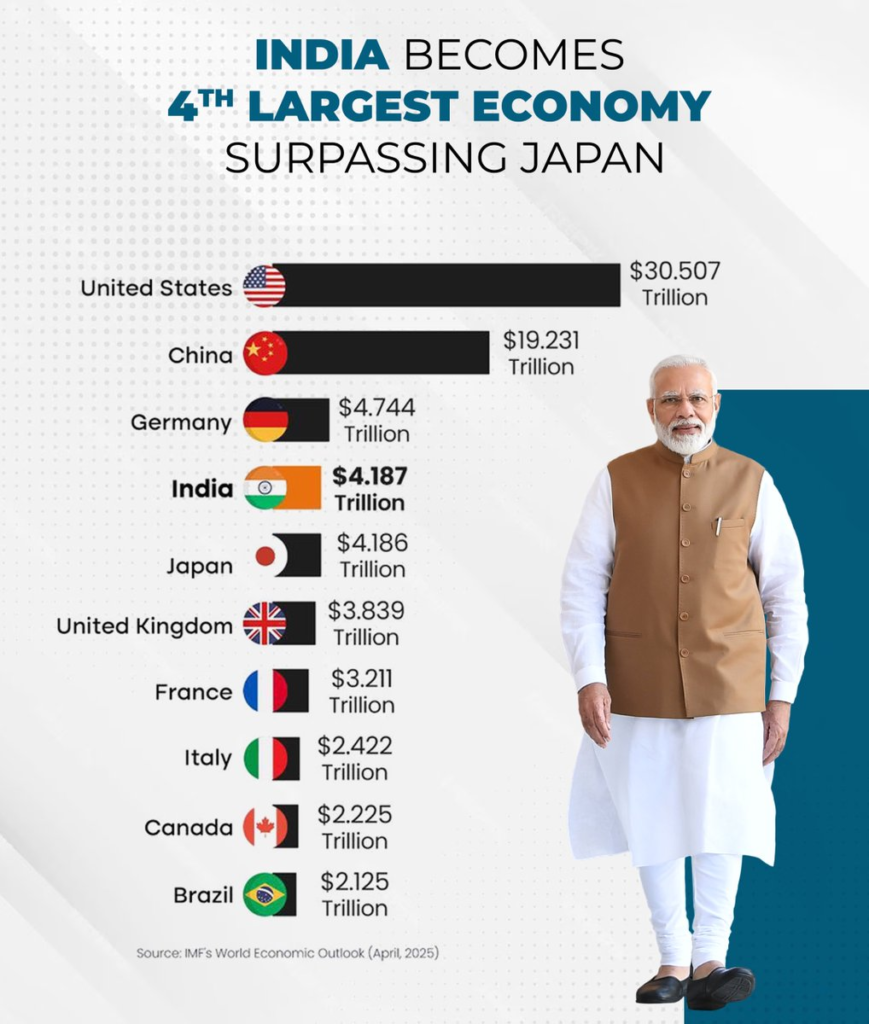
Government data indicates India’s GDP is US$4.18 trillion, with forecasts suggesting it may exceed Germany’s by 2026, notwithstanding global trade obstacles.
India has surpassed Japan to emerge as the fourth-largest economy globally, with a GDP estimated at $4.18 trillion. The increase signifies a decade marked by swift growth, robust domestic demand, and significant reforms, despite ongoing challenges such as low per capita income, pressures for job creation, and uncertainties in global trade that continue to influence India’s economic path.
India is poised to surpass Germany, emerging as the third-largest economy by 2030, supported by robust growth figures.
“India, with a GDP of $4.18 trillion, has eclipsed Japan to emerge as the fourth-largest economy globally and is on track to overtake Germany within the next 2.5 to 3 years, with a projected GDP of $7.3 trillion by 2030,” as stated in the release.
The United States and China represent the foremost economies globally, as determined by their respective gross domestic product (GDP) figures.
New Delhi’s optimistic evaluation persists in the face of economic concerns following Washington’s imposition of substantial tariffs on its acquisitions of Russian oil in August.
India articulated that its sustained growth is indicative of its fortitude in the face of ongoing global trade uncertainties.
What are the driving forces behind India’s growth narrative?
The central government, in its recent announcement, highlighted India’s growth trajectory, noting that the GDP has reached a six-quarter peak during the July-September period of the financial year concluding in 2025-26.
The nation’s development arises from its steadfastness in the face of ongoing global trade ambiguities. The domestic drivers within India, propelled by private consumption, have been pivotal in bolstering the nation’s GDP growth.
The government has also pointed out that inflation staying beneath the lower threshold, a decrease in unemployment, and enhanced export performance are among the key indicators that bolster India’s growth trajectory.
“The financial landscape has remained favorable, characterized by robust credit inflows to the commercial sector, while demand conditions persist with vigor, bolstered by an additional enhancement of urban consumption,” the government stated. The International Monetary Fund’s forecasts for 2026 estimate India’s economy to reach US$4.51 trillion, surpassing Japan’s projected US$4.46 trillion.
The United States holds the position of the world’s largest economy, while China ranks as the second largest.
The upward trajectory of growth has exceeded expectations, with GDP reaching a six-quarter peak in the second quarter of 2025-26, illustrating India’s robustness in the face of ongoing global trade uncertainties, it noted. The expansion was fundamentally supported by domestic drivers, prominently characterized by strong private consumption.
The announcement indicated that global organizations have reflected this optimism and referenced forecasts provided by multiple sources. The World Bank anticipates a growth rate of 6.5% for the year 2026, while Moody’s forecasts that India will continue to be the fastest-growing economy within the G20, projecting growth rates of 6.4% in 2026 and 6.5% in 2027. The International Monetary Fund has elevated its projections to 6.6% for 2025 and 6.2% for 2026, while the Organisation for Economic Cooperation and Development anticipates a growth rate of 6.7% in 2025 and 6.2% in 2026. Furthermore, the S&P forecasts a growth of 6.5% for the current fiscal year and 6.7% for the subsequent year. The Asian Development Bank has revised its 2025 estimate upward to 7.2%, while Fitch has increased its FY26 projection to 7.4%, attributing this adjustment to heightened consumer demand.
“India stands as one of the most rapidly advancing major economies globally and is strategically poised to maintain this trajectory.” The government stated, “With the aspiration of achieving high middle-income status by 2047, the centenary of its independence, the nation is constructing upon robust foundations of economic growth, structural reforms, and social advancement.”
The announcement underscored that inflation persists beneath the lower tolerance threshold, unemployment is on a downward trajectory, and export performance is steadily enhancing. Moreover, the financial landscape has remained favorable, characterized by robust credit inflows to the commercial sector, while demand conditions persist with resilience, bolstered by an additional enhancement in urban consumption.
The upward trajectory of growth has exceeded expectations, with GDP reaching a six-quarter peak in the second quarter of 2025-26, illustrating India’s robustness in the face of ongoing global trade uncertainties, as noted.
The expansion was fundamentally supported by domestic drivers, prominently featuring strong private consumption.
The announcement additionally indicated that global organizations have resonated with this optimism, referencing forecasts articulated by diverse bodies.
The World Bank anticipates a growth rate of 6.5% for the year 2026, while Moody’s forecasts that India will continue to be the fastest-growing economy within the G20, with projected growth rates of 6.4% in 2026 and 6.5% in 2027.
The International Monetary Fund has adjusted its growth projections to 6.6% for the year 2025 and 6.2% for 2026, while the Organisation for Economic Co-operation and Development anticipates a growth rate of 6.7% in 2025 and 6.2% in 2026.
Furthermore, S&P projects a growth rate of 6.5% for the current fiscal year and 6.7% for the subsequent year; the Asian Development Bank has revised its 2025 forecast upward to 7.2%; and Fitch has elevated its FY26 projection to 7.4% in light of heightened consumer demand.
About the Author