The ₹2000 figure often refers to ongoing government subsidies for low-value UPI person-to-merchant (P2M) transactions under ₹2000, aimed at small merchants with zero MDR and incentives like 0.15% per transaction. Budget 2026 allocated ₹2000 crore for these subsidies, but they do not cap user limits.
No new UPI rule imposes a ₹2000 transaction limit as of February 2026. Standard UPI limits remain at ₹1 lakh per day and per transaction for most users, set by NPCI and individual banks.
Possible Misconceptions
The ₹2000 figure often refers to ongoing government subsidies for low-value UPI person-to-merchant (P2M) transactions under ₹2000, aimed at small merchants with zero MDR and incentives like 0.15% per transaction. Budget 2026 allocated ₹2000 crore for these subsidies, but they do not cap user limits.
Merchants do not pay Merchant Discount Rate (MDR) on standard UPI person-to-merchant (P2M) transactions from bank accounts, keeping them free. However, they may incur platform fees from payment gateways and interchange fees for specific cases like PPI wallets or credit cards.
Standard Charges
UPI P2M payments from bank accounts have 0% MDR due to government policy since 2020. Small merchants get a 0.15% incentive (not a charge) for transactions up to ₹2000, funded by the government.
When Merchants Pay
PPI/Wallets: Interchange fees up to 1.1% on transactions over ₹2000 (e.g., 0.5% fuel, 0.9% supermarkets); small merchants often exempt.
RuPay Credit Card UPI: 1.1-2% MDR plus platform fees.
Payment Gateways: Separate processing fees (e.g., 2% cap) for security and settlements, regardless of MDR.
Payment Type
MDR/Interchange
Applies To
Bank Account UPI
0%
All merchants
PPI > ₹2000
0.5-1.1%
Medium/large merchants
Credit Card UPI
1.1-2%
All
Key Updates (2026)
Government extended subsidies for low-value UPI via ₹1500-2000 crore schemes, ensuring zero MDR for small merchants. Merchants must comply with KYC/QR rules but face no new broad fees on basic UPI.
Differences between small medium and large merchant MDR categories
No new universal MDR categories differentiate small, medium, and large merchants for standard UPI P2M bank transactions in 2026—they remain 0% across all sizes due to government policy.
MDR Applies Only to Specific UPI Types
Categories matter mainly for PPI (wallets) and credit card UPI, where small merchants often get exemptions or lower interchange fees on low-value transactions.
Small merchants (typically annual turnover < ₹20 lakh) qualify for zero MDR or subsidies on transactions ≤ ₹2000 via government schemes.
Medium/large merchants (higher turnover) pay 0.5-1.1% interchange on PPI > ₹2000 or 1.1-2% on RuPay credit UPI.
Category Differences
Merchant Size
Turnover Threshold
UPI Bank MDR
PPI/Credit MDR
Caps/Benefits
Small
< ₹20 lakh/year
0%
Often 0% or subsidized ≤ ₹2000
Incentives up to 0.15% payout
Medium/Large
> ₹20 lakh/year
0%
0.5-2% on high-value/PPI
No subsidies; platform fees apply
Legacy RBI card payment caps (pre-UPI focus) set 0.4% MDR for small vs. 0.9% for others, but UPI overrides this with zero MDR policy. Small merchants benefit most from 2026 subsidies (₹2000 crore allocation).
Can small merchants pass MDR charges to customers
No, small merchants cannot legally pass on MDR charges directly to customers for UPI or card payments in India.
RBI Prohibition
The Reserve Bank of India (RBI) mandates that merchants absorb MDR costs without surcharging customers, especially for small businesses (turnover ≤ ₹20 lakh/year). Violations allow customers to file complaints via RBI’s portal under “MDR levied by merchant.”
Exceptions and Practices
Convenience Fees: Online platforms/gateways may add small fees (e.g., ₹10 + GST on gateway charges), but not direct MDR on the full amount.
Indirect Passing: Some merchants hike MRPs or request separate UPI payments for fees, but this risks RBI action.
UPI Specific: Zero MDR policy for bank UPI P2M reinforces no customer charges; applies uniformly.
Scenario
Allowed?
Example
Direct MDR Surcharge
No
“Pay 2% extra for UPI”
Convenience Fee (Gateway)
Limited
₹10 on ₹1000 purchase
Price Increase
Yes, but indirect
Higher MRP for all
Small merchants benefit from subsidies (e.g., 0.15% incentive on ≤ ₹2000 UPI), reducing their burden further.
By offering additional value beyond the product’s inherent value at its normal price, sales promotion provides a direct incentive for action. These temporary incentives are generally accessible at a time and place where the buying decision is made. Sales promotion includes several communication activities that attempt to provide added value or incentives to consumers, wholesalers, retailers, or other organizational customers to stimulate immediate sales.
Definition
The American Marketing Association (AMA), in its Web-based “Dictionary of Marketing Terms,” defines sales promotion as “media and non-media marketing pressure applied for a predetermined, limited period of time to stimulate trial, increase consumer demand, or improve product availability.”
A. THE SCOPE AND ROLE OF SALES PROMOTION
Direct influence: It gives direct encouragement to the consumers to take instant action.
Better incentive: It provides a stronger incentive for consumers to make a purchase. Here we can say that it acts as a demand creator.
Flexible in nature: It can be used at any stage of an existing product or a new product promotion.
Increase sales: Sales promotions can take the form of discounts, percentage-off deals, rebates, and other methods to increase instant sales volume.
Clear extra bulk: Companies also use sales promotions to clear out excess bulk at the end of a season.
Cross-Selling: Sales promotions also support upselling, where you encourage a customer to buy a more expensive item, and cross-selling, where you sell an associated product to the customer.
Brand switching: Sales promotions inspire consumers to buy a more diverse brand than the one they accepted earlier.
Target audience: Sales promotion can be targeted on specific groups, especially selected retailers and their customers.
Create goodwill: Many sales promotion schemes directly or indirectly increase the goodwill of a firm in the market.
B. REASONS FOR THE INCREASE IN SALES PROMOTION
The growing power of retailers: Nowadays, the power shift in the marketplace is from producers to retailers. Retailers are providing ease of purchasing in retail stores through an advent of technology with optical checkout scanners, consolidation of grocery items in one place, and the evolution of modern barcode private labels for each product with efficient customer service.
Brand spread and new creation: A most important aspect of several firms’ marketing policies over the past decade has been the advancement of new products. Even retailers and middlemen are demanding more rewards from manufacturers.
Reinforced reward: Sales promotions encouraged consumers to buy in packs with discounts and vouchers, and once they used them, they tried to return for the same offers again.
Cost-effective: Usually traditional methods of advertising, like newspaper, radio, television, etc., have high costs of media advertising; due to this, marketers are trying to find out more cost-effective forms of sales promotion.
Create goodwill: Many sales promotion schemes directly or indirectly increase the goodwill of a firm in the market.
Attract more buyers: Sales promotion encourages impulse buying and attracts buyers by repeating a visit of first-time buyers.
Declining brand loyalty: Consumers are more focused on price, value, and convenience at the time of purchasing and less interested in brand loyalty. Loyal customers are those who are ready to buy a specific brand in spite of high cost without any promotional offer. However, the continuous growth of retail marketing with e-marketing makes consumers more focused on the same specific brand, seeing discounts and offers. For example, many retailers, stores, and e-marketing websites provide discount offers on MRP or fixed prices.
Short-term focus: Sales promotion is made up of short-term incentives to encourage purchase or sales of a product or service.
Immediate buying: Advertising gives a reason to buy a product or service, but sales promotion offers an immediate buying reason for a product or service through an eye-catching offer with limited times.
Fragmentation of the consumer markets: As the consumers become more fragmented due to this, they focus more on other tailoring methods to reach consumers, not relying on traditional media. Now marketers or advertisers are more into regional and local marketing techniques to reach consumers directly in their place of locality.
Increased accountability: Modern markets are more competitive; due to this, many companies are demanding real-time data or value for their promotions. Generally, advertising methods like television, radio, etc., are not in a position to provide actual reach and conversion numbers to the company. However, sales promotions are easier and more accurate than those from advertising because they tailor to local markets that vary minutely.
Consumer acceptance: A competition strengthens and promotion multiplies; consumers have learned to earn the rewards of being smart purchasers.
C. OBJECTIVE OF TRADE-ORIENTED SALES PROMOTION
Sales promotion is a mixture of marketing activities and promotional substances to strengthen the efforts of the sales force or encourage intermediaries to stock and sell particular brand products in their store. It also encourages them to motivate or influence customers to purchase the offering within a specified or limited time period.
It encourages the retailers to carry new items and more inventories.
It encourages retailers to buy into the future.
It encourages retailers to advertise the product and give it more shelf space.
It encourages the sales force to move slow, heartrending products.
It encourages the sales force to discover and succeed with new prospects.
It encourages setting up more store display promotions.
D. TECHNIQUES OF TRADE-ORIENTED SALES PROMOTION
Point Of Purchase Displays: This comprises providing free point of purchase (POP) display units to the retailers to increase their sales.
Dealer load or display: A dealer loader is a reward that is given to retailers to buy a minimum amount or to install an in-store display.
Push Money: Extra commission for salespeople and distribution partners to increase sales volume.
Trade allowances: Discounts given to distribution partners such as retailers to encourage them to stock up on your product.
Trade Deals: These are special concessions provided to the merchants to encourage them to promote a specific product and increase its sales for a limited time.
Trade Shows: Trade shows are a great sales promotion strategy where the business promotes its product to thousands of traders at the trade show.
E. OBJECTIVES OF CONSUMER-ORIENTED SALES PROMOTION
Sales promotions aim to accomplish various objectives. Consumer promotions may be used to increase short-term sales or to help build long-term market share. Objectives of consumer-oriented sales promotions are:
It encourages consumers to try a new product.
It encourages the continuous purchase of a settled product.
It pulls consumers away from competitors’ brands or products.
It holds and rewards loyal customers.
It motivates consumers to purchase large volumes.
It helps to create a habit of purchasing on a regular basis.
It creates positive feelings toward a particular brand or product, which is ultimately connected with their incentives, such as discounts and offers.
F. TECHNIQUES OF CONSUMER-ORIENTED SALES PROMOTION
Samples: Samples are one of the most important tools of sales promotion. Samples are defined as offers to consumers of a small amount of a product for trial.
Free Gifts: Offering a free gift is a simple strategy that gets people in the door. The offer is usually combined with a specific purchase.
Discounts/Discount Coupons: Discount coupons are a great method of increasing sales for the short term. People go for discount coupons, as they let them buy the products they couldn’t afford otherwise.
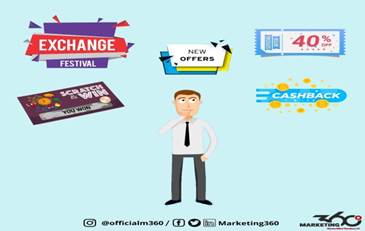
Exchange Schemes: Exchange schemes attract many customers, as they get some value even for their old product.
Free Shipping for Online Sales: Free shipping makes shopping more eye-catching. When consumers don’t need to worry about the added cost of shipping, the convenience of shopping while staying home becomes attractive.
Finance Schemes: Finance schemes like no-cost EMI, low-interest EMI, etc. make it easier for customers to purchase expensive products.
Bonus-pack deal: It means that a customer can get more products for the original price.
Bulk Purchase Deals: Bulk purchase promotions give consumers a deal for buying more of a product. Grocery stores are famous for discounting products that you buy in higher quantities.
Cash refund offer: Cash refund offers are rebates allowed based on the price of the product.
Contests: Contests are the promotion events that give consumers the chance to win something such as cash, trips, or goods.
Loyalty reward program: It means that customers collect points or credits when they buy specific brand products or services.
Advantages of sales promotion
Disadvantages of sales promotion
Short life: Sales promotion activities are temporary and short-lived.
Create confusion: Regular customers may have some doubts about quality considerations due to excessive sales promotion.
Inadequate sell: There is a feeling in the minds of the customers that sales promotional activity tools are used to sell inadequate or low-quality products.
Expensive: It is expensive and leads to a rise in the price of products.
Reflects crisis: If a firm uses sales promotion tools frequently, it may give the impression that the number of consumers is very low or a firm is unable to manage its sales.
Separating Customers: With certain types of sales promotions and discounts, it can be difficult to control the nature and timing of purchasing.
Price compassion: Sales promotion can persuade users to expect a lower price in the future and potentially damage ‘quality.’
A marketing plan is a tactical roadmap that companies use to complete, establish, shape, and track their marketing strategy in a particular time. It includes distinct marketing strategies for the several marketing players throughout the company, but all of them work in the direction of the same business goals.
The sole purpose of the marketing plan of the client is to develop the plans and approaches in an organized pattern. This will help to keep the marketing plan on track and help to measure the success of the company campaigns. However, depending on the client’s plan, it may change from company to company. In simple language, a marketing plan describes how a business will achieve particular goals, objectives, and their mission.
A marketing plan covers several marketing strategies. It is the structure from which all of the clients’ marketing approaches are shaped and helps clients to unite each strategy back to more marketing business goals and operations.
A. THE MARKETING BRIEF
The first step in any successful project is drawing up a brief plan with a clear objective. That’s why clients and marketers love creative briefs. Start with outlining a specific goal or the problem the client wants to solve by hiring the advertising agency. State it explicitly to prevent any misunderstandings.
By presenting it at the beginning of the brief, it allows the client to understand what they must do right away and helps them focus on finding a solution. Agencies must also provide detailed background information about the company, services, and products.
Whether an agency is producing a brand identity, public relations content, and brand campaigning, or anything else in between, and whether agencies are working alongside another stakeholder or staff is outsourced, taking the time to establish a marketing brief will result in a better-managed project and a better end result for the client. The idea of a marketing brief sounds simple, but it can be hard to wrap a bunch of details in a few points. The following points will guide and explain what information must be included in the marketing briefing.
1. Goals and objectives
In this first step, you need to outline exactly what you want to achieve with the campaign or project. In other words, increase awareness, trying to gain more attraction to highlight any potential risks associated with the project.
2. Brand background
The brand and its background are meant to set the tone of the marketing brief. It allows and helps the team and client that you understand their mission and project motivations. Set the scene with one or two sentences that give background on the brand and what led to the development of the project.
3. Target audience
In every marketing brief outline, find a section with the target market and information about the audience. This is one of the most important sections because it will explain exactly who you are trying to reach. Here, in this stage, try to be more specific or try to be better for your client or audience. It includes few important questions like
Who is your customer?
What are they interested in?
What age/culture/sex/income group are they?
What are they interested in?
4. Communication strategy
The communication strategy basically explains how you are going to get the client’s message to their customers. It could be any medium: print media, broadcast media, internet media, or social media marketing campaigns. This will all depend on the type of work your agency does.
5. Deliverable
In this stage, list out what finished products are expected to be included in the campaign. This may include logos, design, advertisements, landing pages, social media viral posts, and others.
6. Competition positioning
It deals with the competition and what they are doing. Identify the main competitors. How does a client project take advantage of the company’s strengths in the marketplace?
7. Project timeline
No matter how big the project is, you need to outline the timeframe for work expected. Here, agencies need to break down every step as much as possible. Set the target for when the campaign will launch and end.
8. Set the budget
Remember to outline the budget for the campaign. Start the project with a range and then map out expenses once the full execution plan is decided on.
9. Measurability
How are you going to measure the effectiveness of the campaign or expenses? Here, the agency needs to evaluate and measure the advertising campaign or budget for their client.
B. MARKETING AUDIT
A marketing audit is a plan precisely considered to help to adapt marketing efforts in the direction of what the target audience needs and wants. It is a designed survey of an organization’s marketing effort. It looks at the way marketing is well planned and managed. It asks what has been done and what else should be done. In simple words we can say, “What has worked?” And what has failed?
A marketing audit is an organized inspection of each part of the firm’s current marketing action and successes. It helps to regulate how well and cost-effectively each element helps the firm to come across its overall goals and objectives. It objectively analyzes the marketing functions of a business by looking in particular at the below points.
Efficiency: It mainly helps to analyze how the marketing team is structured and their activities.
Effectiveness: It is measured by the results of marketing activity and by looking at how the budget has been spent in relation to the original objectives.
Quality: In this analysis, the quality of each work and activity is reviewed by calculating it against external opinions or estimations from clients and other stakeholders.
Importance features of marketing audit
It gives access to managers to be directly involved in making the marketing judgments.
It is logical and organized in case of an unstructured and random investigation.
It was carried out timely and periodically.
It is wide-ranging and broad in focus, wrapping the entire marketing environment of the enterprise.
What are the key elements that may be covered in a marketing audit?
The SWOT analysis (Strengths, Weaknesses, Opportunities and Threats)
Competitor landscape analysis
Customer and prospect research
Overview of external market factors covering the PESTLE analysis (Political, Economic, Social, Technological, Legal and Environmental)
Review of current internal marketing activities assessing their impact and results in the past.
C. MARKETING OBJECTIVES
Introduction
Marketing is all about goals and objectives. Without them, organizations have no way of knowing whether or not their work is valuable and meaningful. It is a set out of what a business wants to achieve from its marketing activities. They need to be consistent with the overall aims and objectives of the business.
Marketing objectives are the approaches set to manage the overall development of the organizations. When it comes to a particular product, a company’s marketing objectives may include increasing product awareness, reducing consumer resistance, and providing information. They also provide an important focus for the marketing team. Provided the marketing objectives are relevant and achievable, there are some important business benefits from setting them and monitoring progress against them. It may include:
Set significances for marketing resources and effort.
Certify well-designed, consistent activities with corporate objectives.
Make available incentives for the marketing team and measuring of success or failures.
Provide a focus for marketing effort and decision-making.
Types of marketing objectives
Profitability objective: A profitability objective is a marketing objective that controls the amount of probable income based on the promotional objectives.
Construct demand: It works for creating the demand for services and products among the customers.
Ensure effectiveness: It controls the amount of estimated revenue grounded on the marketing success and strategies.
Customer happiness: The main purpose of a company is to satisfy the needs, wants, and desires of customers.
Construct time and place utility: It makes sure that the product or service is available to the consumer whenever and wherever they need it.
Increase sales volume: It is a demanding progression of increasing the sale of a product or service to create revenue.
Increase product quality: Marketing pledges customer reviews and feedback to implement them for product development.
Creating organizational goodwill: It describes the product and the company’s positive image in front of the customers.
D. MARKETING PROBLEMS AND OPPORTUNITIES REVIEWS
Introduction
Every marketing strategy is unique, just like every business is unique and has different strategies. With a wider remit than ever before, marketers today face a range of challenges. Nowadays, marketing jobs have more responsibility than ever, which helps marketers to direct a business towards growth in the face of uncertain times. Whatever the situation is, there’s always at least one area that businesses can stand where they improve and grow consistently.
1. Insufficient budget and time
Problem: Insufficient resources mean businesses face common issues like less budget and time to complete the marketing processes.
Opportunity: Here, businesses may try to promote their products and services in local marketing with a smaller budget. Even they can also hire agencies that make it possible on a small budget.
2. Failed to explain the product or service
Problem: A producer may be good at a particular product or service, but it doesn’t mean you are the right person to sell it.
Opportunity: Here, the producer needs an experienced and efficient staff to explain and sell the product or service to the consumer. Experienced staff helps to increase the opportunity of selling products and services in larger volumes.
3. New marketing trends
Problem: As new trends appear on the market, it can be difficult for marketing personnel to keep track of the changes and implement them in their own strategies.
Opportunities: Embracing and accepting new changes would be to their benefit. For example, in modern marketing, social media and internet media carry huge traffic. If a marketer uses these new trends, it helps to reach more of the target audience at the least cost and in the least time.
4. Pricing problem
Problem: The price of the product is crucial to the success of the company and should be supposed as right by consumers. There are number of factors involved in setting price for final product, like competitor product price, profit margin, cost of production, promotional expenses, etc.
Opportunities: The marketers may use different pricing methods to set the price of the product. For example, a well-known brand using a skimming pricing strategy to take all the cream in a short period. In the case of a new brand, they use a penetration strategy to enter into a competitive market.
E. STP (Segmentation, Targeting, Positioning)
Introduction
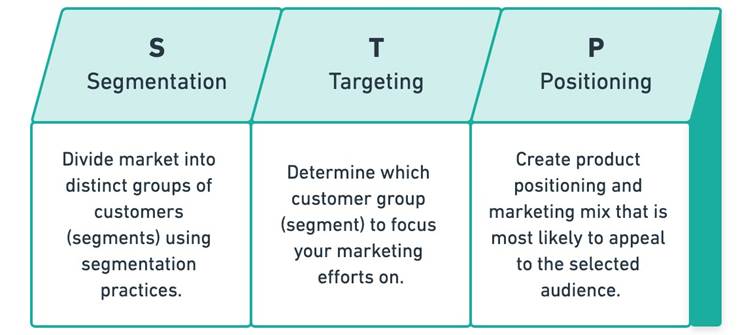
The STP model is a central concept in marketing that is absolutely key to servicing a market successfully. Discovering customers and targeting them is the concept that stands behind the STP modelling. The acronym stands for the following key part of the concept.
1. Segmentation
Common segmentation variables include
Demographic: Age gender, ethnicity, marital status, etc.
Values: Religion, politics, cultural beliefs, etc.
Geography: Country, state, region, climate, etc.
Psychographics: Habits, attitude, lifestyle, customer loyalty, etc.
Behaviours: Likes, dislikes, interests, tastes, etc.
Life stages: Educational status, work status, old stage, etc.
2. Targeting
Targeting refers to defining which, if any, of the segments discovered should be targeted and made the focus of an all-inclusive marketing program. According to Philip Kotler (1984), for market segmentation to be effective, all segments must be:
Accessible: Buyers must be able to reach through appropriate promotional activities and distribution channels.
Measurable: The segment must be easy to identify and measure
Profitable: Each segment must clearly differ from the other segments, which makes different marketing mixes necessary.
Distinct: Each segment must clearly differ from other segments, which makes different marketing mixes necessary.
3. Positioning
The last part of the STP model is positioning, which means to ensure that a brand occupies the right spot in the mind of target consumers. It mainly places the product in the right place, and positioning in marketing means where your products stand in the market. There are three standard ways you can position your product to achieve a competitive advantage.
Experiential positioning: It refers to focusing on those elements of your product or brand that connect emotionally with your customers.
Symbolic positioning: It refers to enhancing the self-image, ego, and belongingness needs of customers. For example, luxury cars, watches, etc., are themselves using symbolic positioning.
Functional positioning: It refers to solving a problem or providing a benefit to customers.
F. EXECUTING THE PLAN
Execution is an easy concept to talk about, but it’s a hard one to apply. The major problem is how to measure and manage a concept. The execution phase is the longest in duration because there are three major steps, as follows:
Sharpen the focus: Focuses deliver the precision to make decisions that support the most significant goals. It results in a noticeably defined pathway to success.
Build competency: Competency incorporates all the necessary skills, processes, systems, and other tools to achieve the client’s goals. It is a talent to promise, obligate, measure, and hit the targets.
Ignite passion: Passion produces a sense of connectedness. It shapes an association between teammates, a connection to our human need for meaningful work, and a connection to each individual’s sense of contribution and value.
G. EVALUATING THE PLAN
Evaluating marketing performance guides future marketing creativities and supports businesses to achieve their aim.
Set goals: When launching a campaign, marketers need to set clear goals for the marketing campaign. It is like a compass that guides the marketer throughout their campaign and helps to measure performance.
Branding: Does your brand image reflect or redefine itself? It is important to bring together the what, who, and why of the campaign and other things under the brand because the brand is the face of the companies’ businesses and manufacturing products.
Market research: Market research tends to always be ignored, but it is one of the most significant factors in re-evaluating marketing campaign research.
Look at the numbers: it means return on investment. In times of evaluating a marketing campaign or strategy, every business wants to look at the end factor—what they gain in numbers. Here, the numbers may include profit amount, sales unit, reaching of consumers, etc.
Marketing progress: Observing marketing progress in the direction of its annual ends.
If an individual or start-up want to build his/her own advertising agency, need a small financial support, powerful business idea, a bit of push and passion. Starting own advertising agency can be a very rewarding and profitable start-up choice. Managing, operating, and controlling our own advertising agency required lots of effort and dedication to set the ground. However, at the same time, to form an advertising agency also required huge research and preparation to avoid future consequences or uncertainties.
Today’s world markets are highly competitive and saturated; here businesses need effective and creative advertising campaigns to help attract customers. In this highly competitive market, advertising agencies are specializing in creating and planning all types of these plans. Let’s start an advertising agency by following steps.
1. Plan your agency business
A clear plan is essential for success, or you need to define definite goals as an entrepreneur. First, you need to consider whether the founder is looking for a full-time foundation or just a spare time from home. If you are looking for or want to be the next big agency in the near future, then you need to set the office in a prime location where businesses function easily.
The business plan and goals will determine how you run your business or agencies, what type of specialized staff you want, who your target market is, and how much budget it requires to start the advertising agency. For example, what type of agency are you looking for, like a full-time agency, specialized agency, creative agency, etc.? There are certain stages required to set up a new agency, which are given below.
2. Process Design and Documentation
This involves getting people on board to document best practices. It includes identifying the key people involved in an agency process. To have the best industry practices, you should check with other similar agencies.
Process design aims to establish what the process produces and inputs and parameters that target success. It indicates how the agency gets the work done and the support to come from people and the technology. So facilitation is important to bring people who matter together. It essentially shows that it won’t be one person’s viewpoint but the whole team’s.
B. VARIOUS STAGES IN SETTING UP A NEW AGENCY
3. Creating and holding necessary funds
There’s no magical number that put to all businesses. The cost to form an agency is varying from agency to agency, so business may need more or less finance depending on the circumstances.
The start-up costs of starting an agency are minimal. Ideally, agencies should have an office for meeting clients, a production house for working, the latest computers for daily work, and expenses included for other works. Few start-ups are well equipped with all necessary funds and backing, in this situation they are more capable to face any situation.
However, if start-ups that are operating with a tight budget can rent an office as per the requirement, outsourcing some business works with the help of other agencies, hiring employees on low wages, or sometimes appointing interns for a limited term and preferring public places to meet with clients.
4. Identify the target audience
Before you start pitching yourself to potential clients, sit down and think about who your ideal client for businesses. In the case of the advertising agencies ideal client most often are corporates for their upcoming and existing product, non-profit organizations for effective social content creation.
Advertising is a dynamic industry, so agencies need to keep all information on the newest trends in the market, buying patterns of consumers, competitors’ strategies and promotional methods, etc. All this information helps advertisers to create a unique plan to make their client successful in the current trend.
The advertising agency played an important role for an industry as a retainer. A retainer means an arrangement where a client pays an agency a consistent amount regularly on the basis of weekly or monthly periods, or it depends on the number of hours each period to work on the client’s promotional activities and regular campaigns.
5. Creating an industry-based knowledge
Industry-based knowledge is a major key factor between the company and advertising agency. Getting ahead of the competition is crucial to advertising agencies here to deliver the best service providers that can get you to where you want to go. The ad agency helps to connect businesses with experienced professionals and introduce them to proven software solutions. The agency performs an extensive analysis and review based on custom-tailored evaluation methodologies uniquely devised for each service or software type.
Advertising agencies understand the key performance indicators of the company. Here we can say that the agency knows the current trends of the market and understands the needs of consumers, which helps to achieve the industry’s goals and objectives through specialized advertisements.
6. Build effective interaction/communication with industries, media and consumers
The quality and commitment of the people working with business will determine the quality of advice, level of service and expertise provided by advertising agency. The roles of communication procedures in advertising agencies are creative processes with industry, media channels, and consumers. At the interaction level, agencies have a passion and commitment for building strong, healthy, vibrant brands, specifically in existing brands. Most prominently, my agency is to create and support an existing brand with effective communication with all working elements.
7. Transparency and dependability with clients
“Transparency” must be one of the most-used words in the advertising industry. There is a tremendous benefit to building trust in a brand, but it takes time and specific strategies. Be accessible to customers and allow them to interact with you. Advertising is an industry that spends over a billion dollars yearly, so make sure the money counts. So here the agency should be honest and transparent about all costs and estimations.
8. Media networking
Media buying is taking a commercial, or newspaper ad, or other sales message and getting it viewed by the future audience. Media buyers negotiate and purchase audience-targeted time and advertising space to convey a marketing message.
A media buy is the purchase of advertising from a media company such as a television station, newspaper, magazine, blog, or website. It also entails the negotiation for price and placement of ads, as well as research into the best new venues for ad placement.
There are three integral aspects of the media buying process:
a. Networking
Media buyers must be able to grow and cultivate relationships with important channel owners. Airtime is not unlimited and in order to get the optimal spaces, it is important to know the right people.
b. Investigation
Find the latest, greatest, and most appropriate locations for distribution. Keeping up on the media trends is an important task when it comes to media buying. The development of the communications business must be understood; purchasers must be on top of new platforms and their target markets and be able to translate that into beneficial client recommendations.
c. Negotiation
Media buyers should not only be able to negotiate fair prices for the media slots. But also find deals or extras to profit clients.
9. Agency compensation
An advertising agency is an autonomous business organization focused on advertising work that commences the work of planning, making, and performing advertising promotion for its clients. In current time agency payments are based on their inputs; if they succeed or fail in performance in the end, it may affect their profit. For many marketers, reducing agency fees is a main target when it comes to meeting budget-saving goals. In this dynamic situation agencies need to open a new compensation method which supports their goals with those of their clients. Earlier, media agencies paid a fixed commission on the media they purchased on behalf of their clients.
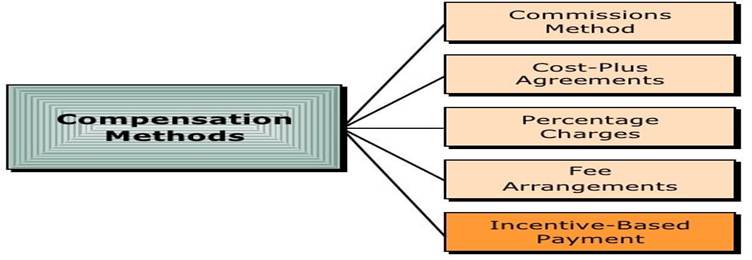
Advertising agency compensation may change strongly in current time as advertisers put stress on agencies to lower commissions and link compensation to performance following advertising campaigns. The reasons are very clear given the need to attain balance in market fallouts and stabilize or cultivate working media levels while reaching the preferred savings target. Advertising agencies don’t sell products; they sell ideas, with the knowledge and planning to achieve them. There are various ways the advertising agencies get compensated for their work and services. Agencies may be compensated in a variety of ways include:
a. Commission method
In the earlier years, as the advertising business advanced, newspaper owners paid a commission of 15% to advertising agents who credited advertisement space in their newspapers and publications. Most of the companies still paying commission use some form of paced procedure or descending scale, and the amount of media commission reserved by the agency or rebated to the client is by negotiation.
b. Cost-Plus Agreement
According to George E.Belch in his book Advertising and Promotion, “Under a cost-plus system, the client agrees to pay the agency a fee based on the costs of its work plus some agreed-on profit margin (often a percentage of total costs). This system needs the agency to keep complete accounts of costs incurred in working on a client’s account.
c. Incentive-based payments
According to George E. Belch, Incentive-Based Compensation, many clients these days are demanding more accountability from their agencies and tying agency compensation to performance through some type of incentive-based system. While there are many variations, the basic idea is that the agency’s ultimate compensation level will depend on how well it meets predetermined performance goals. These goals often include objective measures such as sales or market share as well as more subjective measures such as evaluations of the quality of the agency’s creative work. Companies using incentive-based systems determine agency compensation through media commissions, fees, bonuses, or some combination of these methods.
d. Fees arrangements
Fee Arrangement Under the fee structure, the client and the ad agency negotiate a flat sum to be paid to the agency for all work done. The agency estimates the cost (including out-of-pocket expenses) of servicing the client, who either accepts or negotiates for a lesser amount. Negotiations continue until an agreement is reached. There are two basic types of fee arrangement systems.
e. Percentage charges
An agency works on a profit margin of 01 percent to 10 percent, or it may depend on negotiation and how the agency is run and structured. So that means if an agency has 1,00,00,000 Rs. (1 Crore Rs.) in an account, the agency will end up with anywhere between 1,00,000 Rs. (1 Lakh) to 10,00,000 Rs. (10 Lakhs). in its pocket as profit.
The rest of the money will be spent on buying commercial advertising space (print media, broadcast, internet, etc.) and paying the agency for marketing advice (expert, professional, skilled, etc.) and creative and production costs (talent, knowledge, capability, etc.).
It may sound like the agency will be making money on that, too, but that money paid to the agency from the client will be used to pay staff and operating expenses. The profit is what is left over when all the money has been spent to pay salaries and other expenses.
10. Share information
In most cases, the client has taken on an agency to fill a gap in their business and wants to see value for money. The agency’s most important job is to be the experts’ advice to clients. The best advice helps to achieve their consequences and remain an active performer in the market.
The agency then has an obligation to ask all the queries they need to in order to confirm they have took the brief properly. Consuming an open and informative conversation at the commencement of a project means that the client can go away safe in the information that the agency knows what they’re doing.
11. Work in collaboration
Keep in mind that both parties are invested in what they do and that keeping a strong relationship will require continuous work on both ends. Agencies aren’t possessions; they’re strategic partners. Clients and agencies are experts in their respective fields, and they should treat each other as equals. Trust, honesty, and commitment are vital elements for the achievement of any campaign and relationship. In a collaborative environment of a relationship, each party must have confidence in the other’s capability.
12. Set realistic expectations
One of the best ways to build a strong relationship with a client is to gain a reputation as an agency that not only delivers results but is also willing to go above and beyond. Setting realistic expectations gives you the chance to impress the client and position yourself as a partner. This is especially important when working on behalf of a client.
Both parties need to take part in this process to make sure that each knows what’s expected of the other. Agencies may have exclusive methods, but a good degree of transparency is essential. These services create trust and set realistic expectations.
13. Attempt for nonstop progress
When an agency functions with these principles, performing measured efforts to their clients and determined to not only accomplish but maintain confidence with clients, the phase can be set for achievement with great appraisals, referrals and customer remembering.
Rural communication methods and advertising play a vital role in reaching and engaging the large, diverse population living in India’s villages. Unlike urban markets, rural areas often face challenges such as lower literacy rates, limited access to digital media, and dispersed populations. As a result, companies must adapt their communication and advertising strategies to be effective in these unique settings.
Rural communication methods typically include traditional media like wall paintings, folk performances, street plays (nukkad natak), and local fairs (melas), as well as modern approaches such as mobile vans, community radio, and village-level influencers. Companies choose these methods because they can effectively connect with rural audiences in local languages, utilizing culturally relevant messages.
Rural advertising leverages these communication channels to create awareness, educate, and influence buying decisions. Brands often tailor their campaigns to local contexts, combining visual, oral, and experiential elements to ensure high impact and recall.
Case Studies and Examples
1. HUL’s Lifebuoy Soap – Nukkad Natak and Wall Paintings
Method: Hindustan Unilever used street plays and wall paintings to educate rural communities about hygiene and handwashing.
Impact: These interactive performances, conducted in local dialects during village fairs, made the message relatable and memorable, significantly boosting Lifebuoy’s rural sales.
2. ITC’s e-Choupal – Digital Kiosks and Community Meetings
Method: ITC set up e-Choupal digital kiosks in villages, providing farmers with information about crops, weather, and market prices. Regular community meetings and demonstrations further reinforced these messages.
Impact: This two-way communication built trust and increased adoption of ITC’s products and services.
3. Coca-Cola – Mobile Van Campaigns and Village Melas
Method: Coca-Cola used mobile vans equipped with audio-visual aids to travel to remote villages, participating in local melas and festivals for product sampling and brand promotion.
Impact: This approach helped Coca-Cola build brand awareness in areas with limited traditional media reach.
4. Colgate – School and Panchayat Programs
Method: Colgate partnered with schools and village panchayats, conducting oral health education sessions and distributing free samples.
Impact: These grassroots campaigns, delivered by trusted local influencers, increased toothpaste usage and brand preference.
In summary: Rural communication and advertising require a blend of traditional and innovative methods to overcome infrastructural and cultural barriers. By leveraging local media, folk traditions, and community influencers, brands can effectively reach and engage rural consumers, leading to greater awareness and market penetration.
In India, contracts can range from simple purchase agreements to complex joint ventures, mergers, or licensing deals. Negotiations are critical because they determine the rights, duties, and remedies of each party, reduce the risk of disputes, and foster trust.
Key Features of Contracts in India
Offer and Acceptance: A valid contract requires a clear offer by one party and its unconditional acceptance by the other.
Consideration: There must be something of value exchanged.
Capacity: Parties must be competent (e.g., of legal age, of sound mind).
Legality: The agreement must be for a lawful purpose.
Examples and Case Studies
1. Reliance Jio and Facebook (2020):
Context: Facebook acquired a 9.99% stake in Jio Platforms.
Negotiation: Intense negotiations were held around price, governance rights, and digital collaboration.
Outcome: A landmark deal that set new standards for tech investments in India, with all terms documented in a detailed share subscription agreement and strategic partnership contract.
2. Vendor Agreement in IT Sector:
Example: Infosys contracts with global clients for software services.
Negotiation Points: Scope of work, payment terms, intellectual property rights, service-level agreements (SLAs), and dispute resolution mechanisms.
Impact: Well-negotiated contracts protect both client and service provider, ensuring project success and legal compliance.
3. Real Estate Lease Agreement Dispute:
Case: Delhi High Court’s ruling in DLF v. MCD (2012).
Issue: Disagreement over lease terms and maintenance obligations.
Learning: Highlighted the importance of detailed negotiations and clear terms to avoid litigation.
Summary: In India, effective contracts and skilled negotiations are essential for business stability and growth. Notable deals (like Reliance-Facebook) and everyday vendor agreements demonstrate how thorough negotiation and clear documentation safeguard interests and reduce risks.
B. Revenue sharing model
Revenue Sharing Model in Contracts and Negotiations
A revenue sharing model is an agreement where two or more parties agree to divide the income generated from a business activity in a specified proportion. This model is widely used in sectors like technology, media, entertainment, franchising, e-commerce, and sports. Revenue sharing aligns incentives, reduces upfront costs for partners, and spreads risk.
Key Features
Percentage Split: Revenue is often split based on a pre-decided ratio (e.g., 70:30 or 50:50).
Scope: Applies to gross or net revenues, and the contract specifies what counts as “revenue.”
Duration: The agreement can be for a fixed term or tied to the lifespan of the venture/product.
Audit Rights: Parties may have rights to inspect books to ensure correct sharing.
Recent Examples and Case Studies
1. OTT Platforms and Film Producers
Example: Netflix & Dharma Productions (2022–2023)
Context: Dharma Productions licensed several films to Netflix India.
Revenue Sharing: Instead of a simple one-time fee, Dharma and Netflix agreed on a model where streaming revenue (from subscriptions/viewership) is shared in a set ratio, incentivizing both to promote the films.
Outcome: Both parties benefit—producers gain recurring revenue, and Netflix shares risk and reward.
2. E-commerce Marketplace Sellers
Example: Amazon India and Small Retailers
Context: Sellers on Amazon India agree to a revenue sharing model, where Amazon takes a commission (ranging from 5% to 25%) on each sale.
Negotiation Points: Commission percentage, payment timelines, promotional costs, and handling of returns.
Case: During the 2023 festive sales, Amazon introduced special revenue-sharing incentives for local artisans under its “Local Shops on Amazon” program, increasing their share for a limited period to boost participation.
3. IPL (Indian Premier League) – Broadcasting Rights
Case Study: BCCI & Broadcasters (2023–2027)
Context: The BCCI sold IPL media rights to Viacom18 and Star India in a multi-billion dollar deal.
Revenue Sharing: Broadcasters and BCCI share advertising and subscription revenue based on detailed contractual terms.
Impact: This model ensures the BCCI gains from the league’s growing popularity, while broadcasters are incentivized to maximize viewership and ad sales.
4. Music Streaming Platforms
Example: Gaana/Saavn & Independent Artists
Context: Indian music streaming platforms share revenue with artists/labels based on streams.
Model: A percentage of subscription/ad revenue is distributed to rights holders, negotiated individually or via collective rights organizations.
Summary Table
Sector
Parties Involved
Revenue Sharing Model
Recent Example/Case Study
OTT & Film
Producer & Streamer
Percentage of streaming revenue
Netflix & Dharma Productions
E-commerce
Marketplace & Seller
Commission per sale
Amazon India & Local Retailers
Sports Broadcasting
League & Broadcaster
Share of ad/subscription revenue
IPL Media Rights (BCCI & Viacom18)
Music Streaming
Platform & Artists/Labels
Pro-rata share of platform revenue
Gaana/Saavn & Indie Artists
In summary:
Revenue sharing models are now central to many Indian business contracts and negotiations, ensuring risk and reward are balanced between parties. These models are increasingly favored due to their flexibility and ability to incentivize long-term collaboration.
B. Minimum guarantee model
The minimum guarantee model is a contractual arrangement where one party (usually a distributor, platform, or licensee) commits to paying the other (often a content creator, producer, or rights holder) a fixed minimum amount, regardless of actual revenue or performance. If revenues exceed the MG, additional profits may be shared according to agreed terms. This model is common in entertainment, publishing, and licensing industries.
How It Works
Upfront Payment: The licensee/distributor pays a non-refundable minimum guarantee to the producer/content owner.
Recoupment: The licensee recovers this amount from future earnings (sales, subscriptions, box office, etc.).
Additional Revenue: If earnings surpass the MG, surplus is split based on a negotiated revenue-sharing ratio.
Risk: The licensee bears the risk if actual revenues are less than the MG.
Examples and Case Studies
1. Indian Film Distribution
Example: A Bollywood producer sells theatrical rights for a new film to a regional distributor for a minimum guarantee of ₹20 crore.
The distributor pays ₹20 crore upfront.
If box office collections in that region exceed ₹20 crore (after costs), the surplus is shared as per contract (e.g., 50:50 split).
If collections fall short, the distributor absorbs the loss.
Case Study: Baahubali: The Beginning (2015)
The Telugu film’s Hindi theatrical rights were sold to Karan Johar’s Dharma Productions with a substantial MG.
Dharma paid a high upfront MG, banking on the film’s pan-India appeal.
As the film became a blockbuster, revenues far exceeded the MG, benefiting both parties.
2. OTT Platform Acquisitions
Example: Amazon Prime Video acquires exclusive streaming rights to a highly anticipated Tamil movie for an MG of ₹30 crore.
The producer receives this amount regardless of the film’s streaming performance.
If the film drives massive new subscribers, the platform can realize greater long-term value, but bears risk if viewership is low.
Case Study: Soorarai Pottru (2020)
Amazon Prime Video reportedly paid a significant MG to acquire worldwide streaming rights, providing financial security to the producers during the pandemic when theatrical releases were uncertain.
3. Music Licensing
Example: A music label sells digital rights for a new album to a streaming service for an MG of ₹5 crore.
The streaming service must pay this sum, regardless of the album’s performance on the platform.
Additional royalties may be paid if streams surpass a certain threshold.
Summary Table
Sector
Parties Involved
MG Application
Example/Case Study
Film Distribution
Producer & Distributor
Upfront minimum for theatrical rights
Baahubali, Bollywood deals
OTT Acquisition
Producer & OTT Platform
Upfront MG for digital rights
Soorarai Pottru, Amazon Prime
Music Licensing
Label & Streaming Service
MG for album/track rights
Major Indian label deals
In summary:
The minimum guarantee model provides financial assurance to content creators and shifts risk to distributors or platforms. It is widely used in Indian entertainment, with successful examples in film and digital content. Thorough negotiation of MG terms and revenue-sharing ratios is crucial to balance risk and reward for both parties.
C. Share in profits model
Share in Profits Model in Contracts and Negotiations
The share in profits model is an agreement where two or more parties agree to split the actual profits generated from a business activity, project, or intellectual property, according to a pre-agreed ratio. Unlike minimum guarantee or revenue sharing, this model focuses on profits (net of costs/expenses), so all parties are invested in both generating income and controlling costs.
How It Works
Profit Calculation: Net profit is calculated after deducting all expenses (production, marketing, distribution, taxes, etc.) from total revenue.
Profit Split: The remaining profit is distributed among stakeholders as per the contract (e.g., 60:40, 50:50 splits).
Alignment of Interests: Both sides are incentivized to maximize profitability, not just gross revenue.
Recent Indian Examples and Case Studies
1. Bollywood Co-production Agreements
Example: Pathaan (2023) – Produced by Yash Raj Films, several distributors and exhibitors entered into profit-sharing agreements rather than flat-fee deals. After deducting costs, profits from box office collections were shared between the producer and key distribution partners, which incentivized both to invest in marketing and maximize earnings.
2. Actor-Producer Partnerships
Example: In recent years, top actors like Akshay Kumar and Shah Rukh Khan have taken a share in profits instead of a fixed upfront fee for certain films. For instance, Akshay Kumar, for Mission Mangal (2019), reportedly opted for a lower upfront fee in exchange for a larger share of profits, aligning his compensation with the movie’s success.
3. OTT Originals (Web Series and Films)
Case Study: Sacred Games (Netflix India) – The production house, Phantom Films, negotiated a profit-sharing arrangement with Netflix, where profits from international syndication and merchandise were shared, not just the initial licensing fee. This encouraged the production team to maintain high quality and cross-promotional efforts.
4. Franchise and Sports Leagues
Example: Indian Premier League (IPL) franchises share profits with team owners, sponsors, and players through bonus pools, especially based on team performance and seasonal profits, ensuring all stakeholders benefit from the league’s commercial success.
Context: Tata Motors, in some strategic partnerships for new vehicle launches, uses profit-sharing agreements with key component manufacturers, especially for electric vehicles.
How it Works: Instead of a fixed payment, suppliers receive a percentage of net profits from vehicle sales. This incentivizes suppliers to maintain quality and innovation, as their earnings grow with the success of the vehicle line.
6.. Pharmaceuticals: Dr. Reddy’s Laboratories & International Licensing Partners
Context: Dr. Reddy’s Labs has entered into profit-sharing arrangements with overseas pharma companies for co-developed or out-licensed drugs.
Details: After deducting manufacturing and marketing costs, profits from drug sales in target markets are split between Dr. Reddy’s and the partner company, ensuring both share rewards and risks.
7. E-Commerce: Flipkart & Private Label Brands
Context: Flipkart collaborates with private label brands on a profit-sharing basis for exclusive product launches.
Mechanism: Instead of buying inventory outright, Flipkart agrees to share profits (after costs) from sales of the product line, encouraging both parties to invest in marketing, quality, and supply chain efficiency.
8. Media & Entertainment: Zee Music & Independent Artists
Context: Zee Music often enters profit-sharing contracts with independent artists for digital releases.
How it Works: After deducting promotion and distribution costs, remaining profits from streams and digital sales are split between the label and the artist, allowing both to benefit from a song’s popularity.
Summary Table
Sector
Parties Involved
Share in Profits Model
Example/Case Study
Film Production
Producers & Distributors
Profits post-expenses split among stakeholders
Pathaan, Mission Mangal
Talent Contracts
Producers & Actors
Actor receives % of net profits
Akshay Kumar, Shah Rukh Khan
OTT Originals
Producers & Platforms
Profit share from syndication/merchandising
Sacred Games/Netflix
Sports/Franchises
League, Franchise, Players
Profits shared as bonuses or dividends
IPL teams
In summary: The share in profits model is increasingly popular in Indian films, OTT, and sports, fostering collaboration, aligning incentives, and maximizing value for all parties involved. Thorough negotiation and transparent accounting are crucial
Company law in India is a specialized branch of law that governs the formation, functioning, and dissolution of companies. It establishes the legal framework that companies must operate within, ensuring transparency, accountability, and protection of stakeholder interests. The primary legislation governing company law in India is the Companies Act, 2013.
Key Aspects of Company Law
Formation and Incorporation: Lays down rules for how companies are legally created, including requirements for directors, shareholders, and capital.
Corporate Governance: Specifies how companies should be managed, including board structure, meetings, disclosures, and audits.
Rights and Duties: Outlines the rights and responsibilities of directors, shareholders, and other officers.
Regulatory Compliance: Mandates regular filings, audits, and disclosures to ensure companies remain compliant and transparent.
Winding Up: Provides procedures for dissolution or closure of a company.
TCS, as a public limited company, strictly complies with the Companies Act, 2013 and SEBI’s listing obligations.
The company’s strong board structure, regular disclosures, and adherence to independent directors’ requirements are exemplary, showing the Act’s impact on governance and transparency.
2. Satyam Scandal (2009): Lessons in Ethics and Law
Satyam Computer Services was involved in one of India’s largest corporate frauds, where its founder admitted to manipulating accounts.
The scandal exposed gaps in regulatory oversight and led to significant amendments in company law, emphasizing stricter auditor oversight and more robust disclosure norms in the Companies Act, 2013.
3. Section 135 – Corporate Social Responsibility (CSR)
India became the first country to mandate CSR spending for certain companies through Section 135 of the Companies Act, 2013.
Example: Infosys, Reliance, and ITC have set up extensive CSR programs in compliance with this requirement, investing in education, healthcare, and rural development.
4. Byju’s (2023–2024): Compliance and Governance
Byju’s faced regulatory scrutiny due to delayed financial reporting and alleged lapses in governance.
The case highlights the importance of transparency, timely filings, and adherence to statutory obligations under company law.
Summary: Company law in India is essential for fostering fair, ethical, and transparent business practices. High-profile examples like TCS and Infosys illustrate the benefits of strong corporate governance, while cases like Satyam and Byju’s show the consequences of non-compliance and unethical conduct. The Companies Act, 2013 continues to evolve, adapting to new business realities and global standards.
B. Registration Procedures and Exceptions
Standard Registration Procedures
In India, company registration is governed by the Companies Act, 2013. The process has become largely digital and streamlined through the Ministry of Corporate Affairs (MCA) portal. Here’s a step-by-step overview:
Choose a Business Structure: Select the appropriate entity type (Private Limited Company, Public Limited Company, LLP, OPC, etc.) based on your needs.
Name Reservation: Apply for name approval via the RUN (Reserve Unique Name) service on the MCA portal.
Obtain Digital Signature Certificates (DSC) and Director Identification Numbers (DIN): All directors must have a DSC and DIN for digital filings.
Draft Charter Documents: Prepare the Memorandum of Association (MOA) and Articles of Association (AOA).
File Incorporation Forms: Submit the SPICe+ (Simplified Proforma for Incorporating Company Electronically Plus) form, which integrates registration for PAN, TAN, GST, EPFO, and ESIC.
Certificate of Incorporation: Upon approval, the Registrar of Companies (RoC) issues a Certificate of Incorporation. The company can then open bank accounts and commence business.
Case Study: Zepto (2021): Zepto, a quick-commerce startup, was incorporated as a Private Limited Company using the SPICe+ form. The digital process enabled the founders to register and start operations within days, facilitating rapid expansion and fundraising.
Exceptions and Simplified Procedures
To foster entrepreneurship, certain company types and initiatives enjoy simplified or special procedures:
1. One Person Company (OPC)
What: Allows a single individual to incorporate a company with limited liability.
Exception: Reduced compliance compared to other companies (e.g., no need for annual general meetings).
Example: Many tech consultants and solo entrepreneurs in India register as OPCs for ease and protection.
2. Startup India Recognition
What: Startups recognized under the Startup India scheme get expedited registration, tax exemptions, and relaxed compliance.
Exception: Faster incorporation and self-certification for labor and environmental laws.
Case Study: Razorpay (2014): Recognized as a startup, Razorpay benefited from quick registration and compliance under Startup India, enabling it to focus on innovation and scale rapidly.
3. Limited Liability Partnership (LLP)
What: Hybrid between partnership and company; simpler compliance and lower cost of registration.
Exception: Less regulatory burden than a Private Limited Company.
Example: Many small service firms (consultancies, legal firms) prefer LLPs for flexibility and limited liability.
4. SPICe+ Integrated Form
What: Allows for single-window registration covering company, PAN, TAN, GST, ESIC, and EPFO.
Exception: Reduces paperwork and time-to-incorporation for all company types.
Case Study: Nykaa (2012): Used the then-available digital forms (precursor to SPICe+) for swift registration and compliance, supporting rapid growth.
Summary Table
Procedure/Exception
Description
Example/Case Study
Standard Registration
Name, DSC, DIN, MOA/AOA, SPICe+, RoC
Zepto
OPC
Single founder, reduced compliance
Tech consultants
Startup India
Faster process, tax benefits
Razorpay
LLP
Hybrid entity, easier compliance
Legal/accounting firms
SPICe+ Form
One-stop digital registration
Nykaa
In summary: India’s company registration process is robust yet increasingly simplified, with notable exceptions for new-age businesses and startups. Case studies like Zepto, Razorpay, and Nykaa show how these procedures and exceptions enable rapid, compliant business creation and growth.
C. Company Procedure and Ethics
Company Procedure
Company procedure refers to the formal steps and processes that companies must follow to operate legally and efficiently. These include:
Conducting Board and General Meetings: Proper notice, agenda, and minutes must be maintained.
Statutory Filings: Annual returns, financial statements, and other documents must be filed with the Registrar of Companies (RoC).
Compliance with Laws: Adhering to the Companies Act, SEBI regulations (for listed companies), and other applicable laws.
Maintaining Registers and Records: Companies must keep statutory registers of members, directors, and charges.
Recent Example: Tata Consultancy Services (TCS): TCS consistently demonstrates robust corporate procedures, with timely annual general meetings (AGMs), transparent disclosures, and meticulous compliance with SEBI and Companies Act norms. This has helped TCS maintain investor confidence and avoid regulatory penalties.
Company Ethics
Company ethics refer to the principles of integrity, transparency, fairness, and accountability in business conduct. Ethical lapses can lead to regulatory scrutiny, reputational damage, and legal consequences.
Recent Indian Cases:
Byju’s (2023–2024):
Issue: Byju’s, a leading edtech firm, faced criticism for delayed financial disclosures, aggressive sales tactics, and alleged misrepresentation in its accounts.
Ethical Concern: Lack of transparency and potential misleading of stakeholders led to investigations and loss of trust among investors and customers.
Satyam Scandal (Legacy, but still relevant):
Issue: Satyam Computers (2009) involved large-scale financial fraud, falsification of accounts, and unethical board conduct.
Impact: The scandal prompted reforms in corporate governance and ethics, influencing the Companies Act, 2013.
Zilingo (2022):
Issue: Singapore-based, but with significant Indian operations, Zilingo suspended its CEO over alleged financial irregularities. The case highlighted the importance of ethical leadership and strong internal controls for startups operating in India.
Transparency issues and delayed financial reporting
Ethics
Satyam
Accounting fraud, led to stricter corporate governance laws
Ethics
Zilingo
Leadership suspended over financial irregularities
In summary: Company procedures ensure legal compliance and orderly operation, while robust ethics build trust and long-term sustainability. Recent Indian cases like Byju’s and TCS illustrate the impact—both positive and negative—of following or ignoring these principles.
Company creation is the process by which entrepreneurs formally establish a legal business entity to operate, grow, and scale their ideas. This process involves transforming an innovative concept into a structured organization recognized by law, allowing for organized operations, access to funding, and legal protection for founders.
Key Steps in Company Creation
Idea Validation: Assessing the feasibility and market demand for the business concept.
Choosing a Business Structure: Selecting the most suitable form—such as sole proprietorship, partnership, Limited Liability Partnership (LLP), private limited company, or public limited company—based on scale, liability, and goals.
Legal Registration: Registering the entity with government authorities (such as the Registrar of Companies in India), obtaining necessary licenses, and complying with statutory requirements.
Operational Setup: Setting up banking, hiring, creating operational processes, and launching products or services.
Examples and Case Studies
1. Start-up Example: Nykaa
Background: Falguni Nayar founded Nykaa in 2012 as a private limited company.
Process:
Registered as FSN E-Commerce Ventures Pvt Ltd.
Secured initial funding, set up e-commerce operations, and established partnerships with suppliers.
Transitioned to a public limited company before its IPO in 2021.
Outcome: Today, Nykaa is a leading e-commerce platform in the beauty sector and a publicly listed company.
2. Social Enterprise Example: SELCO India
Background: SELCO was founded to make solar energy accessible to rural India.
Process:
Registered as a private limited company focused on social impact.
Developed partnerships with local banks for financing.
Built a scalable model that combines profit with social good.
Outcome: SELCO has impacted over half a million households and received national and international recognition.
3. Tech Start-up Example: Zepto
Background: Founded by two teenagers in 2021, Zepto started as a quick-commerce grocery delivery company.
Process:
Registered as a private limited company in Mumbai.
Raised venture capital funding.
Scaled operations rapidly across major Indian cities.
Outcome: Zepto became a recognized brand in the 10-minute delivery space and secured significant investment.
Summary: Company creation is a foundational step for any aspiring entrepreneur, providing a legal identity and framework for business growth. Real-world examples like Nykaa, SELCO, and Zepto highlight the diverse ways companies can be created—whether for profit, social impact, or rapid innovation—by following structured steps from ideation to legal formation and operational rollout.
Company Creation
Company creation is the act of legally establishing a business entity. This process transforms a business idea into an officially recognized organization, allowing it to operate, contract, hire, and grow. Common types of business entities include:
Sole Proprietorship
Partnership
Limited Liability Partnership (LLP)
Private Limited Company
Public Limited Company
One Person Company (OPC)
Choosing the right structure depends on factors like the number of founders, liability protection, capital needs, and regulatory requirements.
Processes of Registration and Incorporation
1. Choosing a Business Structure
Select the most suitable type of company based on your needs (e.g., private limited for startups seeking investment).
2. Name Reservation
Choose a unique name and check its availability using the Ministry of Corporate Affairs (MCA) portal. Submit your name for approval.
3. Preparing Documents
Draft the Memorandum of Association (MOA) and Articles of Association (AOA), which define your company’s objectives and internal rules.
4. Obtaining Digital Signatures and DIN
Directors must get Digital Signature Certificates (DSC) and Director Identification Numbers (DIN) to sign documents electronically.
5. Filing Incorporation Forms
Submit all required documents using forms like SPICe+ (Simplified Proforma for Incorporating Company Electronically Plus) on the MCA portal. This integrated form covers company registration, PAN, TAN, GST, ESIC, and EPFO registration.
6. Verification and Approval
The Registrar of Companies (RoC) reviews the documents and may seek clarifications or corrections.
7. Certificate of Incorporation
Once approved, the RoC issues a Certificate of Incorporation. Your company is now a distinct legal entity and can commence business activities.
Examples and Case Studies
Case Study 1: Nykaa
Background: Founded by Falguni Nayar in 2012.
Process: Registered as FSN E-Commerce Ventures Private Limited using the MCA portal. Followed all standard steps, raised funding, and later converted to a public company for IPO.
Outcome: Became a leading beauty e-commerce player in India, demonstrating the importance of professional incorporation and compliance.
Case Study 2: Zepto
Background: Quick-commerce startup founded in 2021 by two young entrepreneurs.
Process: Incorporated as a Private Limited Company in Mumbai using the SPICe+ form, allowing quick digital registration and access to investors.
Outcome: Raised significant venture capital and expanded rapidly, showing how robust incorporation enables fast scaling.
Example: One Person Company (OPC)
Context: Introduced in India for solo founders.
Example: A software consultant registers as an OPC for limited liability and ease of compliance, making it easier to contract with larger firms and banks.
Summary Table
Step
Description
Example/Case Study
Structure Selection
Decide between Pvt Ltd, LLP, OPC, etc.
Zepto chose Pvt Ltd
Name Reservation
Propose and get approval for company name
Nykaa reserved unique name
DSC & DIN
Obtain digital signatures and director IDs
Standard for all founders
MOA & AOA
Draft company purpose and rules
Nykaa, Zepto
Filing Registration
Submit SPICe+ and documents on MCA portal
All registered digitally
Incorporation Cert.
Receive legal status and commence operations
Nykaa, Zepto, OPC examples.
In summary: Company creation and incorporation involve structured legal steps that provide a foundation for business growth and credibility. Successful examples like Nykaa and Zepto illustrate how following these processes enables companies to attract investment, scale operations, and achieve industry leadership.
Entrepreneurship routes refer to the various pathways individuals can take to start and grow a business. Each route offers distinct opportunities, challenges, and strategic considerations, allowing entrepreneurs to choose the path that best aligns with their goals, resources, and interests.
Common routes include starting a business from scratch with a novel idea, acquiring an existing business, entering into franchising agreements, engaging in social entrepreneurship to address societal challenges, and practicing intrapreneurship by innovating within established organizations. Understanding these different approaches helps aspiring entrepreneurs identify the most suitable avenue for launching and scaling their ventures, considering factors like industry trends, market needs, and available support systems.
Business Plans and Ideation
Business Ideation is the process of generating creative ideas for a new business, often by identifying problems and designing solutions that can be scaled. This stage involves brainstorming, market research, and evaluating the feasibility of ideas.
Business Plans are structured documents outlining the business idea, target market, competition, marketing and sales strategies, operational plans, and financial projections. A well-crafted business plan helps in securing funding and guiding the growth of the business.
Entrepreneurship Routes
Starting from Scratch: Building an entirely new business based on an original idea. Example: Ola Cabs was built from scratch to solve urban mobility issues in India.
Franchising: Purchasing the right to operate under an established brand and business model. Example: McDonald’s and Domino’s franchises in India.
Acquisition: Buying an existing business and scaling or transforming it. Example: Zomato’s acquisition of Uber Eats India.
Social Entrepreneurship: Establishing ventures that address social or environmental challenges. Example: SELCO India, which provides sustainable energy solutions to underserved communities.
Intrapreneurship: Innovating within an existing large organization. Example: Tata Group’s launch of Tata Neu as a super-app was driven by an internal team.
A logo is a graphic mark, emblem, or symbol used to aid or promote public identification and recognition. It may be an abstract or figurative design or include the text of the name it represents, as in a wordmark. A logo is defined as a small symbol or design adopted by an organization to identify its products, uniforms, vehicles, etc.
Role of Logo in Business Advertising:
When advertising a particular kind of business, there are many different types of methods that are used to ensure a brand is properly visible to its highest prospects. Many businesses overlook the power of logos as an advertising method, despite their potential to yield significant results.
Firms use logo designs as commercial enterprises and institutions do to encourage or advance prominence. Throughout the years, logos have been an important part of brand marketing and identity.
Visual representation of a logo can support a brand and effectively communicate its principles and values, commonly referred to as the symbolic benefits of the business. Advertising using logos carries immense importance.
Why are logos important in business advertising?
Creates a corporate personality and trust
brands,Including your brand’s logo in advertising campaigns can build the brand’s corporate personality and trust in the eyes of the customers and public. In advertising efforts, the more the brand’s logo is displayed, the more you will gain the trust of the potential customers and public, which will in turn result in more sales, production, profits, and revenues. Many popular brands like McDonald’s, Pizza Hut, etc., have made their endeavor a great success through their logo showing it via all their advertising methods.
Connects with the customers:
On a personal level, integrating your brand’s logo in the advertisements helps your customers learn about the product on a much deeper level. It is one of the best ways you can connect with the customers and create a positive impact and response from your customers. Your customers need to relate to the product you are selling, and the logo serves this purpose by creating a connection between the business and the consumer.
Long-term advertising
The firm must remember that the product logo will be the brand’s face and foundation for years to come. If the company dislikes the logo, it will be hard to change after it’s made. So one should always think about the long-term advertising when creating a logo for the brand.
Visualizing what the customers will consider
Your logo is your business’s and product’s face, so design it with the customer’s view in mind. Your customer will be the one who relates to your brand and product, so make sure you design it according to what matters most to the consumers.
Comparing other contenders’ logos:
It is always best to know what the contender is doing and how they have designed their brand logo in the same industry. By doing this, it will give you a deeper understanding or a clear perception of what should be and what should not be done while designing your brand logo. The most symbolic logos are the ones with minimal design, less complicated, easy to understand, etc. The easier the logo, the more it creates savviness among the public. When comparing logos, consider the colors, fonts, shapes, and designs used by other contenders, as these elements can make a logo more attractive to the public.
Elemental, yet influential.
To attract customers, you need to create a simple yet influential eye-catching logo to drive their attention to your brand. FedEx is the best example of the logos here. If you closely look at the white space between the E and the X, you can see an arrow. It’s a subliminal message conveying speedy service. So always keep it simple yet intensive.
Businesses like KFC and McDonald’s are all known by their brand’s logo itself. They carry enormous importance, and therefore getting a logo is critical.