

Business creation
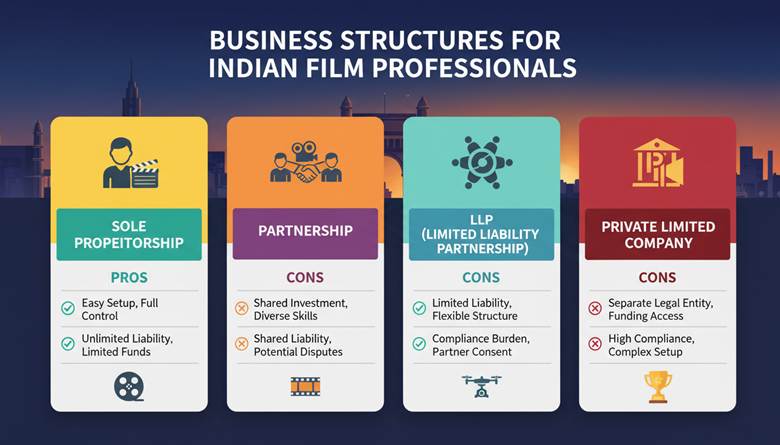
- Sole proprietorship, partnership, LLP, and private limited company
- Pros and cons of each for media and film professionals
- Key legal terminology: entity, liability, director, shareholder, etc.
- Steps to register a media production company under MCA
- PAN, TAN, GST registration for film and media businesses
- ROC filing, MOA & AOA, annual compliances
- TDS, GST on production services and freelancer payments
- Government schemes, FFO incentives, and CSR fund usage in filmmaking
Business Creation for Media and Film Professionals in India
I. BUSINESS STRUCTURES IN INDIA
1. Sole Proprietorship
Definition and Overview
A sole proprietorship is the simplest form of business in India, owned and managed by a single individual. There is no legal distinction between the owner and the business entity; the owner receives all profits and is personally responsible for all losses and liabilities.
Features
- Single ownership and control
- Easy formation and closure
- Minimal compliance and regulatory requirements
- Business income is treated as the owner’s personal income
- The business does not have a separate legal identity
Indian Example
Priya Malik, Freelance Film Editor (Mumbai):
Priya started her editing business under her own name. She registered for a Shop & Establishment License with the local municipal office, opened a current account in her name, and used her PAN for taxation. She billed small production houses and independent filmmakers directly.
Pros
- Ease of formation: No formal registration required (aside from local licenses)
- Complete control: Owner makes all decisions
- Direct taxation: Profits are taxed as personal income, possibly at lower rates for small amounts
- Minimal compliance: No requirement for annual ROC returns, board meetings, etc.
- Full retention of profits
Cons
- Unlimited liability: Owner’s personal assets are at risk for business debts and lawsuits
- No perpetual succession: Business ceases upon owner’s death or incapacity
- Limited fundraising: Cannot issue equity; banks may hesitate to lend
- Credibility issues: Larger clients and corporations may hesitate to contract with sole proprietors
Indian Case Study
SoundScape Studios (Bangalore):
Rahul, an independent sound designer, started as a sole proprietor, working on ad jingles and short films. When he tried to expand into feature film post-production, he struggled to secure larger contracts: producers wanted GST invoices and proof of liability insurance, but as a sole proprietor, he couldn’t offer these easily. He eventually had to convert his business into an LLP to grow further.
2. Partnership
Definition and Overview
A partnership firm involves two or more people who co-own the business, share profits/losses, and jointly manage operations. Partnerships in India are governed by the Indian Partnership Act, 1932.
Features
- Minimum two partners, maximum twenty
- Partnership deed governs terms (profit-sharing, management, dissolution)
- Registration is optional but recommended for legal standing
- Partners share unlimited liability (joint and several)
Indian Example
Cinematic Creations (Delhi):
Two film graduates, Neha and Aakash, started a content production house together. They created a partnership deed outlining each partner’s investment, profit share, and roles. They registered the partnership to secure government contracts.
Pros
- Shared resources and skills: Partners bring different expertise (e.g., one is a director, the other a producer)
- Simple and low-cost formation: Only a partnership deed required (registration optional)
- Taxation as a firm: Income taxed at firm rates, with profits distributed to partners
- Flexible management: Decision-making shared among partners
Cons
- Unlimited liability: Each partner’s personal assets are at risk for firm’s debts
- Personal disputes: Differences can disrupt business continuity
- No separate legal identity: Firm can’t own property in its name unless registered
- Dissolution risk: Firm dissolves if a partner dies or withdraws (unless deed provides otherwise)
- Limited external funding: Difficult to attract institutional or VC investment
Indian Case Study
Green Mango Films (Mumbai):
Started by two friends as a partnership to produce wedding films and ad shoots. Initially, both invested equally and split profits. As business grew, one partner wanted to invest in new camera gear while the other preferred to save. Disputes arose, leading to split and eventual dissolution. The experience highlighted the importance of a detailed, registered partnership deed clarifying exit and dispute resolution processes.
3. Limited Liability Partnership (LLP)
Definition and Overview
An LLP is a relatively new business structure in India (since 2008) that combines the flexibility of a partnership with the liability protection of a company. It is especially popular among creative professionals and service businesses.
Features
- Separate legal entity: LLP can own property, sue/be sued in its own name
- Limited liability: Partners’ liability is limited to agreed contribution
- Minimum two “Designated Partners” (at least one Indian resident)
- LLP Agreement: Governs profit sharing, management, partner roles, etc.
- Perpetual succession: LLP continues even if partners change
Indian Example
Pocket Films LLP (Mumbai):
Formed by three digital content creators, Pocket Films LLP distributes short films and web series to digital platforms. The LLP structure allowed them to scale, bring in new partners, and limit personal risk.
Pros
- Limited liability: Personal assets of partners protected
- Separate legal entity: LLP can own assets, enter contracts, and sue/be sued
- Flexible management: No minimum capital; profit-sharing as agreed in LLP Agreement
- Lower compliance burden than companies
- Perpetual succession: LLP continues despite partner changes
Cons
- Moderate compliance: Annual statement of accounts and solvency must be filed with the Registrar
- No option to issue shares: Cannot attract equity investment like a company
- Public disclosure: Financials and partner details become public
- Transferability limitations: Bringing in new partners or transferring ownership involves amending LLP Agreement
Indian Case Study
Indie Creators LLP (Kolkata):
A group of four media professionals (director, scriptwriter, DOP, and sound engineer) formed an LLP to produce a web series. When the director exited for a new project, the LLP structure made it easy to bring in a new partner and continue operations, with the departing partner’s liability ceasing from the date of exit. This flexibility and risk protection gave the team confidence to take on bigger projects.
4. Private Limited Company
Definition and Overview
A private limited company is the most formal and scalable business structure for film and media professionals in India, especially for those seeking to raise funds, secure large contracts, or build a production house with enduring legacy.
Features
- Separate legal entity: Company can own assets and intellectual property
- Limited liability: Shareholders’ liability is limited to unpaid share capital
- Minimum two shareholders and two directors (can be the same people)
- Shares not freely transferable: Must be approved by the board
- Perpetual succession: Company continues regardless of changes in ownership
Indian Example
Red Chillies Entertainment Pvt Ltd (Mumbai):
Founded by Shah Rukh Khan and Gauri Khan, this company produces films, manages VFX, and handles distribution. Its structure enables it to raise funds, own IP, and enter into major contracts with studios and OTT platforms.
Pros
- Limited liability: Shareholder risk limited to invested capital
- Perpetual succession: Company exists beyond the founders
- Access to funding: Can issue shares to raise equity; eligible for bank loans and VC investment
- Credibility: Preferred by large clients, broadcasters, and international partners
- Ownership of IP: Company holds copyright and trademarks
Cons
- Complex and costly setup: Requires professional assistance, government fees, and more documents
- High compliance: Annual ROC filings, statutory audits, board meetings, etc.
- Ownership transfer restrictions: Shares can’t be freely sold without board approval
- Public disclosure: Financial statements and director details are public
Indian Case Study
Phantom Films Pvt Ltd (Mumbai):
Founded by filmmakers Anurag Kashyap, Vikramaditya Motwane, and others, Phantom Films operated as a private limited company. This structure made it possible to bring in external investors, hold copyrights in the company’s name, and facilitate international co-productions. When the founders decided to part ways, the clear shareholding structure enabled a formal split of assets and liabilities, underscoring the value of a private limited company for large, collaborative media ventures.
II. PROS AND CONS FOR MEDIA AND FILM PROFESSIONALS—A COMPARATIVE PERSPECTIVE
When to Choose Each Structure
Sole Proprietorship
- Best for: Freelancers, individual artists, or small-scale operators (editors, solo filmmakers, designers)
- Avoid if: Planning to scale, hire staff, or raise external funds
Partnership
- Best for: Small creative teams with mutual trust, e.g., two or three collaborators pooling resources or networks
- Avoid if: Concerned about liability or want to bring in external investors
LLP
- Best for: Professional teams (writers, directors, technicians) who want to limit risk, formalize profit sharing, and potentially expand (but don’t need to issue shares)
- Avoid if: Raising VC/angel funding is a top priority
Private Limited Company
- Best for: Ambitious production houses, agencies, or studios seeking credibility, funding, and long-term continuity
- Avoid if: You want minimal compliance and are starting with small projects
Comparative Table
| Feature | Sole Proprietorship | Partnership | LLP | Private Limited Company |
| Legal Status | Not separate | Not separate | Separate entity | Separate entity |
| Liability | Unlimited | Unlimited | Limited | Limited |
| No. of Members | 1 | 2–20 | 2+ | 2–200 |
| Perpetual Succession | No | No | Yes | Yes |
| Compliance | Low | Low | Medium | High |
| Fundraising | Difficult | Difficult | Moderate | Easy |
| Suitable for | Freelancers | Small teams | SME collaborations | Scalable businesses |
Real-World Scenario: Evolving Your Business Structure
Case Study: Studio X Films (Delhi)
Three friends started as a partnership to produce indie documentaries. When they secured a web series deal, they realized the risks (liability, disputes) and converted to an LLP for better protection and professional image. As their business grew—attracting angel investors and needing to own IP—they transitioned to a private limited company. This journey illustrates how creative businesses often evolve structures as they scale up.
Key Lessons for Media and Film Professionals
- Start simple, but think ahead: Many creative professionals begin as sole proprietors or partnerships. As the business matures, consider transitioning to LLP or private limited company for credibility, risk protection, and scalability.
- Always formalize agreements: Even among friends, draft clear partnership deeds or LLP Agreements to avoid future disputes.
- Understand liability: Unlimited liability structures put your personal assets at risk—critical in a field with high financial stakes, such as film production.
- Plan for growth: If you foresee raising funds or dealing with large clients, set up a private limited company from the outset—even if compliance is higher.
- Legal advice pays off: Consult a company secretary or legal professional, especially when drafting partnership deeds, LLP Agreements, or incorporating a company.
Conclusion
India’s film and media sector is dynamic, offering vast opportunities for creative professionals. Choosing the right business structure—whether sole proprietorship, partnership, LLP, or private limited company—has a profound impact on your risk, growth, and long-term success. Real-world examples and Indian case studies demonstrate that while many start simple, those who formalize their business with LLP or private limited company structures are better positioned for growth, funding, and sustainability.
Carefully evaluate your goals, resources, and risk appetite before deciding. As you scale, don’t hesitate to transition to a more robust structure to unlock new opportunities in India’s vibrant film and media landscape.
III. KEY LEGAL CONCEPTS AND BUSINESS REGISTRATION FOR INDIAN FILM AND MEDIA COMPANIES
Understanding legal terminology is essential before setting up a media or film business in India. Here are the most relevant terms with examples from the Indian film industry:
1. Entity
A legally recognized organization.
Types:
- Sole proprietorship, partnership, LLP, private limited company.
Example:
Red Chillies Entertainment Pvt Ltd is a legal entity registered as a private limited company.
2. Liability
The legal responsibility for debts and obligations.
- Limited Liability: Owners/shareholders’ risk is limited to their investment.
- Unlimited Liability: Owners’ personal assets are at risk.
Example:
Phantom Films Pvt Ltd: The liability of each shareholder is limited to the unpaid amount on shares held.
Case Study:
A partnership firm like Green Mango Films exposes personal assets of its owners to business debts, unlike an LLP or private company.
3. Director
A person appointed to manage and oversee company affairs.
- Minimum two for a private limited company.
Example:
Shah Rukh Khan is one of the directors of Red Chillies Entertainment Pvt Ltd.
4. Shareholder
A person or entity owning shares in a company.
- Shareholders are the real owners; directors manage the company.
Example:
Gauri Khan is a significant shareholder in Red Chillies Entertainment Pvt Ltd.
5. Partner
A co-owner in a partnership or LLP, sharing profits, losses, and management.
Example:
Three filmmakers form Indie Creators LLP as equal partners to produce web content.
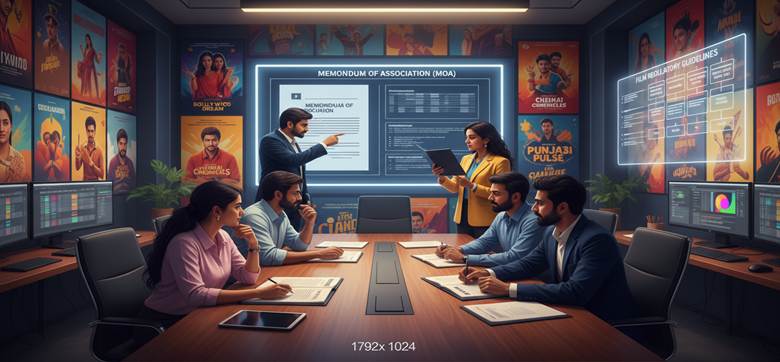
6. MOA (Memorandum of Association)
A company’s charter outlining its main objectives and scope.
Example:
Dharma Productions Pvt Ltd’s MOA specifies film production, distribution, and allied activities as its primary business objects.
7. AOA (Articles of Association)
Rules for the company’s internal management (board meetings, share transfer, etc.).
Case Study:
When Phantom Films dissolved, the AOA outlined the process for asset division and director exit.
8. ROC (Registrar of Companies)
A government authority under the Ministry of Corporate Affairs (MCA) that registers and regulates companies and LLPs.
Example:
Excel Entertainment Pvt Ltd files annual returns and financial statements with the ROC.
9. PAN (Permanent Account Number)
A unique 10-digit tax identifier for all entities and individuals.
Example:
Every film production company, like Yash Raj Films, needs a separate PAN for tax compliance.
10. TAN (Tax Deduction and Collection Account Number)
Needed by businesses to deduct TDS (Tax Deducted at Source) from payments to actors, crew, or freelancers.
Example:
Balaji Telefilms Ltd uses its TAN to deduct TDS on payments to scriptwriters.
11. GST (Goods and Services Tax)
An indirect tax levied on goods and services, including film production services.
Example:
Viacom18 Studios charges 18% GST on its production invoices.
12. DIN (Director Identification Number)
A unique number allotted to every company director.
Example:
All directors of Red Chillies Entertainment Pvt Ltd have a DIN, recorded in ROC filings.
13. Designated Partner
A partner in an LLP responsible for regulatory and legal compliance.
Example:
In Pocket Films LLP, one partner acts as the designated partner, handling ROC filings.
14. Perpetual Succession
The entity continues to exist even if owners change or pass away.
Example:
Yash Raj Films Pvt Ltd continues operations after Yash Chopra’s passing due to perpetual succession.
IV. STEPS TO REGISTER A MEDIA PRODUCTION COMPANY UNDER MCA
Registering a media/film company as a Private Limited or LLP under the Ministry of Corporate Affairs (MCA) involves several steps:
1. Choose the Right Structure
- Decide between Private Limited (for scalability, funding) or LLP (for flexibility, limited liability).
- Decide on directors/shareholders or partners.
Example:
Red Chillies Entertainment Pvt Ltd chose the private limited structure for scalability and credibility.
2. Obtain Digital Signature Certificates (DSC)
- Needed for all directors/partners to file documents online.
Example:
Directors of Phantom Films Pvt Ltd obtained DSCs through Certifying Authorities.
3. Apply for Director Identification Number (DIN)
- Required for all proposed directors.
Case Study:
When Dharma Productions added a new director, they obtained a DIN for the appointee.
4. Name Reservation
- Use the RUN (Reserve Unique Name) service on the MCA portal to propose and reserve a unique company name.
Example:
CineSpark Productions Pvt Ltd reserved its name through RUN before incorporation.
5. Draft MOA and AOA (For Companies) or LLP Agreement (For LLPs)
- MOA specifies business objectives (e.g., film production, distribution).
- AOA or LLP Agreement details internal rules, roles, and profit sharing.
Case Study:
Pocket Films LLP drafted an LLP Agreement specifying how partners share profits and manage creative rights.
6. File Incorporation Documents
For Private Limited:
- Use SPICe+ integrated form (INC-32, e-MOA, e-AOA) on MCA portal.
- Attach address proof, identity proof, consent, etc.
For LLP:
- File FiLLiP form and submit the LLP Agreement within 30 days.
Example:
Excel Entertainment Pvt Ltd filed all required documents online for quick incorporation.
7. Pay Government Fees
- Fees depend on authorized capital (company) or contribution (LLP).
8. ROC Verification and Certificate of Incorporation
- ROC reviews documents and issues a Certificate of Incorporation with a unique CIN (Corporate Identification Number) or LLPIN (LLP Identification Number).
Example:
Red Chillies Entertainment Pvt Ltd received its CIN from ROC Mumbai.
9. Apply for PAN & TAN
- PAN and TAN applications are integrated with SPICe+ form.
10. Open a Bank Account
- Use the incorporation certificate, PAN, and board resolution.
11. GST Registration (If Required)
- Mandatory if turnover exceeds ₹20 lakh (₹10 lakh in special states) or for interstate supply.
Case Study:
Dharma Productions Pvt Ltd registered for GST due to high turnover and pan-India operations.12. Post-Incorporation Compliances
- Hold first board meeting within 30 days.
- Appoint auditor.
- Issue share certificates (companies).
- File annual returns, maintain statutory registers, etc.
V. PAN, TAN, GST REGISTRATION FOR FILM AND MEDIA BUSINESSES
1. PAN (Permanent Account Number)
- Mandatory for all business entities for income tax compliance.
- Needed for bank accounts, contracts, and all financial transactions.
Example:
Yash Raj Films Pvt Ltd uses a unique PAN for all tax returns and business contracts.
2. TAN (Tax Deduction and Collection Account Number)
- Mandatory for entities making payments that require TDS deduction (actors, technicians, freelancers, vendors).
- File TDS returns quarterly.
Case Study:
Balaji Telefilms Ltd deducts TDS while paying actors and files Form 26Q using its TAN.
3. GST (Goods and Services Tax) Registration
- Required if turnover crosses ₹20 lakh (₹10 lakh in special states) or for interstate business.
- GST @18% applies to most media/film production services.
- GST registration done online at gst.gov.in or during company incorporation (SPICe+).
Example:
Viacom18 Studios charges GST on invoices for production services and claims input tax credit on equipment purchases.
4. Case Study: End-to-End Registration for a Film Company
CineSpark Productions Pvt Ltd (Mumbai)
- Step 1: Chose Private Limited structure for better funding opportunities.
- Step 2: Obtained DSCs and DINs for directors.
- Step 3: Reserved company name via RUN.
- Step 4: Drafted MOA (objectives: film production, distribution, OTT content), AOA (internal rules).
- Step 5: Filed SPICe+ (INC-32), e-MOA, and e-AOA with the ROC.
- Step 6: Paid registration fees and received Certificate of Incorporation (CIN).
- Step 7: Applied for PAN and TAN via SPICe+.
- Step 8: Opened a current account at HDFC Bank.
- Step 9: Registered for GST due to expected high turnover.
- Step 10: Hired a CA to manage TDS compliance, GST returns, and annual ROC filings.
Conclusion
Grasping key legal terms and properly registering your media/film business (with PAN, TAN, GST) is vital for credibility, compliance, and sustainable growth in India’s film industry.
Real-world examples (like Red Chillies Entertainment, Pocket Films LLP, and Balaji Telefilms) show that success in media begins with a strong legal and regulatory foundation.
Advanced Compliance and Incentives for Indian Film Production Companies
VI. ROC FILING, MOA & AOA, AND ANNUAL COMPLIANCES
1. MOA (Memorandum of Association): The Company’s Charter
What is MOA?
- MOA is the foundational document of a company, defining its constitutional framework.
- It sets out the main and ancillary objects for which the company is formed, the state of registration, liability of members, share capital, etc.
Key Clauses:
- Name Clause: Legal name of the company (e.g., “CineSpark Productions Pvt Ltd”)
- Registered Office Clause: Address of the company
- Object Clause: Main business activities (e.g., “to produce, distribute, and exploit feature films, TV serials, web series, and digital content”)
- Liability Clause: Whether liability is limited or unlimited
- Capital Clause: Authorized share capital
Indian Example:
Dharma Productions Pvt Ltd’s MOA includes main objects such as film production, distribution, and allied activities, which enables the company to expand into music, television, merchandising, and OTT content.
2. AOA (Articles of Association): The Rulebook
What is AOA?
- The Articles of Association are the internal rules governing the management of the company.
- Covers director’s powers, voting rights, share transfers, board meetings, dividend policies, etc.
Example Clauses:
- Minimum quorum required for a board meeting
- Procedures for appointing or removing directors
- Rules for issuing new shares or transferring existing ones
Case Study:
Phantom Films Pvt Ltd had detailed AOA provisions on how to handle founder exits and the distribution of intellectual property. When the company was dissolved, the AOA guided the legal split and asset allocation.
3. ROC Filing: Annual and Event-Based Compliances
What is ROC?
- Registrar of Companies (ROC) is the government body under the Ministry of Corporate Affairs (MCA) that regulates company compliance.
Annual Compliance Checklist:
- Board Meetings: At least two per year (four for public companies). First board meeting within 30 days of incorporation.
- Annual General Meeting (AGM): Within six months after the close of the financial year.
- Annual Return (Form MGT-7): Contains details of directors, shareholders, and changes during the year.
- Financial Statements (Form AOC-4): Audited balance sheet, profit & loss statement, and auditor’s report.
- Director KYC: Annual Know Your Customer update for all directors (DIR-3 KYC).
- Appointment of Auditors: Within 30 days of incorporation.
- Statutory Registers: Maintain registers for members, directors, contracts, loans, etc.
- Event-Based Filings: Changes in directors, share capital, registered office, etc., must be reported promptly.
Penalties for Non-Compliance:
- Heavy penalties for late filing or non-compliance (ranging from ₹100/day to several lakh rupees).
- Directors can be disqualified or held personally liable in cases of persistent non-compliance.
Indian Example:
Red Chillies Entertainment Pvt Ltd maintains rigorous annual compliance, with a dedicated legal team ensuring timely board meetings, ROC filings, and statutory register maintenance. This is crucial for retaining investor trust and eligibility for co-productions.
Case Study:
Balaji Telefilms Ltd failed to file one of its MCA annual returns on time in 2019, resulting in a penalty and a temporary freeze on certain corporate actions. This demonstrated to the industry the importance of timely ROC filings for uninterrupted business operations.

VII. TDS, GST ON PRODUCTION SERVICES AND FREELANCER PAYMENTS
1. TDS (Tax Deducted at Source): How it Works in the Film Industry
TDS Applicability
- Section 194J: TDS @ 10% on professional services (directors, actors, scriptwriters, composers, editors, etc.)
- Section 194C: TDS @ 2% (individuals/HUF) or 1% (others) on contract payments (e.g., set construction, catering, technical crew)
Thresholds:
- TDS deduction required if single transaction payment exceeds ₹30,000 or aggregate exceeds ₹1 lakh in a financial year.
Workflow Example:
Viacom18 Studios hires a scriptwriter for ₹2 lakh. Payment is made after deducting ₹20,000 (10% TDS under 194J). The TDS is deposited to the government, and the scriptwriter receives a Form 16A as proof for tax credit.
TDS Returns and Compliance:
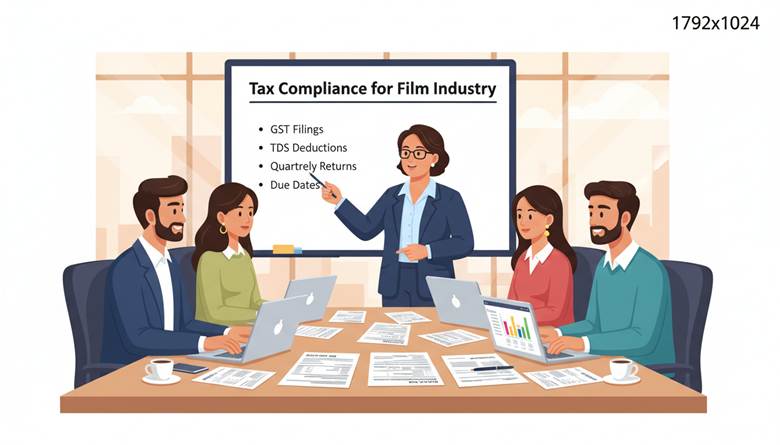
- Quarterly TDS returns must be filed (Form 26Q).
- Delay in deposit attracts interest, and late returns draw penalties.
Indian Example:
Excel Entertainment Pvt Ltd deducts TDS from all freelancer payments (directors, editors, VFX artists) and provides TDS certificates for tax filing.
Case Study:
In 2020, a major Mumbai-based production house faced a tax demand after failing to deduct TDS from payments to a celebrity choreographer. The company had to pay back taxes, interest, and a penalty, highlighting the critical nature of TDS compliance in the industry.
2. GST (Goods and Services Tax): Application in Film and Media
Applicability
- GST @ 18% is applicable on most film and media production services.
- Threshold: Registration mandatory if annual revenue exceeds ₹20 lakh (₹10 lakh in special category states) or if making interstate supply.
Key GST Concepts:
- Input Tax Credit (ITC): Production houses can claim ITC on GST paid for equipment, set materials, or professional services.
- Output GST: Charged to clients/TV channels/OTT platforms on the sale of production services or rights.
- Reverse Charge Mechanism: In some cases, GST liability shifts to the recipient.
Practical Example:
Dharma Productions Pvt Ltd charges 18% GST on invoices raised to Netflix India for a web series. The company also claims ITC on GST paid for camera rentals and post-production software.
GST Returns:
- Monthly/quarterly filing of GSTR-1 (outward supplies) and GSTR-3B (summary return).
- Annual return (GSTR-9) mandatory if registered under GST.
Indian Example:
Pocket Films LLP produces digital content, bills YouTube and other OTT platforms with GST, and claims input credits on all eligible production expenses.
Case Study:
A Chennai-based animation studio lost significant input credits due to late GST filing and non-reconciliation of invoices submitted by vendors. This affected their cash flows and profitability, underlining the importance of timely, accurate GST compliance.
3. Freelancers and TDS/GST
TDS for Freelancers:
- Freelancers earning above the threshold must have a PAN and provide it to clients.
- Clients deduct TDS before making payments.
GST for Freelancers:
- Freelancers with turnover above ₹20 lakh must register for GST and raise GST-compliant invoices.
- They can claim ITC on business-related expenses.
Example:
A freelance editor working for Red Chillies Entertainment Pvt Ltd submits an invoice for ₹1,20,000 plus 18% GST. The company deducts TDS on the fee portion and pays GST separately.
Case Study:
A Delhi-based freelance cinematographer lost a lucrative assignment with a broadcaster because he lacked a GST registration, which was mandatory for the broadcaster’s vendor policy. He later registered for GST, which opened up new opportunities.
VIII. GOVERNMENT SCHEMES, FFO INCENTIVES, AND CSR FUND USAGE IN FILMMAKING
1. Film Facilitation Office (FFO) Incentives
What is FFO?
- The Film Facilitation Office (FFO) under NFDC (National Film Development Corporation) is a government initiative to promote film shooting in India by streamlining permissions and offering financial incentives.
Key FFO Functions:
- Single-window clearance for shooting permissions across central and state government agencies.
- Assistance with customs, visas, and location scouting.
- Financial incentives and rebates for both Indian and international productions.
Example:
“The Amazing Race” (US TV show) filmed multiple episodes in Rajasthan, India, utilizing FFO’s single-window system for quick permissions and logistical support.
Case Study:
A UK-based production, “Indian Summers,” received FFO support for location scouting, import of equipment, and expedited clearances for a period drama filmed in Shimla.
2. State-Level Incentives for Film Production
Key Features:
- Many Indian states (Maharashtra, UP, MP, Gujarat, Rajasthan) offer:
- Subsidies for local language and regional films
- Cash rebates for spending in the state
- Reduced fees for government location usage
- Assistance with police/security, visas, crowd management
Example:
“Sairat” (Marathi film) received a production subsidy from the Maharashtra government for promoting local culture and language films.
Case Study:
The film “Pad Man” (starring Akshay Kumar) was partly shot in Madhya Pradesh, which provided location subsidies and logistical support to attract filming to the state.
3. Central Government Schemes and Funding
NFDC Schemes:
- NFDC provides funding, co-production support, and marketing for Indian independent films.
- Organizes Film Bazaar for networking, financing, and distribution opportunities.
Example:
“Court” (Marathi film) received NFDC support for development, which helped the film gain international distribution and awards.
4. CSR Fund Usage in Filmmaking
Legal Framework:
- Section 135, Companies Act, 2013: Companies with a net worth of ₹500 crore+, turnover of ₹1,000 crore+, or net profit of ₹5 crore+ must spend 2% of profits on CSR.
- Eligible CSR activities: Promotion of art, culture, and heritage, including film production with social messages.
How to Access CSR Funds for Filmmaking:
- Nonprofits or production companies can approach corporates for CSR funding for documentaries or films with a social purpose (e.g., education, health, gender equality).
- Must ensure the film aligns with Schedule VII of Companies Act (CSR policy).
Example:
A film on environmental awareness for rural India was fully funded by the CSR budget of a major FMCG company.
Case Study:
Tata Trusts funded and distributed short films on child health and education, using their CSR allocation. These films were later used for community outreach and advocacy.
5. Additional Support: Single Window Clearance, Co-Production Treaties, and Film Markets
Single-Window Clearance:
- Many states and FFO provide a digital portal for all filming permissions, reducing red tape.
Co-Production Treaties:
- India has bilateral co-production treaties with over 15 countries, allowing joint film projects to access grants and incentives from both nations.
Film Bazaars and Markets:
- Platforms like NFDC Film Bazaar provide a forum for Indian filmmakers to pitch projects to investors, distributors, and government agencies.
Example:
“The Lunchbox” (India-France-Germany co-production) utilized Indo-European treaties for funding, distribution, and festival support.
6. Checklist: Leveraging Incentives and Compliance for Film Projects
- Register company as Private Limited or LLP with clear MOA/AOA (film production as main object)
- Maintain annual ROC compliance to stay eligible for state and central schemes
- Register for GST and TDS, and ensure freelancers’ compliance
- Approach FFO and state governments for location subsidies and single-window permissions
- Apply to NFDC and state film funds for production grants
- Align social film projects with CSR guidelines and pitch to eligible corporates
Conclusion
Success in Indian filmmaking today depends as much on regulatory compliance and funding strategy as on creativity. Leading studios like Red Chillies Entertainment, Dharma Productions, and even regional players like the producers of “Sairat” have all benefited from understanding and leveraging ROC compliance, GST regimes, TDS rules, and government/CSR funding mechanisms.
By building robust legal and financial systems, film professionals can unlock new funding streams, access global markets, and thrive in India’s competitive cinema landscape.
About the Author